
Gaza's Class of 2026 Faces a Fourth Year Without School as Education System Collapses
A fourth school year is slipping away for roughly 700,000 children in Gaza as a new Gaza Centre for Human Rights report documents a shattered education system, destroyed classrooms and a generation at risk.
In a recent Middle East Eye video report, "Gaza's class of 2026," War Child's head of humanitarian programmes, Kieran King, described what is at stake for the enclave's children in stark terms: "It's not about missing lessons ... it's about the entire generation in Gaza having the education, the wellbeing and opportunity to rebuild its own society." The report, published on September 9, arrives as roughly 700,000 children in Gaza face a fourth consecutive academic year without formal education — a reality laid bare by a new Gaza Centre for Human Rights (GCHR) assessment warning that the territory's education system is collapsing entirely.
Gaza's Class of 2026: A Fourth Year Without Classrooms
Gaza City, occupied Palestinian territory — September 9, 2026 — As the new school year approaches, the children of Gaza are preparing not for a first day of class but for another year of uncertainty, displacement and loss. In a warning issued on Sunday, September 6, the Gaza Centre for Human Rights said the Strip's education system is collapsing for a fourth consecutive academic year, with hundreds of thousands of children denied their fundamental right to learn.
A Generation Without Classrooms
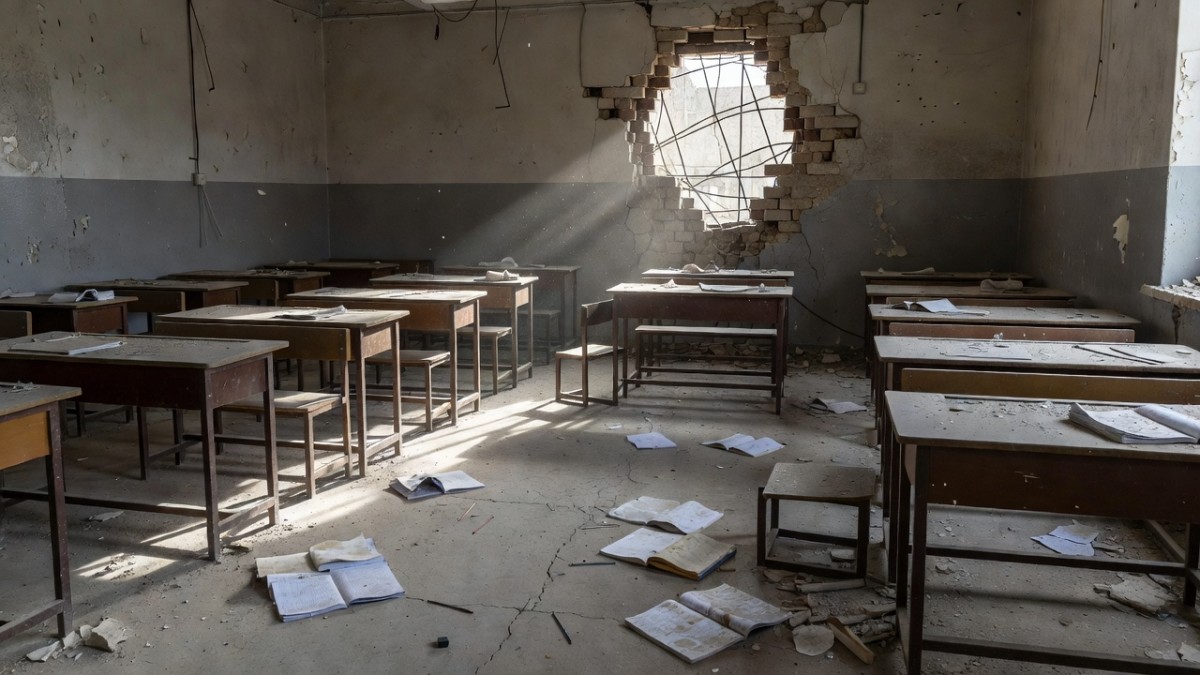
The Gaza Centre for Human Rights (GCHR) assessment documents the scale of the collapse in the Strip's own classrooms. More than 20,051 school-age students in Gaza have been killed since October 2023, the Centre said, while at least 19,886 others have been forced out of the education system by displacement, travel, abduction or injury. More than 532 teachers employed by public, private and UNRWA schools have been killed, along with at least 769 Ministry of Education employees, including administrative and support staff.
For the children of Gaza, this is not merely a statistic. It is the sound of silence where morning bells once rang. It is the absence of chalk dust on blackboards, the missing scribbles of homework notebooks, and the hollowed-out shells of buildings that once echoed with recitation and laughter. In the tent camps of Rafah, Deir al-Balah, and Khan Younis, children now wake to the sound of generators and distant drones, not the call to morning assembly.
Aid agencies have repeatedly warned that the psychological toll compounds the educational loss. In a study released earlier this year, researchers at the University of Cambridge, working with UNRWA, warned that Gaza risks a "lost generation" — children too hungry, too traumatised and too long out of school to learn, and increasingly doubtful that peace or a future will ever come.
The Class of 2026: A Cohort Defined by War
Among the most affected are those who should have been celebrating a milestone this summer. The class of 2026 — this year's Tawjihi graduates — are mostly young people born in 2008, the year of an earlier major Israeli assault on the Gaza Strip. They have grown up entirely under the blockade that has strangled the territory since 2007, and their entire educational journey has been shaped by recurrent conflict, poverty, and closure.
For this cohort, the final secondary-school examinations — the Tawjihi, which gates university admission — were held electronically for a third consecutive year because formal exam centres were impossible to establish. Palestinian essayist Taqwa Ahmed Al-Wawi wrote in The Nation that for this generation, war was not a history lesson but "the world they entered." She noted that this summer's exams took place "without functioning schools," a stark illustration of how profoundly the infrastructure of learning has collapsed.
These graduates, who have known nothing but siege and periodic war, now face an uncertain future. Many have lost family members, their homes, and any semblance of a normal adolescence. Their exam results, achieved under the most extraordinary circumstances, will determine their access to higher education — but with universities in Gaza reduced to rubble, and with travel restrictions tighter than ever, even the most accomplished students find their paths blocked.
Sitting the exams required students to navigate power cuts, unreliable internet and repeated displacement. The Ministry of Education coordinated the electronic examination process remotely, and the logistical challenges were immense. That thousands of students nevertheless completed their Tawjihi is a testament to their resilience — and to how much they have already overcome.
Ruined Schools and Improvised Learning
The physical destruction of schools is only part of the story. Many of the school buildings that still stand have for years doubled as shelters for displaced families. At the height of the conflict, over 1.9 million people were internally displaced, and schools operated by the UN Relief and Works Agency (UNRWA) became de facto refugee camps. Even now, with a fragile ceasefire in place, hundreds of thousands of people remain sheltering in school compounds, their homes reduced to dust.
The Centre's assessment catalogues what has been lost in bricks and mortar: Gaza had 584 school buildings before the war; 96 have been completely destroyed and 44 partially destroyed, with dozens more damaged. At least 9,308 classroom boards, 142,242 desks and 440,000 seats are gone. The annual school calendar has shrunk from 200 instructional days to 60, and weekly lessons from 30 to 12. GCHR projects that enrolment this academic year will reach no more than 625,832 children against the 665,769 expected under normal population growth — a shortfall of roughly 39,937 students before a single desk is counted.
This means that even repaired classrooms are not simply available to reopen. The buildings are occupied. The floors are lined with mattresses, cooking areas, and laundry lines. The blackboards have been repurposed as noticeboards for missing persons and aid distribution schedules. The sanitation systems, designed for a few hundred students, are overwhelmed by thousands of residents. The very concept of a school as a place of learning has been fundamentally altered.
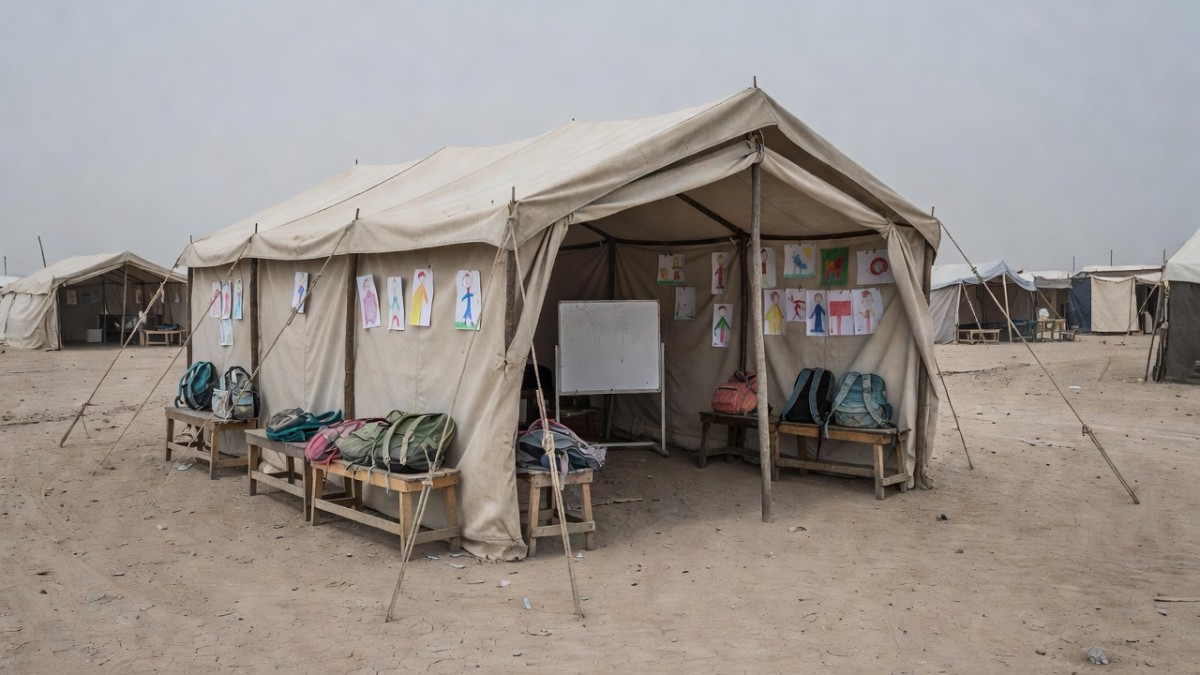
In response, teachers and volunteers have improvised. In tent camps, informal learning spaces have been established, with volunteers teaching basic literacy, numeracy, and English using whatever materials are available. Some teachers have begun holding classes in the open air, under tarpaulins, or in the shaded corners of bombed-out buildings. These efforts are heroic but woefully insufficient. The Gaza Centre for Human Rights (GCHR) has warned that the damage reaches far beyond buildings to equipment, records, staff, and administrative capacity — Gaza's entire learning environment has been dismantled.
Textbooks are scarce, having been destroyed in warehouse strikes or used as fuel for cooking fires during the worst of the fuel shortages. School records, including student transcripts and examination results, have been lost in the chaos. The administrative backbone of the education system — the inspectors, counsellors, and support staff — has been scattered, with many killed, injured, or displaced. Rebuilding this institutional memory and capacity will take years, even after the physical structures are restored.
The Legal Obligation to Protect Education
Under international humanitarian law, schools are protected civilian objects. Attacks on educational institutions are prohibited, and parties to a conflict are required to take all feasible precautions to spare civilians and civilian infrastructure. Human rights organisations, including Amnesty International and Human Rights Watch, have documented numerous strikes on schools in Gaza and called for independent investigations.
Israel has said it targets only sites it alleges are used by armed groups, including claims that fighters and weapons have been embedded in civilian buildings. International legal observers have responded that even where such allegations are made, the principle of proportionality requires weighing any military advantage against expected civilian harm — and that the wholesale destruction of an education system cannot be justified.
The Gaza Centre for Human Rights has urged the UN Independent International Commission of Inquiry and the International Criminal Court to investigate attacks on students, educators and schools, and has called on UNESCO, UNICEF and UNRWA to help restore education, deliver supplies and rehabilitate schools that can be repaired. The Centre notes that the right to education is guaranteed under Article 13 of the International Covenant on Economic, Social and Cultural Rights and Articles 28 and 29 of the Convention on the Rights of the Child — obligations, it argues, that the international community has yet to meet.
Yet, despite these calls, the reconstruction of Gaza's schools has not begun, and the cost is immense. Donor fatigue, ongoing political instability and the absence of a durable political horizon have all stalled recovery efforts. The ceasefire, while halting the most intense fighting, has not brought peace, and the threat of renewed hostilities still looms over every classroom that might reopen.
The Future of a Generation
The long-term consequences of this educational catastrophe are difficult to overstate. The Gaza Centre for Human Rights has warned that a fourth year of educational destruction threatens far more than lost school time. It risks leaving lasting consequences for an entire generation and for Gaza's ability to recover and rebuild its institutions. Without education, there can be no doctors, no engineers, no teachers, no civil society leaders to rebuild the territory when the guns finally fall silent.
The Centre has emphasised that psychosocial support and remedial-learning programmes are prerequisites for any meaningful return to school. Children who have witnessed the horrors of war cannot simply sit at a desk and absorb a mathematics lesson. They need counselling, safe spaces, and structured activities to help them process their trauma. The Centre has called for urgent donor funding for reconstruction, but also for a comprehensive approach that addresses the psychological and social dimensions of the crisis.
Some initiatives are already underway. Local NGOs, in coordination with international partners, have begun pilot projects in psychosocial support, training teachers to identify and assist children suffering from post-traumatic stress. Mobile libraries and storytelling sessions have been organised in the camps, offering a semblance of normalcy. But these efforts, while valuable, are a drop in the ocean compared to the scale of the need.
For the children of Gaza, the future remains profoundly uncertain. They have been denied the most basic of childhood experiences — the daily rhythm of school, the friendship of classmates, the guidance of teachers. They have been forced to grow up too fast, to understand too much about death and destruction. The international community's response, so far, has been a patchwork of emergency aid and well-intentioned statements, but it has not matched the magnitude of the catastrophe.
As the new school year begins without them, the children of Gaza are not just missing lessons in mathematics and science. They are missing the very foundation of their future. And without urgent, sustained, and comprehensive action, that future may be lost forever.
By Fatima Al-Rashid, Staff Writer
This article was produced with AI-assisted research and editorial support. Sources: Middle East Eye, Gaza Centre for Human Rights, IMEMC, The Nation.
By Fatima Al-Rashid, Staff Writer
This article was produced with AI-assisted research and editorial support. Sources: Middle East Eye, Gaza Centre for Human Rights, IMEMC, The Nation.
By Fatima Al-Rashid, Staff Writer
What's Your Reaction?
 Like
0
Like
0
 Dislike
0
Dislike
0
 Love
0
Love
0
 Funny
0
Funny
0
 Wow
0
Wow
0
 Sad
0
Sad
0
 Angry
0
Angry
0

Gulf/MENA Correspondent at Global1.News. Based in Doha, covering Gulf politics, energy markets, diplomacy, and development across the Middle East and North Africa. Tracks the economic transformation of the Gulf states.












Comments (0)