
Gaza's Girls Face Puberty Amid War With No Supplies and Little Support
In the Zeitoun neighborhood of Gaza City, a 16-year-old girl teaches younger children to balance on skateboards, a fleeting image of normalcy in a landscape defined by rubble and loss. But for the tens of thousands of adolescent girls who have come of age since October 2023, there is no such reprieve.
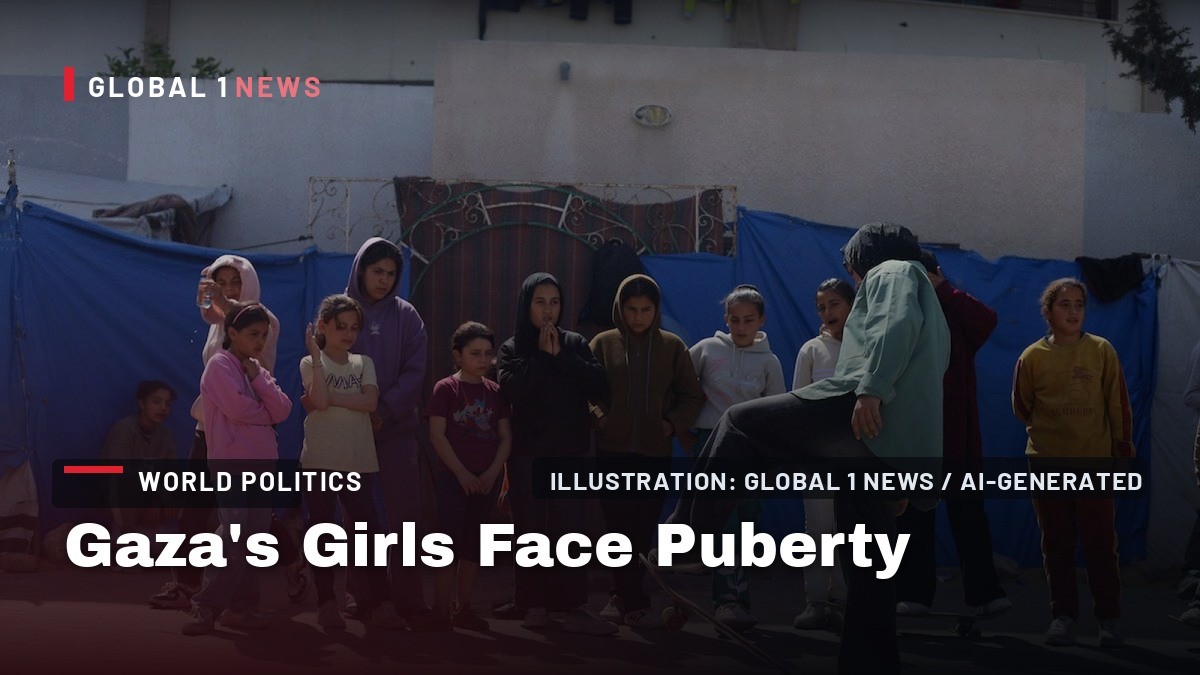
In the Zeitoun neighborhood of Gaza City, a 16-year-old girl teaches younger children to balance on skateboards, a fleeting image of normalcy in a landscape defined by rubble and loss. But for the tens of thousands of adolescent girls who have come of age since October 2023, there is no such reprieve. They are navigating the biological transition into womanhood amid a war that many international bodies and human rights organizations have described as a genocide, one that has stripped away the most basic dignities: privacy, sanitation, and the simple cotton pad that once cost a few shekels. For these girls, puberty is not a milestone; it is a source of terror, shame, and isolation.
Since the start of the Israeli military campaign, which has killed more than 40,000 Palestinians, according to the Gaza Health Ministry, and displaced nearly the entire population of 2.3 million, an entire generation of girls has been forced to confront menstruation in overcrowded classrooms, shared tents, and bombed-out shelters. With no access to proper hygiene supplies, educational programmes, or psychological support, these young women are being left to navigate one of life's most sensitive transitions entirely alone—or with only the improvised help of the women around them.
A Generation Marked by Fear and Secrecy
The scale of the crisis is staggering. Tens of thousands of girls in Gaza have experienced puberty since the war began, according to humanitarian assessments cited in the Middle East Monitor report. For 12-year-old Sara, that moment arrived in a repurposed school in the Rimal neighbourhood of Gaza City, where her family had sought shelter after fleeing Israeli bombardment. She was sharing a single classroom with more than 40 people when she got her first period.
Unprepared and without any hygiene supplies, Sara's introduction to womanhood was not met with celebration or guidance, but with what her mother described as "severe overcrowding in the classroom [that] turned a natural biological milestone into a source of fear, guilt and the urge to hide away." The trauma of that moment was so profound that Sara became emotionally withdrawn and "refused to eat food just to avoid having to use the contaminated public bathroom." For her, menstruation now represents the "overwhelming terror and anxiety of knowing that having a period meant an immense added burden and pressure under these living conditions."
Sara's story is not an isolated case. It is emblematic of a broader failure by the international community to address the specific needs of adolescent girls in conflict zones. When a girl's first period is marked by fear rather than support, the psychological scars can last a lifetime, affecting her confidence, her education, and her ability to function in daily life.
The Collapse of Reproductive Health Infrastructure
Before the war, Gaza had a network of sexual and reproductive health programmes that provided education, supplies, and psychological support to young women. But when the war began, most of these programmes shut down quickly due to safety concerns for staff. The result has been a catastrophic gap in both physical and psychological support for girls hitting puberty.
Sara's sister, who has taken on the role of caregiver, explained the consequences of this withdrawal: "Girls reaching puberty during wartime requires sensitive humanitarian intervention that honours both their mental health and physical development." Instead, this generation of girls is reliant only on the women around them to provide the limited support they can offer. Sara's sister crafted a cloth substitute for her to reuse in place of sanitary pads, which had become extortionately priced at local markets—if they could be found at all. She also borrowed pain relief medicine from neighbours to soothe cramps.
The collapse of these programmes is not just an administrative failure; it is a public health emergency. Menstrual hygiene management is a fundamental component of health and dignity, yet it has been deprioritised in the humanitarian response. As one aid worker noted, the focus remains almost entirely on food packages, with age-specific needs largely ignored.
The 'Resilient' Debate: A Critique of Dehumanising Language
Palestinian academic Israa Saleh, a humanitarian worker for Medicines Du Monde, has become a vocal critic of how the international community frames the Palestinian experience. "We hate the term resilient because it dehumanises us," she said, adding: "It's so sad to say this because we spent two years proving to the world that we deserve to live."
Saleh's critique cuts to the heart of a troubling dynamic. By celebrating Palestinian "resilience," the international community can absolve itself of responsibility, framing survival as a triumph of the human spirit rather than a failure of humanitarian intervention. She argues that part of the silence around this issue is that "menstruation is not recognised as a public health problem," meaning infrastructure projects are not designed to prioritise period care.
This is compounded by what Save the Children describes as a "siege" designed to create "chaos, starvation and death." NGOs are finding it impossible to provide even limited menstrual hygiene support, as food and medical aid take priority at checkpoints. Period supplies remain in short supply, and when they do arrive, they are often unaffordable for families already struggling to survive.
Personal Stories: Saffiyah, Dina, and the Weight of Womanhood
For 13-year-old Saffiyah, her first period started in a crowded room surrounded by relatives. The experience triggered "a panic attack and uncontrollable crying." Her mother calmed her down, tore up a soft piece of clean cotton cloth, prepared it for her, and shielded her in a quiet corner of the tent. But without proper supplies and educational materials, her family could only do so much.
The distress of going through puberty in a war zone has left Saffiyah with deep mental scars. Her family noted that she still displays "constant fear and confusion [when her period occurs], and will avoid leaving the tent or attending temporary learning spaces due to panic over leaking." This has not only affected her confidence but is continuing to limit her access to education—which has already been disrupted for almost three years. For many girls like Saffiyah, periods and a fear of leaking in public have started to impact their ability to undertake even the simplest of daily tasks, with many forced to remain enclosed in tents until the bleeding has passed.
Saffiyah's mother has already spoken to shelter supervisors on her daughter's behalf to ask for hygiene kits specifically tailored to the needs of young girls. But her family concluded by criticising the lack of support, saying: "There are no dedicated programmes for young adolescent girls from aid organisations. The focus remains almost entirely on food packages without considering age-specific needs." They noted that the crisis is not just an issue of hygiene items, but that "young girls urgently require emotional and educational support alongside age-appropriate hygiene kits."
Women's Solidarity: The Last Safety Net
In the absence of institutional support, older women have had to make extraordinary sacrifices to support young girls through puberty. Dina, who lives in Nuseirat camp with her two young girls, shares a tent with several neighbouring families. Before the war, they had complete independence and private access to personal care products. Now they rely entirely on mutual support from other women in the camp.
Dina supports her daughters by setting specific hidden hours to wash clothes and cloth substitutes away from public view. She explained that "we have created a rotation system to wash cloth rags and dry them discreetly in a corner draped with bedsheets" to find some privacy even within their shared tent. She notes that it is only through shared female compassion that her daughters have had any protection at all, saying: "Women's solidarity is the only safety net preserving women's dignity in the complete absence of basic living necessities."
Ayah, who has been caring for her grandchildren as they approach puberty, recalls "sharing the very last piece of clean cloth between two young girls on the exact same day to handle an emergency and prevent embarrassment." She adds that "the spirit of sisterhood and mutual support among women remains the ultimate shield against the harshness of displacement." She also recalls lending pain medicine and boiled herbal drinks, like anise, across tents to soothe cramps and menstrual pain. "Living in crowded classrooms or tents dissolved personal boundaries," Ayah says, "turning the management of bleeding and periods into a shared effort."
What Is Needed: Beyond Cloth and Good Intentions
Rebuilding infrastructure across Gaza continues to be a complex challenge for humanitarian workers, but the female solidarity that has emerged to protect young girls cannot be considered an alternative to proper menstrual support. What is required is a coordinated, age-sensitive humanitarian response that includes the distribution of hygiene kits tailored to adolescent girls, the restoration of educational programmes about puberty and reproductive health, and the provision of psychological support to address the trauma these girls have endured.
The international community must move beyond the language of resilience and acknowledge that these girls deserve more than survival. They deserve dignity, privacy, and the right to grow into womanhood without fear. As Israa Saleh put it, "We spent two years proving to the world that we deserve to live." It is time for the world to act on that recognition, not with platitudes, but with the resources and political will to ensure that no girl in Gaza has to face her first period alone in a crowded tent, terrified and ashamed.
By Fatima Al-Rashid, Staff Writer
This article was produced with AI-assisted research and editorial support. Sources: Middle East Monitor
What's Your Reaction?
 Like
0
Like
0
 Dislike
0
Dislike
0
 Love
0
Love
0
 Funny
0
Funny
0
 Wow
0
Wow
0
 Sad
0
Sad
0
 Angry
0
Angry
0
Gulf/MENA Correspondent at Global1.News. Based in Doha, covering Gulf politics, energy markets, diplomacy, and development across the Middle East and North Africa. Tracks the economic transformation of the Gulf states.












Comments (0)