
Justice Department Announces Largest-Ever Anti-Scam Sweep as Its Chief Dodges Questions on Nvidia
The Justice Department says it has brought more than 400 cases against over 800 defendants since March, the largest anti-scam enforcement surge in its history, while Attorney General Todd Blanche refused at the same briefing to discuss the DOJ's role in Nvidia's CEO reinstatement.

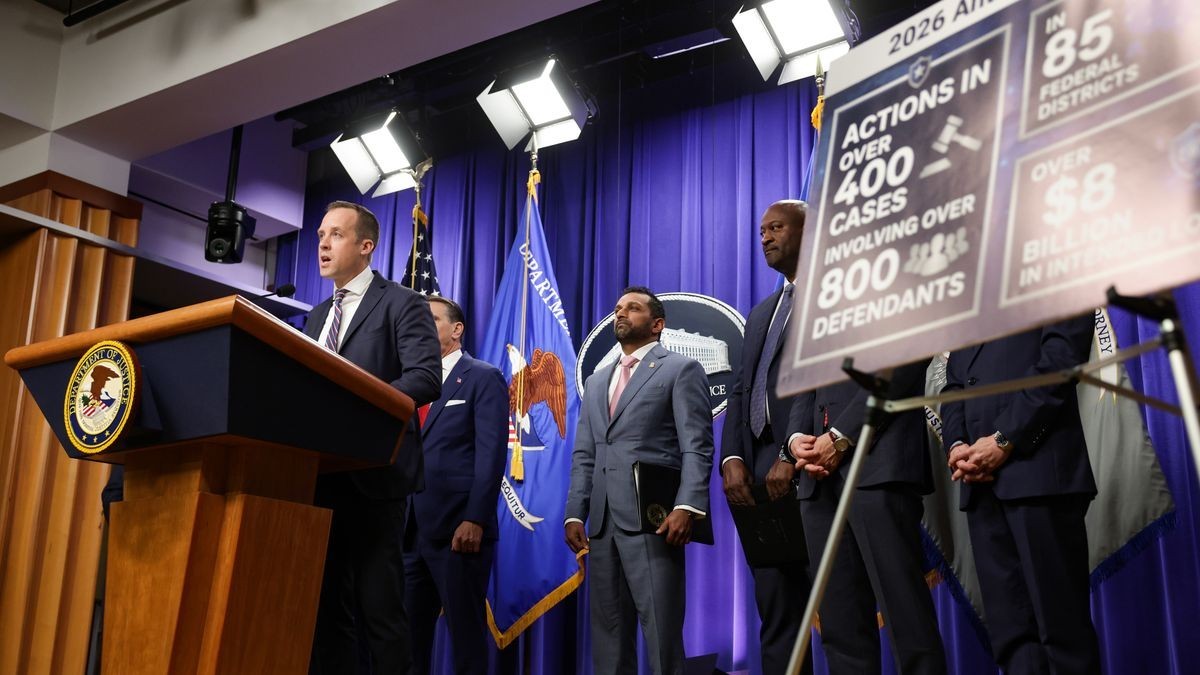
Eight and a half months after an executive order told the whole federal government to go after fraud, the Justice Department put its numbers on a display board and walked reporters through them. Eight hundred defendants. Four hundred cases. Eighty-five federal districts. Thirty extraditions. And an aggregate the department's own board words carefully: over $8 billion in interdiction.
Justice Department Announces Largest-Ever Anti-Scam Sweep as Its Chief Dodges Questions on Nvidia
Washington, D.C. - Attorney General Todd Blanche announced Tuesday that federal prosecutors have taken action in more than 400 cases against more than 800 defendants since March, describing it as the largest anti-scam enforcement surge in the department's history. At the same briefing he repeatedly declined to answer questions about the Justice Department's role in the reinstatement of Nvidia's chief executive, and called the chipmaker "a good corporate citizen."
What the Podium Showed
The surge runs from Executive Order 14390, signed March 6, which directed a government-wide crackdown on cybercrime, fraud and predatory schemes aimed at Americans. Since then, according to the department's written release, prosecutors have logged new charges, extraditions, guilty verdicts and criminal sentences across 85 federal districts, and American prosecutors and agents helped law enforcement in more than 10 countries raid foreign scam call centers and compounds that targeted people in the United States.
Thirty defendants were extradited to face charges in American courts. In the month before Tuesday's announcement alone, the Criminal Division filed and unsealed charges against more than 30 scam defendants. The work is coordinated out of the Criminal Division, drawing on its white collar section, its computer crime section, its money laundering and forfeiture section, its child exploitation section and its international affairs office, with the FBI, State Department, Homeland Security Investigations, the Secret Service, Treasury, the Postal Inspection Service, the FCC, the FTC, the SEC and the Consumer Financial Protection Bureau all listed as partners.
The Number Behind the Number
Why the scale matters is in the survey the department cites. Gallup found that 10 percent of American adults experienced a scam last year, either directly or through someone in their household, and that nearly three in four victims reported a negative effect on their mental health or well-being. The department, citing Gallup, says Americans lost an estimated $68 billion to scams in 2025 alone.
Read that against the enforcement figures and the ratio becomes the story. The department's headline $8 billion, even taken at face value, is a fraction of one year's estimated losses. The schemes behind that $68 billion are the ordinary ones: fake cryptocurrency investments, sextortion, people pretending to be a government agency, a caller who says a prize comes with a fee. As Assistant Attorney General A. Tysen Duva put it, scammers profit from lies and vulnerability, and the department intends to make sure they cannot "hide behind their screens."
A Scam Run From Inside a Georgia Prison
The case officials lingered on is the one that best explains why this is hard. Current and former members of prison gangs in Georgia used contraband mobile phones to call people and tell them they had missed jury duty and would be arrested unless they paid a fine. The department says 14 people were charged in three indictments in federal and state courts, and another 17 were charged in state court over a scheme to smuggle phones into the prisons.
According to the Postal Inspection Service, inmates got those phones with help from drones and from bribed prison employees. Victims were kept on the line, told not to contact anyone, and pushed toward cryptocurrency kiosks; in a nine-count Northern District of Texas indictment returned the previous week, prosecutors say one victim lost more than $40,000 and the operation generated about $1 million from hundreds of people. Inspectors sent warning letters to more than 1,300 people identified as possible money mules. On November 19 the FCC approved a rule letting prisons and jails jam contraband cell signals, a change Chairman Brendan Carr tied directly to a veteran, Jared Johns, who took his own life after inmates extorted and threatened him.
Operation Blackout: $17 Billion Restrained
The international half of the surge runs through the FBI's Operation Blackout, its scam-center demolition program. Director Kash Patel said the bureau has restrained nearly $17 billion in illicit funds, seized more than 14,000 digital devices and helped dismantle more than 29 scam compounds across Asia, Africa and the Middle East. Those operations produced federal charges against more than 50 people, while foreign partners arrested or detained more than 320 others overseas.
The FBI also says it helped liberate and repatriate more than 2,200 trafficked workers who had been forced to run the scams. Patel, asked about the geography, did not soften it: "They thought they could get away with it in Southeast Asia. They moved to Africa. They moved to the Middle East. We annihilated them on every single continent that they chose to operate and attack American citizens." A push coordinated in London, he said, produced 28 arrests across Africa, $11 million in seized assets, the rescue of 120 trafficked workers and the removal of 3.7 million fraudulent Facebook and Instagram accounts.
Two Figures for One Program
Operation Level Up, the bureau's early-warning effort that WJLA describes as a joint undertaking with the Secret Service, is reported in figures that look contradictory until you separate them. In his prepared remarks Patel said the program had prevented "more than $690 million in potential victim losses" and directly warned more than 11,000 Americans, and Fox News reported him putting the prevented losses at nearly $700 million across roughly 11,000 people, 77 percent of whom did not know they were being targeted. The department's written release, by contrast, says that since March 6 Level Up has prevented more than $143 million in victim losses.
Both can be right. One is a cumulative figure for the program's life, the other is scoped to the surge period, and neither is the same measure as the $350 million the FBI says its Recovery Asset Team froze in assets. The same discipline applies to the headline number. The board calls it interdiction. Fox News reported that Blanche described the total as more than $8 billion in intended victim losses recovered, while the department's written release itemizes seizures and restraints by agency rather than reconciling them into one figure. Interdicted, restrained, frozen, prevented and recovered are five different things.
Where the Money Actually Moved
The agency-level numbers are where the detail lives. Homeland Security Investigations says its offices made more than 300 arrests, indicted more than 100 defendants, secured about 80 convictions and guilty pleas, and seized, restrained, froze or recovered more than $120 million in illicit proceeds.
The Secret Service says it restrained more than $200 million, disrupted 1,780 scammer-operated domains and recovered more than $119 million while working more than 1,540 business email compromise cases. One of its cases, a cryptocurrency investment conspiracy run from scam centers in Cambodia, targeted at least 174 American victims; in October a Chinese national was extradited from the Netherlands and arraigned in the Central District of California over it. The State Department says its funded advisers helped freeze more than $1 billion in stolen cryptocurrency in Southeast Asia and analyze 10,000 devices in Thailand, and that State-trained prosecutors in Moldova oversaw October arrests in a romance scheme that took $440,000 in a single month.
The Schemes That Read Like Fiction
The list of cases filed in the past month is its own argument for why this is not a niche crime. A cremation services provider allegedly ran bait-and-switch pricing in violation of a court order and hid his real location from grieving families. The operator of a Peruvian call center allegedly told Spanish-speaking Americans they had to buy English-learning products or be arrested or deported. A list broker in Mexico allegedly sold the names and contact details of elderly Americans to dozens of scammers, with at least $15 million in losses, and was extradited in the past two weeks. A Nigerian national was extradited from the United Kingdom for allegedly targeting American service members to steal their military pay, and a dozen defendants, several of them Jamaican nationals, were charged over a sweepstakes scheme that defrauded elderly Americans.
The Regulators' Ledger
The civil side is quieter and, in raw dollars, larger. The SEC says it has filed enforcement actions against 39 entities since March for allegedly filing false Forms ADV to look like legitimate American investment advisers, charged firms over confidence scams that misappropriated more than $15 million, and brought a case against BG Wealth Sharing Ltd and DSJ Exchange Pty Ltd over a scheme that raised more than $130 million from tens of thousands of retail investors.
The FTC filed 16 actions during the surge covering tech support scams, debt relief, unauthorized billing and impersonation of government agencies, took down 19 websites impersonating the commission or its officials, and since April has connected more than 365 callers to the Justice Department's National Elder Fraud Hotline. Chairman Andrew Ferguson says the FTC has returned almost $3 billion to consumers harmed by fraud and deception. The FCC, for its part, says it has stopped nearly 300 million illegal robocalls and blocked more than 1,400 providers.
The Same Podium, a Different Question
Then the briefing turned. NBC News reports that Blanche was asked about President Donald Trump's remarks to CNBC on Monday, in which Trump said he had spoken to the attorney general and that "they did a pretty good investigation, and they felt that he himself was exonerated," referring to Nvidia chief executive Jensen Huang. Blanche replied that the president "talked to a lot of people going into the decision that he made to encourage the board to reinstate him," declined to discuss his communications with the president, and said Trump's account was "exactly right."
Asked whether Huang had been investigated, Blanche replied, "What does that mean?" He went on, "Had Huang been investigated for what?" and added, "I don't understand the question." Asked whether a probe into the chip exporter the alleged spy worked for was ongoing, he said, "I don't know what you're talking about," before adding that the department has "hundreds, if not more, export investigations going at any time." Pressed on whether the company or Huang knew of efforts to send high-tech chips to China, he said: "Nvidia is a good corporate citizen." Patel, standing beside him, said only, "I don't have anything to add."
What Is Not Answered, and What to Do
Some things Tuesday did not settle. The release does not break down how many of the more than 800 defendants have been convicted, how many are still facing charges, or how the $8 billion figure was assembled. Every defendant named in a charging document is presumed innocent, and the department says so in its own release. Independent verification of the aggregate is not something the announcement offered.
What it did offer is a playbook worth repeating to anyone who picks up the phone. Courts and police do not demand cryptocurrency to clear an arrest warrant. If a caller says you missed jury duty, hang up and call the courthouse yourself. If someone says you have won a prize but must pay a fee, it is not a prize. Report it to local law enforcement, the FBI, Homeland Security Investigations or the Postal Inspection Service, and do not stay quiet out of embarrassment. Blanche's point was practical: reports are what let investigators find the wider network behind a single stolen retirement.
By Jessica Ali, Staff Writer
This article was produced with AI-assisted research and editorial support. Sources: U.S. Department of Justice (Office of Public Affairs press release 26-1404 and Criminal Division materials), Fox News, WJLA / The National News Desk, and NBC News. Photographs: Anna Moneymaker/Getty Images via WJLA; Getty Images; APK via Wikimedia Commons (CC BY 4.0).
What's Your Reaction?
 Like
0
 Dislike
0
 Love
0
 Funny
0
 Wow
0
 Sad
0
 Angry
0

Editor-in-Chief at Global1.News. Atlanta-based journalist who cuts through the BS and tells it like it is. Lead anchor, host, and the voice you hear when the spin stops and the truth starts.














Comments (0)