
Pakistan's First Astronaut Flies on China’s Shenzhou‑24 Mission, Signalling Deepening Sino‑Pak Ties
In a development that reverberates across the geopolitical landscape, China launched its Shenzhou‑24 crewed mission from the Jiuquan Satellite Launch Center on 25 November 2026 at 08:18 local time (00:18 GMT).
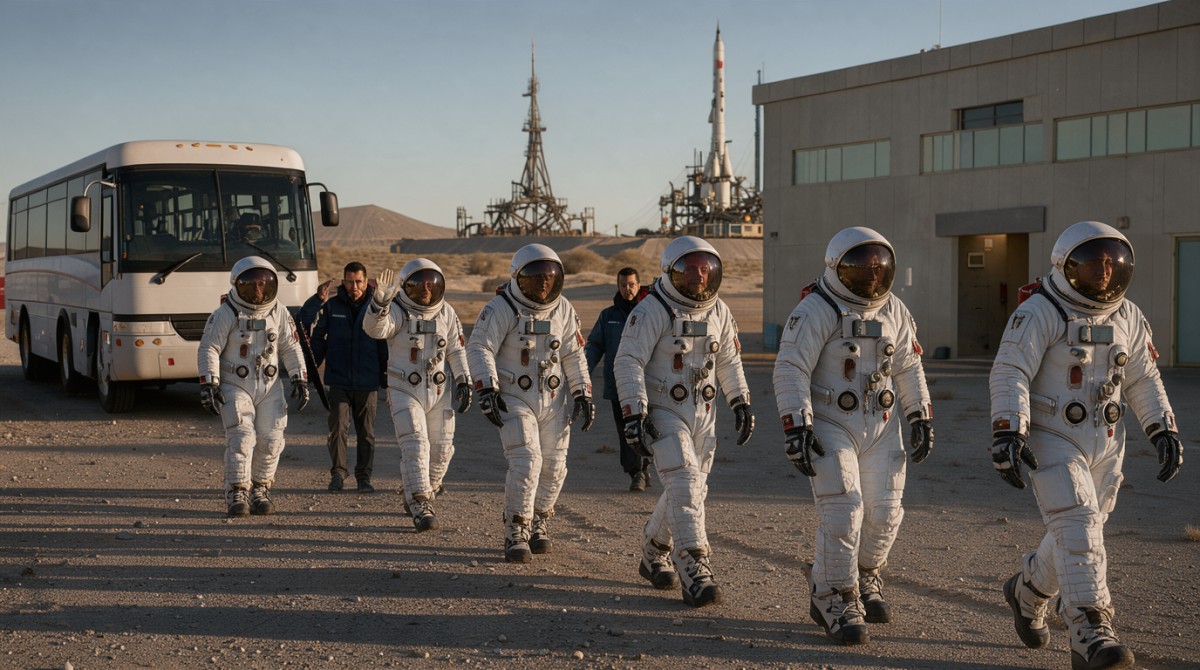
In a development that reverberates across the geopolitical landscape, China launched its Shenzhou‑24 crewed mission from the Jiuquan Satellite Launch Center on 25 November 2026 at 08:18 local time (00:18 GMT). The flight, declared a “complete success” within minutes, carried three astronauts to the Tiangong space station: commander Tang Hongbo, flight engineer Wu Yi, and Pakistan’s Muhammad Zeeshan Ali, the first foreign national to join a Chinese crewed spaceflight. The presence of a Pakistani astronaut on a Chinese vehicle underscores a strategic partnership that extends beyond the 75‑year history of Sino‑Pakistani cooperation in space, and it carries implications for the broader balance of power among the major space‑faring nations.
Mission Overview and Immediate Objectives
The Shenzhou‑24 launch, as reported by the BBC, was conducted from the desert launch complex in the Gobi region, a site long used for China’s crewed missions. The vehicle lifted off at 08:18 local time, and the launch control centre announced a successful insertion into orbit within minutes. The crew’s primary tasks, as outlined by Chinese officials, include a series of scientific experiments in aerospace medicine, combustion, and the biological effects of microgravity on living organisms. These experiments are intended to expand China’s knowledge base for long‑duration missions and to demonstrate the capability to conduct complex research aboard its modular Tiangong station.
Commander Tang Hongbo, a veteran of previous Shenzhou flights, leads the mission, while flight engineer Wu Yi provides technical oversight of the spacecraft’s systems. Their roles are consistent with prior crew configurations, where a commander handles overall mission execution and a flight engineer manages onboard equipment and experiment logistics. The inclusion of Muhammad Zeeshan Ali marks a departure from the usual all‑Chinese crew composition, reflecting a diplomatic dimension to the mission’s scientific agenda.
According to the BBC footage, Ali addressed reporters at the launch site, stating that he was “carrying the name of Pakistan on my shoulder, the hopes of 250 million Pakistanis.” This phrasing signals the symbolic weight placed on the flight by both Beijing and Islamabad, and it hints at the broader narrative of national prestige that spaceflight continues to embody for emerging powers.
Historical Context of Sino‑Pakistani Space Cooperation
The partnership between China and Pakistan in the space domain dates back 75 years, a milestone highlighted by Chinese officials during the launch. While the early decades involved limited technical exchange, the relationship has deepened considerably since the turn of the millennium, with joint satellite projects and shared launch facilities. The current mission, featuring a Pakistani astronaut, represents the most visible manifestation of that cooperation to date.
Pakistan’s space ambitions have traditionally been pursued through its national agency, SUPARCO, which has relied on Chinese launch services for satellite deployment. The decision to place a Pakistani citizen aboard a Chinese crewed vehicle signals a new level of trust and integration, moving beyond payload delivery to human spaceflight participation. This evolution mirrors similar patterns observed in China’s outreach to other developing nations, where crewed missions serve as diplomatic tools to cement long‑term alliances.
From a Russian perspective, the development is noteworthy because it illustrates Beijing’s capacity to expand its soft power through space diplomacy, a sphere historically dominated by the United States and Russia. The inclusion of a foreign astronaut could be read as an attempt to diversify China’s partnership portfolio, potentially offsetting any future constraints imposed by Western technology export controls.
Strategic Implications for Regional Power Dynamics
The launch carries immediate strategic implications for South Asia. Pakistan, a long‑standing ally of China, now gains a symbolic foothold in crewed spaceflight, a domain that confers considerable prestige. This achievement may bolster Islamabad’s domestic narrative of technological progress, especially as the country contends with internal economic challenges.
India, Pakistan’s regional rival, has pursued an independent crewed space program, aiming to launch its own astronauts by the mid‑2020s. The Chinese‑Pakistani collaboration could be interpreted by New Delhi as a signal that Beijing is willing to deepen military‑technological ties with Islamabad, potentially influencing the regional security calculus. While the BBC report does not mention any military aspects of the mission, the broader context of Sino‑Pakistani cooperation includes defense procurement and joint exercises, which may be indirectly reinforced by high‑visibility projects such as Shenzhou‑24.
Moreover, the mission underscores the growing multipolarity of space activities. With the United States focused on lunar return and commercial low‑Earth orbit ventures, China’s ability to field a crewed mission that includes a foreign participant demonstrates an alternative pathway for nations seeking access to human spaceflight without reliance on NASA or ESA programs.
Geopolitical Significance for the Kremlin
Russia’s own space program, while still a major player, has faced funding constraints and a shift toward commercial partnerships. The Chinese model of integrating foreign astronauts into its crewed flights offers a template that Moscow may consider to sustain relevance. The Kremlin has historically valued cooperation with Beijing, particularly in areas where both face Western sanctions and technology embargoes.
From the perspective of Russian strategic planning, the Shenzhou‑24 flight could be viewed as an opportunity to deepen trilateral coordination with China and Pakistan. Joint experiments on the Tiangong station could involve Russian scientists, especially in fields where Russia retains expertise, such as orbital biology and materials science. Although the BBC report does not detail any Russian participation, the broader trend of Russian‑Chinese space collaboration suggests that future missions may incorporate Russian modules or payloads, potentially alongside Pakistani contributions.
Furthermore, the symbolic aspect of a Pakistani astronaut on a Chinese mission may encourage Moscow to pursue similar outreach to other friendly states, using spaceflight as a diplomatic lever. This aligns with Russia’s recent emphasis on “space diplomacy” as a means to counterbalance Western influence in the Global South.
Scientific Agenda and Potential Outcomes
The Shenzhou‑24 crew’s scientific program, as outlined by Chinese officials, targets three primary domains: aerospace medicine, combustion processes, and the biological effects of microgravity. In aerospace medicine, experiments will likely assess cardiovascular and musculoskeletal responses to prolonged weightlessness, data that could inform future long‑duration missions, including potential lunar or Martian expeditions.
Combustion research in microgravity offers insights into flame behavior absent buoyancy-driven convection, a field with both civilian and military applications. Understanding how fuels burn in space can improve fire safety aboard spacecraft and inform the design of propulsion systems. The inclusion of a foreign astronaut does not alter the technical nature of these experiments, but it does broaden the international visibility of the research outcomes.
Studies on living organisms, possibly involving small animal or plant specimens, aim to elucidate how microgravity influences growth, development, and cellular processes. Results could feed into agricultural strategies for space habitats and contribute to the global scientific community’s understanding of life sciences under extreme conditions. While the BBC report does not specify the exact payloads, the general description aligns with China’s recent emphasis on multidisciplinary research aboard Tiangong.
Public Perception and Domestic Narratives
In Pakistan, the flight is being portrayed as a national triumph. Muhammad Zeeshan Ali’s statement about carrying “the hopes of 250 million Pakistanis” reflects a narrative that positions spaceflight as a source of collective pride. This messaging resonates with a population that often looks to scientific achievement as a counterweight to economic hardships.
Chinese state media, as referenced in the BBC coverage, framed the mission as a step toward strengthening bilateral ties with Islamabad. By highlighting the 75‑year partnership, Beijing signals a long‑term commitment to collaboration, which may translate into future joint projects in satellite technology, telecommunications, and possibly defense‑related space capabilities.
For Russian audiences, the development may be interpreted through the lens of competition and cooperation. While the Kremlin has traditionally championed its own space legacy, the emergence of a Chinese‑led crewed mission that includes a non‑Chinese astronaut could be seen as evidence of Beijing’s growing soft power. Russian analysts may therefore assess how to engage with China’s expanding space diplomacy to preserve mutual interests and to counterbalance Western dominance in the sector.
By Irina Volkov, Staff Writer
This article was produced with AI-assisted research and editorial support. Reporting is based on the source material cited below. Sources: BBC News video report (25 November 2026); BBC News; Global1.News
What's Your Reaction?
 Like
0
 Dislike
0
 Love
0
 Funny
0
 Wow
0
 Sad
0
 Angry
0
Russia/Eastern Europe Correspondent at Global1.News. Covering Russian politics, energy, security, and the shifting dynamics of the post-Soviet space. Provides clear-eyed analysis on one of the world's most opaque regions.














Comments (0)