
China's New Silk Road Corridor Pierces the Tien Shan: The CKU Railway's Strategic Breakthrough
China's CKU railway has drilled through its first tunnel on the Kyrgyz section, ending more than 25 years of stalemate on a corridor that will link Kashgar in Xinjiang to Andijan in Uzbekistan. The breakthrough signals Beijing's push to diversify Eurasian trade routes away from Russia and to turn landlocked Central Asia into a land-linked transit hub.
In a recent CGTN report titled "From 'landlocked' to 'land-linked': CKU railway opens a new development corridor," the network highlighted a milestone that has been more than a quarter-century in the making. On September 5, 2026, the China-Kyrgyzstan-Uzbekistan Railway Company announced that the first tunnel on the Kyrgyz section of the long-awaited China-Kyrgyzstan-Uzbekistan (CKU) railway had been drilled through. The 209.6-meter Kosh Dobo North No. 2 tunnel, whose construction began in June 2025, represents more than just a technical feat in the Tien Shan mountains; it is a physical manifestation of a shifting geopolitical landscape in Central Asia. The breakthrough is not merely about moving freight. It signals Beijing's successful diversification of trade corridors away from the traditional Northern Route through Russia, offers landlocked Central Asian states a path to "land-linked" status, and transforms the remote city of Kashgar in Xinjiang into an international rail gateway. As the diplomatic track runs parallel to the infrastructure track—with the breakthrough coming days after the SCO 25th-anniversary summit in Bishkek—the CKU railway is emerging as a flagship of the Belt and Road Initiative (BRI) that could redefine economic integration from the Caspian to the Pacific.
A Milestone Decades in the Making
The completion of the Kosh Dobo North No. 2 tunnel is a symbolic victory for a project that was first proposed in the 1990s but remained stalled for over 25 years due to a combination of geopolitical resistance, financing hurdles, and engineering challenges. According to Xinhua's report from Bishkek on September 5, the tunnel is just the beginning. Construction is now underway across the Kyrgyz section on 27 tunnels, 43 bridges, and 88 roadbed sections, with work progressing on 20 railway stations. The scale of this undertaking is immense: the railway runs just over 500 kilometers from Kashgar in China's Xinjiang region through the Torugart pass, then via Makmal and Jalal-Abad in Kyrgyzstan to Andijan in eastern Uzbekistan. Of that total route, 304.84 kilometers lie inside Kyrgyzstan, much of it carving through the high-altitude, remote terrain of the Tien Shan mountains. The project's trajectory has been marked by significant diplomatic milestones. The final trilateral implementation agreement was signed in Beijing on June 6, 2024, followed by a groundbreaking ceremony on December 27, 2024, in Jalal-Abad. At that ceremony, Kyrgyz President Sadyr Japarov called it "a historical event that gave impetus to the development of Central Asian countries." Substantive construction began in July 2025 under a six-year programme, with a target completion date of 2030—a timeline that Japarov reaffirmed in March 2026. The project company, the China-Kyrgyzstan-Uzbekistan Railway Company, is a joint venture established by enterprises authorized by the three governments. Its ownership structure reflects the hierarchy of interests: China holds 51 percent, while Kyrgyzstan and Uzbekistan each hold 24.5 percent. China Railway International, a subsidiary of China State Railway Group, is the lead Chinese participant. This structure ensures that while the project is trilateral in name, Beijing retains operational and financial primacy.
The Corridor's Strategic Logic
The CKU railway is not simply an infrastructure project; it is a strategic instrument designed to rewire the economic geography of Eurasia. For China, the route offers a direct southern corridor to Central Asia that bypasses the Northern Corridor running through Kazakhstan and Russia. This diversification is critical for Beijing's supply-chain security calculus, particularly given the uncertainties surrounding Russia's reliability as a transit partner in the wake of its 2022 war with Ukraine. For Kyrgyzstan and Uzbekistan, both landlocked nations that inherited the Soviet-era dependency on transit through Russia and Kazakhstan, the railway represents a path to genuine "land-linked" status. The route will connect to the Trans-Caspian International Transport Route—commonly known as the "Middle Corridor"—which runs toward Turkiye and Europe. This integration is expected to shave approximately a week off current China-Central Asia-Europe cargo delivery times, a significant competitive advantage in global trade logistics. The project also elevates Kashgar's status from a peripheral border city to a central node in regional trade networks. By tying Xinjiang into this infrastructure web, Beijing is pursuing a dual objective: economic integration of the region and the normalization of Xinjiang's role in China's broader foreign policy doctrine. The railway effectively makes Kashgar the western gateway for Chinese exports, reducing the logistical bottlenecks that have historically constrained trade through the region. As The Diplomat quoted Japarov, the railway is "not just a transport corridor, but an important strategic bridge connecting the countries of the East and West."
 Russia's Shadow: Why the Project Stalled and Why It Moved Now
For decades, the CKU railway was a geopolitical non-starter, largely due to Moscow's resistance. Russia viewed any major east-west rail link that bypassed its own network as a threat to its transit monopoly and, by extension, its political leverage over Central Asia. The Northern Corridor through Kazakhstan and Russia was the default route for China-Europe rail freight, and Moscow was loath to see alternatives emerge. The calculus changed dramatically after Russia's 2022 invasion of Ukraine. As analysts at Asia Times, the CACI Analyst, and The Diplomat have noted, Moscow's leverage over Central Asia weakened considerably as its economy came under sanctions and its military attention was diverted westward. Russia could no longer credibly veto infrastructure projects that its southern neighbors saw as vital to their economic futures. The corridor runs south of Russia's rail network, meaning that even as Moscow watches the project develop, it has limited ability to influence its operations or capture its transit revenues. The diplomatic timing is telling. The breakthrough on the tunnel came just days after the SCO 25th-anniversary summit in Bishkek (August 31-September 1, 2026), where Chinese President Xi Jinping and President Japarov signed a bilateral Treaty on Permanent Good-Neighborliness, Friendship and Cooperation. This diplomatic track running parallel to the infrastructure track suggests that Beijing is deliberately pairing political commitments with physical connectivity. For Russia, the message is clear: Central Asia is diversifying its partnerships, and China is the preferred partner for infrastructure-led development.
The Engineering and Financing Hurdles
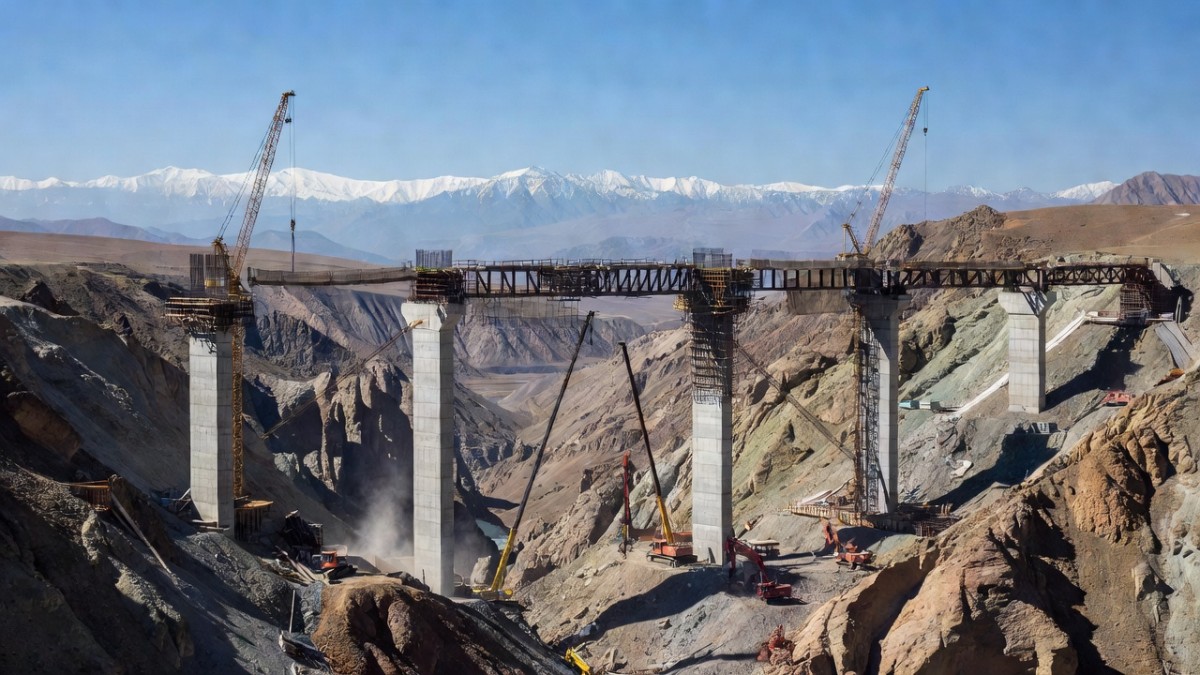
The physical challenges of building the CKU railway are formidable. The Kyrgyz section traverses the Tien Shan mountains at high altitude, requiring extensive tunneling and bridge construction in remote, seismically active terrain. The 27 tunnels and 43 bridges under construction represent some of the most complex engineering work ever attempted in Central Asia. The Kosh Dobo North No. 2 tunnel, while modest in length at 209.6 meters, is a proof-of-concept for the more difficult excavations to come. The financing structure is equally complex. The Kyrgyz section alone is estimated to cost about US$4.7 billion, though earlier estimates for the wider project reached approximately US$8 billion. A financing package was finalized on December 16, 2025, with about US$2.3 billion—roughly half the Kyrgyz section cost—provided as a 35-year loan from a Chinese bank consortium to the joint venture. The remainder is covered via equity contributions matching the ownership shares: China 51 percent, Kyrgyzstan 24.5 percent, and Uzbekistan 24.5 percent. The gauge compromise is a masterstroke of technical diplomacy. China's network operates on the 1,435 mm standard gauge, while Kyrgyzstan and Uzbekistan inherited the Soviet-era 1,520 mm broad gauge. The final design calls for standard gauge from Kashgar through Torugart to Makmal—approximately 160 kilometers—followed by a break-of-gauge transshipment hub at Makmal. This hub will handle cargo transfers, container handling, and wheelset exchanges before the line continues on broad gauge from Makmal through Jalal-Abad to Andijan, a distance of about 145 kilometers. This compromise avoids the political friction of forcing a gauge change on sovereign territory while creating a logistical bottleneck that China can manage.
Winners, Skeptics and the Debt Question
The CKU railway creates clear winners. For China, it secures a new export corridor and deepens its economic integration with Central Asia. For Kyrgyzstan and Uzbekistan, it offers reduced transit dependence on Russia and Kazakhstan, new trade links to Chinese markets, and the potential for economic diversification. For the broader region, it strengthens the Middle Corridor and provides an alternative to the Northern Route. Yet the project is not without its skeptics. Analysts at The Diplomat and the CACI Analyst have raised concerns about debt-trap narratives, given Kyrgyzstan's small economy relative to the US$4.7 billion cost of the Kyrgyz section. The 35-year loan from Chinese banks, while concessional in structure, adds to Bishkek's external debt burden. There is also Sinophobic sentiment among some Kyrgyz opposition figures, who view the project as a vehicle for Chinese influence rather than a genuine development opportunity. Environmental and security challenges also loom large. Building through remote, high-altitude mountain terrain poses risks of landslides, seismic activity, and construction accidents. The security situation in the border regions, while stable, requires ongoing vigilance. These factors could delay completion or inflate costs, though Uzbek officials have expressed optimism. Transport Minister Ilkhom Makhkamov said in 2026 that roughly 17 percent of construction is complete and the project could finish at least a year early. Earlier, Uzbekistan Railways deputy head Hikmatulla Rakhmetov suggested completion could come two years ahead of schedule.
 What to Watch: Timelines, Volumes, and Corridor Competition
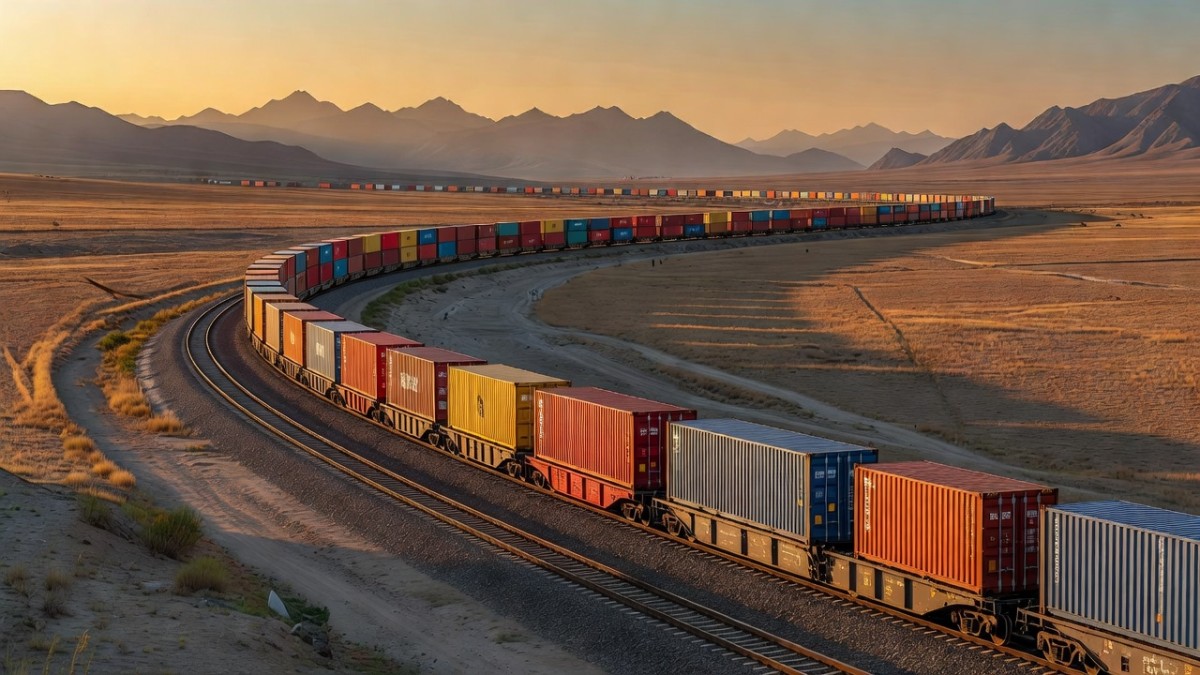
The immediate question is whether the 2030 target will hold or whether the project will indeed finish early. If Uzbek officials are correct and construction continues at its current pace, the railway could be operational by 2028 or 2029. This would be a significant achievement for a project of this complexity, but it depends on sustained financing, political stability, and the absence of major engineering setbacks. Freight volumes are another key indicator. Feasibility studies offer conservative estimates of 5-8 million tonnes annually at first, rising to 13-15 million tonnes over the long run. Whether these projections materialize depends on the integration of the CKU with the Middle Corridor and the broader China-Europe trade network. The route's ability to shave a week off delivery times will be a critical competitive advantage, but it must compete with the established Northern Corridor and the maritime routes through the Suez Canal. Future extensions are also on the horizon, though not yet under development. A southern extension toward Pakistan has been discussed, which would link the CKU to the China-Pakistan Economic Corridor and potentially open new routes to the Arabian Sea. For now, the focus remains on completing the core route and demonstrating its viability. The diplomatic momentum is equally important. The treaty signed between Xi Jinping and Japarov at the SCO summit provides a political foundation for the railway's completion. As the project progresses, it will likely attract additional investment and interest from other Central Asian states, potentially reshaping regional alliances and economic priorities. The CKU railway is more than a transport link; it is a statement of intent. For Beijing, it represents the maturation of the Belt and Road Initiative from a series of disparate projects into an integrated network of corridors that can withstand geopolitical shocks. For Central Asia, it offers a future less dependent on the whims of Moscow or the bottlenecks of Kazakhstan. For the global order, it signals that infrastructure-led development, financed and built by China, is now a permanent feature of the Eurasian landscape. The first tunnel is drilled, but the strategic implications are just beginning to emerge. By Prof. Marcus Chen, Staff Writer
This article was produced with AI-assisted research and editorial support. Sources: Xinhua, CGTN, The Diplomat, Asia Times, CACI Analyst, Times of Central Asia.
What's Your Reaction?
 Like
0
Like
0
 Dislike
0
Dislike
0
 Love
0
Love
0
 Funny
0
Funny
0
 Wow
0
Wow
0
 Sad
0
Sad
0
 Angry
0
Angry
0

World Politics Analyst at Global1.News. Based in Beijing, covering US-China relations, global trade, and geopolitical strategy. Brings deep analytical perspective to the power dynamics shaping international affairs.














Comments (0)