
Russian Supreme Court Bans Ingush Sufi Muslim Order as ‘Extremist’
The Russian Supreme Court’s decision on 14 October 2026 to outlaw the Batal Hajji brotherhood marks the latest escalation in Moscow’s campaign against religious and regional groups it deems a security threat.
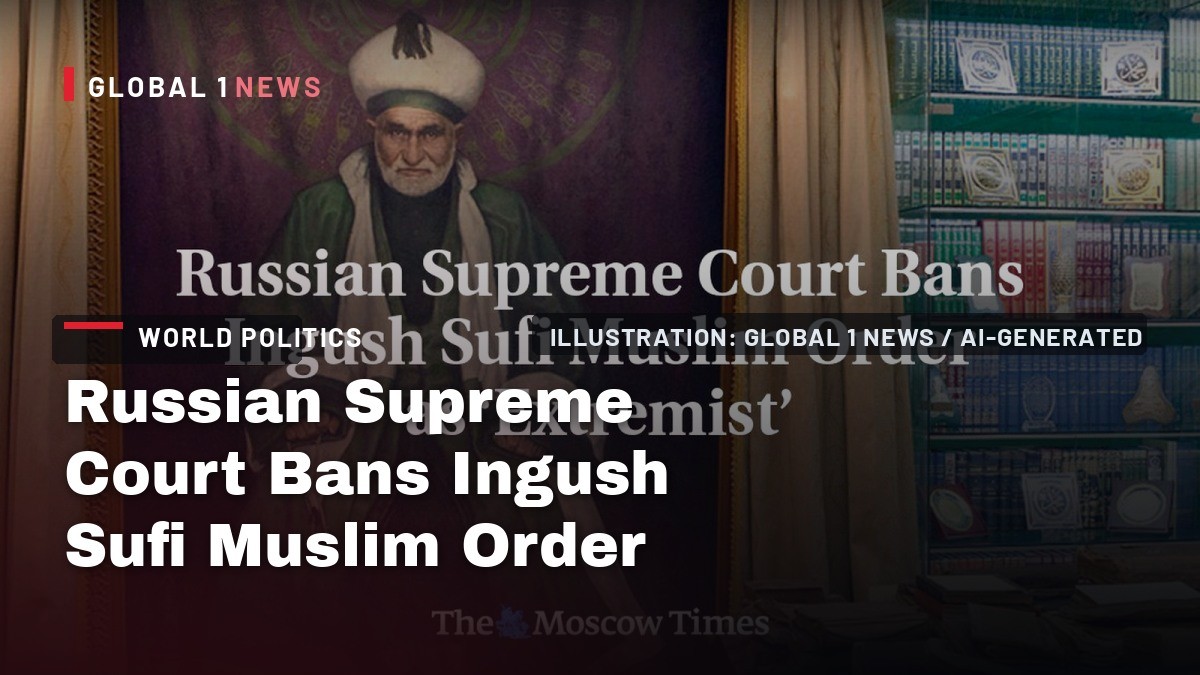
The Russian Supreme Court’s decision on 14 October 2026 to outlaw the Batal Hajji brotherhood marks the latest escalation in Moscow’s campaign against religious and regional groups it deems a security threat. The court, acting on a request from the Prosecutor General’s Office, designated the Ingush‑origin Sufi order as an “extremist” organization, accusing it of providing material support to insurgents in the North Caucasus. This move follows a series of legal actions that have increasingly linked the brotherhood to high‑profile terrorist attacks, including the 2024 Crocus City Hall bombing and the assassination of Lieutenant General Igor Kirillov. The ruling not only criminalises a historic religious community but also signals a broader strategy to tighten Kremlin control over the volatile North Caucasus region.
Legal Basis and Prosecutorial Claims
The Supreme Court’s ruling rests on a prosecutor’s statement that Batal Hajji members have been “linked to numerous attacks on Russian police and military in the North Caucasus” and were “orchestrated the deadly 2009 Nevsky Express train bombing claimed by Chechen rebel leader Doku Umarov.” The prosecutor further alleged that affiliates of the brotherhood supplied weapons and ammunition for the March 2024 assault on the Crocus City Hall concert venue near Moscow, as well as for the murder of Lieutenant General Igor Kirillov that same year. According to the Prosecutor General’s Office, “more than 100 members of the order have been convicted of the illicit trafficking of means for committing acts of terror.” These claims form the official narrative used to justify the extremist label.
In addition to the recent designation, the brotherhood’s so‑called “military wing” was already labelled a “terrorist” organization in 2023. The prosecutor’s statement emphasized that the group “organized illegal channels to supply foreign‑made firearms from abroad,” underscoring a pattern of alleged illicit arms procurement. While the court’s decision does not detail the evidentiary standards applied, the prosecutor’s language frames the brotherhood as an entrenched conduit for foreign weaponry and insurgent financing.
Historical Roots and Membership Structure
The Batal Hajji brotherhood traces its origins to the 19th century, founded by Ingush Sheikh Batal Hajji Belkhoroev, a disciple of the Chechen mystic Kunta‑Hajji (Kunta Kishiev). Historically, the order operated as a closed, hereditary community, with membership “passed down strictly by birthright.” Estimates place the brotherhood’s size at around 20,000 members, a figure that reflects its deep roots in Ingushetian society. This hereditary model has traditionally insulated the group from external influence, allowing it to maintain a distinct identity within the broader Sufi tradition.
During the 1990s and early 2000s, the brotherhood wielded considerable economic and political influence in Ingushetia. Its members occupied “a handful of key government roles” and held a near‑monopoly on the republic’s construction industry. This period of dominance ended when the Kremlin appointed new regional leadership, prompting a clash that led to the brotherhood’s loss of power. The subsequent marginalisation set the stage for the current crackdown, as the order’s former authority and resources now appear to be recast as potential security liabilities.
Militarisation and Links to Chechen Forces
According to the exiled news website Meduza, approximately 100 members of the brotherhood enlisted in the Russian military in 2022 as part of the Batal Hajji Rapid Response Unit. This unit was integrated into Chechen leader Ramzan Kadyrov’s Akhmat formation, a paramilitary force operating within the Russian army. The recruitment of brotherhood members into a Kadyrov‑linked unit suggests a complex relationship: while the order has been portrayed as a regional power broker, it also supplied personnel to a force closely aligned with the Kremlin’s security apparatus.
The duality of the brotherhood’s role—both as a regional economic heavyweight and as a source of manpower for a Chechen‑run military unit—complicates the Kremlin’s narrative. On one hand, the order’s historical autonomy and economic clout may be viewed as a challenge to central authority; on the other, its contribution of fighters to Kadyrov’s forces indicates a degree of cooperation with Moscow’s security strategy. The recent extremist designation can be interpreted as an attempt to sever any residual autonomy and bring the brotherhood fully under federal control.
Implications for Ingushetia and the North Caucasus
The outlawing of the Batal Hajji brotherhood carries significant implications for Ingushetia’s social fabric. As a community whose membership is hereditary, the ban effectively criminalises a large segment of the population, exposing them to prosecution, asset seizure, and potential imprisonment. The order’s historic monopoly on construction projects also meant that many local businesses and workers were economically tied to the brotherhood’s networks. Disruption of these networks could precipitate a sharp economic downturn in the republic, exacerbating unemployment and social instability.
Beyond Ingushetia, the move signals a broader Kremlin strategy to tighten its grip on the North Caucasus. By branding a historically influential regional order as extremist, the federal government reinforces a narrative that frames any independent power base in the region as a security threat. This approach mirrors earlier actions against other North Caucasian groups, reinforcing a pattern of pre‑emptive legal suppression aimed at preventing the re‑emergence of regional elites capable of challenging Moscow’s authority.
Political Context and Kremlin Power Dynamics
The timing of the Supreme Court’s decision aligns with a period of heightened sensitivity to dissent within Russia’s political elite. In recent months, the Prosecutor General’s Office has intensified its crackdown on independent media, designating The Moscow Times as an “undesirable” organization and previously labeling it a “foreign agent.” These moves reflect a broader effort by the Kremlin to curtail alternative narratives and consolidate control over both the information sphere and regional power structures.
By targeting the Batal Hajji brotherhood, the Kremlin not only removes a potential source of opposition but also sends a clear message to other regional actors: alignment with federal security priorities is mandatory, and any deviation—whether economic, religious, or political—will be met with legal repression. The designation of the brotherhood’s “military wing” as terrorist in 2023, followed by the 2026 extremist ruling, illustrates a stepwise escalation designed to erode the order’s legitimacy and dismantle its remaining influence.
International Repercussions and Human Rights Concerns
The outlawing of a religious order based on alleged links to terrorism raises questions under international human rights standards, particularly regarding freedom of religion and the right to a fair trial. While the prosecutor’s statements cite concrete incidents—such as the Nevsky Express bombing and the Crocus City Hall attack—the lack of publicly disclosed evidence makes it difficult for external observers to assess the proportionality of the response. Human rights organisations may view the blanket extremist label as a tool for political repression rather than a proportionate counter‑terrorism measure.
Moreover, the designation could affect Russia’s diplomatic relations with countries monitoring religious freedoms in the North Caucasus. The international community may scrutinise whether the ban is part of a broader pattern of using anti‑terrorism legislation to silence minority groups. Such scrutiny could compound existing tensions over Russia’s treatment of independent media, exemplified by the recent “undesirable” status imposed on The Moscow Times.
Future Outlook and Potential Developments
In the short term, the Supreme Court’s ruling will likely trigger a wave of arrests and prosecutions of Batal Hajji members, especially those implicated in the prosecutor’s claims of arms trafficking and involvement in terrorist attacks. The legal process may also involve the seizure of assets tied to the brotherhood’s construction monopoly, further destabilising Ingushetia’s economy. Monitoring the implementation of the extremist designation will be essential to gauge the depth of the crackdown.
Looking ahead, the Kremlin may pursue additional legal actions against other regional organisations that retain autonomous structures or economic clout. The pattern established by the Batal Hajji case—linking historical religious orders to terrorism to justify extreme legal measures—could become a template for future suppressions across the North Caucasus and beyond. Analysts will watch closely for any shifts in the relationship between Moscow’s security agencies and regional power brokers, as well as for the response of the Ingush community, which may either resist or acquiesce to the new legal reality.
This article was produced with AI-assisted research and editorial support. Reporting is based on the source material cited below. Sources: The Moscow Times; themoscowtimes.com; Global1.News (16 October 2026).
By Irina Volkov, Staff Writer
What's Your Reaction?
 Like
0
Like
0
 Dislike
0
Dislike
0
 Love
0
Love
0
 Funny
0
Funny
0
 Wow
0
Wow
0
 Sad
0
Sad
0
 Angry
0
Angry
0
Russia/Eastern Europe Correspondent at Global1.News. Covering Russian politics, energy, security, and the shifting dynamics of the post-Soviet space. Provides clear-eyed analysis on one of the world's most opaque regions.












Comments (0)