
China Stock Traders Cut Leveraged Bets 14% in July Tech Rout
China's stock traders cut leveraged positions by 14% in July to 2.59 trillion yuan as the AI sell-off slammed tech boards, with the Star Market 50 posting its worst month ever and Beijing pledging more market support.
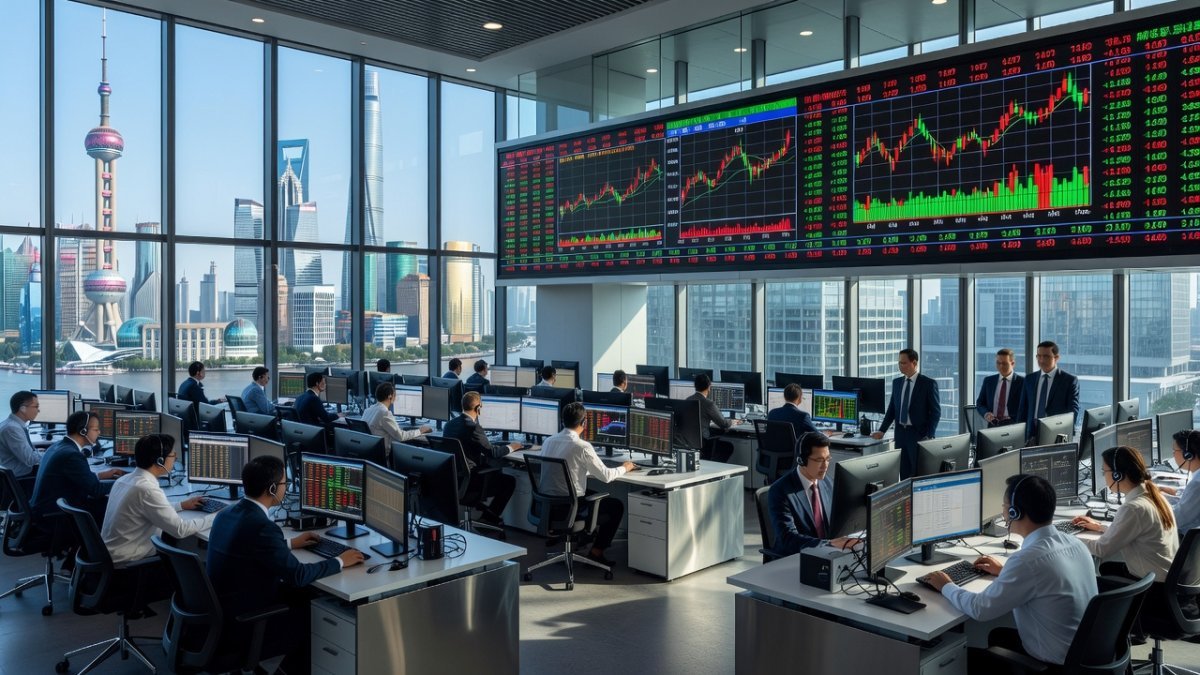
China Stock Traders Cut Leveraged Bets 14% in July Tech Rout
Tokyo, Japan — Chinese stock traders spent July unwinding leveraged positions at the fastest clip since the 2015 market rout, pulling margin-financed buying down 14 percent and deepening the worst monthly sell-off on record for one of the country's flagship technology indices. The deleveraging, concentrated on the Shanghai and Shenzhen exchanges' tech boards, is complicating Beijing's efforts to put a floor under the equity market just as the global artificial-intelligence trade comes unglued.
The outstanding value of stock purchases financed by margin trading stood at 2.59 trillion yuan (US$383.4 billion) on Friday, a decrease of 14 percent from the record high of 3.01 trillion yuan on June 25, according to Chinese financial data provider Wind. The retreat coincided with a 26 percent slump in the tech-centric Star Market 50 Index in July — the worst monthly performance since the gauge was launched in 2020.
Tags: China stock market, margin trading, Star Market 50, AI sell-off, deleveraging, Chinese tech stocks, Shanghai exchange, Shenzhen exchange, semiconductor stocks, Beijing market support, global tech sell-off
Deleveraging Accelerates on the Tech Boards
The unwinding was not spread evenly across the market. It was concentrated in stocks trading on the Shanghai and Shenzhen exchanges under their respective technology boards, where leveraged retail and institutional investors had piled into the hottest names of the AI boom.
Beijing Jingyi Automation Equipment, a semiconductor equipment maker trading on the Star Market in Shanghai, was the stock most exposed to the reduction in leveraged positions in July, seeing a 71 percent decline in the outstanding value of margin trading, according to Wind. Shenzhen-listed Zhuhai Raysharp Technology and YD Electronic Technology were also among the stocks hit hardest by the deleveraging.
"Investors' exiting their leveraged positions largely explains the big decline in the market, particularly technology and AI stocks, though little has changed in the fundamentals," said Wang Chen, a partner at Xufunds Investment Management in Shanghai. "AI stock swings overseas both provoked and accelerated the deleveraging here."
Global AI Fever Unwinds — and China Feels the Tremors
The reduced exposure coincided with the unravelling of global AI fever, as investors questioned the need for massive capital spending on data centres and cloud-service infrastructure amid elevated stock valuations and expectations of monetary tightening by the United States Federal Reserve.
The Nasdaq 100 index hovered on the verge of a technical correction after a nearly 10 percent decline from its record high on June 2. South Korea's Kospi index, heavily weighted towards DRAM giant SK Hynix and peer Samsung Electronics, lost roughly 40 percent over the past month as investors scrambled to exit leveraged positions.
"AI remains one of the most important long-term investment opportunities of this decade. But even the strongest themes can become crowded, expensive and vulnerable to corrections," said Charu Chanana, chief investment strategist at Danish investment bank Saxo. "In investing, the greatest risk is often not being wrong about the opportunity. It's taking so much risk that you don't survive long enough to benefit from it."
Beijing's Support Measures Face a Wall of Selling
The reining in of leveraged bets could add uncertainty and complicate Beijing's efforts to stop the decline in China's onshore markets. The country's securities regulator has repeatedly pledged to soothe sentiment and talk up the market, while two state-backed entities bought stocks worth about 60 billion yuan in an attempt to stabilise prices.
At a Politburo meeting on July 30, chaired by President Xi Jinping, the Communist Party's top decision-making body made a rare reference to stocks, pledging to bolster the resilience and confidence of capital markets and deepen reforms in terms of investment and financing. The readout followed about 460 billion yuan of inflows into exchange-traded funds tied to mainland-listed stocks this month, according to BNP Paribas — a signal that state buying may have been at work.
The technology-heavy Star Market 50 Index rebounded 3 percent on July 31 as investors reassessed the sector's outlook after the Politburo meeting and an overnight rally in US equities driven by dip buying. Even after the bounce, the gauge still closed July down 26 percent, capping its worst month since inception.
Risks Look Manageable Compared With 2015 — and With South Korea
Despite the scale of the unwinding, analysts see the current deleveraging as less dangerous than previous episodes. The outstanding value of margin trading as a percentage of the capitalisation of free-float stocks stood at 2.7 percent, well below the 4.7 percent seen during the 2015 stock rout, according to Wind data.
The contrast with South Korea is instructive. There, a scramble by retail investors to exit leveraged positions spurred unprecedented stock price swings, rattling global markets. In China, the risk from leverage appears more manageable, in part because regulators have tightened margin-lending rules since the 2015 crash and because the current margin balance is a smaller share of market capitalisation.
"Beijing remains committed to building a sovereign technology stack, while US restrictions make domestic capability more strategically valuable," said Stephen Innes, a managing partner at SPI Asset Management in Bangkok. "Chinese platforms continue to develop competitive models and applications, and there will almost certainly be another cycle of policy support, capital expenditure and technological progress."
What the China Tech Wobble Means for Japan
The turbulence in Chinese tech markets carries direct implications for Japan, whose semiconductor supply chain is tightly linked to the mainland's. Japanese equipment makers such as Tokyo Electron and Advantest count Chinese chipmakers among their largest customers, and a slowdown in China's AI-driven capital spending — or a shift towards domestically produced equipment — would ripple through their order books.
There are signs Beijing is pushing precisely in that direction. Media reports this month said China would deliver home-made immersion deep-ultraviolet (DUV) lithography machines to domestic chipmakers this year, a move investors read as a potential threat to the dominance of Dutch manufacturer ASML and, by extension, to the global equipment oligopoly that Japanese firms help sustain.
Currency markets add another layer. The yen briefly rose more than 3 percent against the US dollar on July 30, reaching its strongest level in two months after weakening to a four-decade low, with Nikkei Asia reporting that the Japanese government had stepped in to buy yen. A stronger yen pressures exporter earnings at a moment when global tech sentiment is fragile, while the People's Bank of China's steady management of the yuan — the offshore currency hit a three-year high on July 31 — signals Beijing's determination to marshal its own financial conditions through the volatility.
What to Watch For
For investors watching China's afternoon session, the key questions are whether deleveraging has further to run and whether Beijing's support measures can gain traction. The margin balance has already fallen 14 percent from its June peak, but history suggests unwindings of this scale can overshoot when global sentiment is deteriorating.
Watch for follow-through on the Politburo's pledges: accelerated fiscal spending, monetary easing, property policy adjustments and capital market reforms are all flagged for the second half of the year. The pace and scale of implementation — not the rhetoric — will determine whether Chinese equities can build a constructive backdrop into year-end, as JPMorgan Asset Management strategist Zhu Chaoping noted.
For Japan and the broader Asia Pacific region, the deeper story is structural: China's determination to build a sovereign technology stack is now visible in market data, not just policy documents. The margin-deleveraging episode is the first real test of how investors price that ambition — and its effect on the global AI trade is only beginning to be felt.
By Kenji Tanaka, Staff Writer
This article was produced with AI-assisted research and editorial support. Reporting is based on sources cited in the article.
What's Your Reaction?
 Like
0
Like
0
 Dislike
0
Dislike
0
 Love
0
Love
0
 Funny
0
Funny
0
 Wow
0
Wow
0
 Sad
0
Sad
0
 Angry
0
Angry
0

Japan Correspondent at Global1.News. Tokyo-based voice covering Japanese politics, technology, economy, and culture. Tracks the intersection of tradition and innovation in one of the world's most dynamic societies.















Comments (0)