
China Censors Public Mourning as It Holds Former Premier's Funeral
The passing of former Premier Zhu Rongji at the age of 97 has triggered a carefully calibrated state response that reveals much about the Communist Party of China's (CPC) current anxieties.
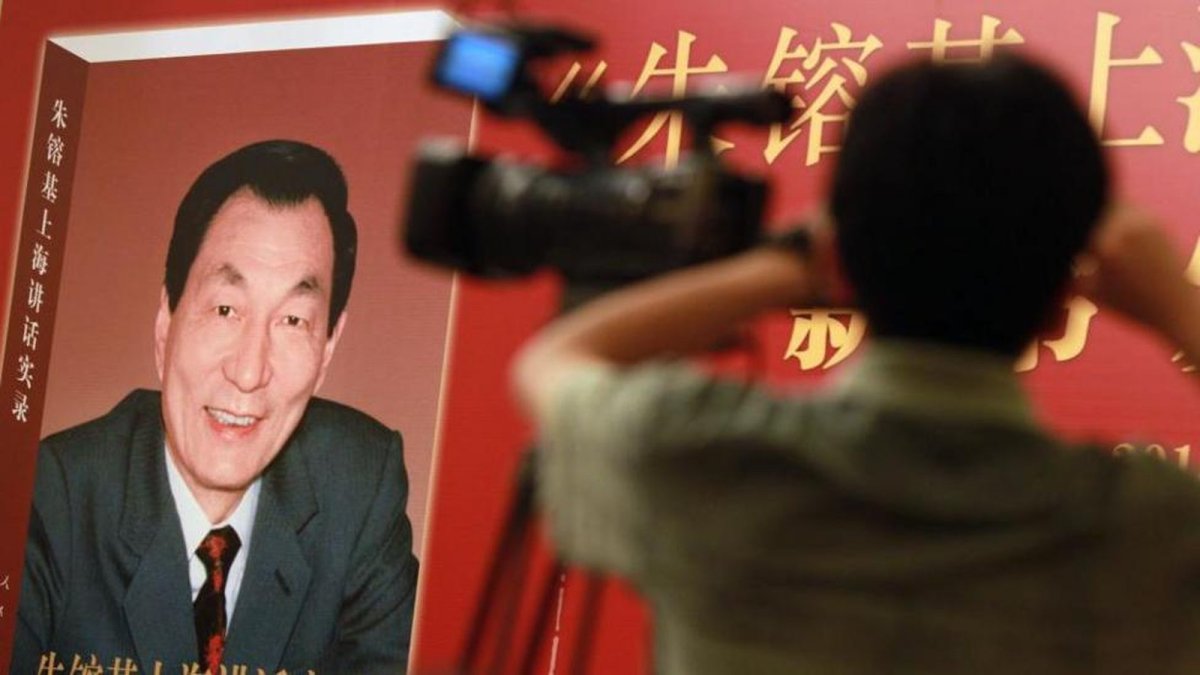
The passing of former Premier Zhu Rongji at the age of 97 has triggered a carefully calibrated state response that reveals much about the Communist Party of China's (CPC) current anxieties. While flags at government sites fly at half-mast and senior leaders, including President Xi Jinping, attended a low-key cremation ceremony at Babaoshan Revolutionary Cemetery on Tuesday, the state's information apparatus has moved swiftly to contain public expressions of grief. The contrast between the official homage and the digital censorship of nostalgic tributes underscores a profound tension within China's political trajectory: how to honor the architects of market reform without inviting uncomfortable comparisons to the present leadership's more statist orientation.
Zhu, who served as premier from 1998 to 2003, is being remembered by the state as an "outstanding member of the Chinese Communist Party" and a "time-tested and loyal Communist fighter," according to official media reports. Yet the decision to keep the funeral low-key, with no footage released, and the removal of a widely-shared essay by economist Zhao Jian from WeChat, signals that Beijing is acutely aware of the political risks embedded in public mourning. This is not merely a procedural matter; it is a strategic calculation about historical memory, generational legitimacy, and the direction of China's economic model under Xi Jinping.
The State's Delicate Balancing Act
The Chinese government's handling of Zhu's death is a masterclass in controlled commemoration. On one hand, the state must accord due respect to a figure who is indelibly linked to China's economic rise. Xi Jinping, along with incumbent Premier Li Qiang and former President Hu Jintao, either visited Zhu in hospital or sent condolences, as reported by state media. The cremation at Babaoshan, an exclusive resting place for high-ranking officials, confers the highest honor. On the other hand, the absence of public broadcast footage and the suppression of online tributes reveal a deep-seated wariness. The party's historical memory is long: the deaths of former Premier Zhou Enlai in 1976 and former CCP General Secretary Hu Yaobang in 1989 triggered mass outpourings of grief that evolved into political protests, events that still shape the party's risk calculus regarding public sentiment.
This balancing act is further complicated by the timing. Zhu died just days before the party leadership gathered to commemorate the birth centenary of President Jiang Zemin, who passed away in 2022. The proximity of these two deaths has created a concentrated moment of reflection on an era that many Chinese citizens view with increasing nostalgia. The state's response is therefore not just about managing the legacy of one man, but about controlling the narrative of an entire historical period that stands in implicit contrast to the present.
The Nostalgia Trap: Remembering the Reform Era
The censored essay by economist Zhao Jian, which was removed from WeChat the day after publication, encapsulates the emotional core of this nostalgia. Zhao remembered Zhu's era as a time when people were "properly poor" but possessed a "clear future ahead." He wrote of a time before smartphones and short-form videos, when "the sky was blue, life moved slowly and people could say what they really thought." This romanticized recollection is politically potent because it implicitly critiques the present: the anxiety-inducing digital landscape, the environmental degradation, and, most dangerously, the perceived restrictions on free expression. The state's decision to remove such content demonstrates a clear understanding that praise for the past can function as a veiled indictment of the current government under Xi.
The nostalgia is not merely sentimental; it is rooted in substantive policy differences. The 1990s and early 2000s were defined by breakneck reforms, an emphasis on private entrepreneurship, and wealth creation. Zhu was the architect of painful but transformative changes: shuttering chronically unprofitable state firms, dismantling the old housing system in favor of a commercial property market, weathering the Asian financial crisis, and securing China's entry into the World Trade Organization in 2001. This era is associated with a palpable sense of opening to the world and a degree of personal freedom that many feel has since been curtailed.
Zhu Rongji's Legacy: The Reformer's Paradox
Zhu's personal story is one of resilience and ideological reinvention. Previously purged under Mao Zedong's regime, he was brought back into the fold after Mao's death in 1976. His rise to the premiership alongside Jiang Zemin, who became party chief in 1989 and president in 1993, marked a decisive shift toward economic pragmatism. Zhu's style was famously blunt and colorful. He once labeled rogue bankers as "half-wits" and described the flood dykes lining the Yangtze River as "flimsy and porous as tofu dregs." His deadpan humor was on full display at a 1999 news conference with former US President Bill Clinton, when he dismissed allegations of illegal campaign donations with a quip about his $146 billion in foreign exchange reserves, asking why he would donate a paltry $300,000 when he could afford $10 billion.
This persona—direct, candid, and willing to speak uncomfortable truths—is precisely what captivates Chinese audiences today. A circulating social media post featuring Jiang and Zhu laughing together praised their "candid communication," noting that "they told the truth, shouldered the responsibility and spared no effort in serving the people." This stands in stark contrast to the "carefully choreographed leadership style" of the current administration. The state's dilemma is that it must celebrate Zhu's achievements without endorsing the stylistic and ideological openness that made him popular.
Xi Jinping's Counter-Narrative: Continuity and Control
President Xi has moved to frame the current leadership as the rightful heir to the reform era's legacy, but on his own terms. In a 40-minute speech on Monday commemorating Jiang Zemin's centenary, Xi called on the party to "carry forward Jiang's legacy," presenting the current leadership as the continuation of his political and ideological project. However, Xi's speech was notably forward-looking, emphasizing the need to "heighten our sense of vigilance against potential dangers." This language of vigilance and threat is a hallmark of Xi's governance, which has exerted greater central control and pressed a state-driven economic policy focused on technological autonomy and strategic industries.
The contrast could not be starker. Where Zhu and Jiang championed market liberalization and global integration, Xi has prioritized national security, self-reliance, and the primacy of the party-state in economic affairs. The passing of Zhu and Jiang into history marks a definitive end to the era of breakneck reform. By controlling the narrative around their deaths, Xi's government is attempting to selectively appropriate their legacies—honoring their contributions to national strength while distancing itself from the more liberal, freewheeling aspects of their governance.
Geopolitical Implications: A Signal to the World
The handling of Zhu's funeral also sends a signal to the international community. Zhu was a figure respected globally, particularly in Western financial and political circles, for his role in integrating China into the global economy. The low-key nature of the ceremony, with no released footage, may be interpreted as an attempt to downplay the significance of an era that was more accommodating to foreign investment and multilateral engagement. This aligns with Beijing's current posture, which has become more assertive and less willing to make concessions in trade negotiations or to prioritize economic growth over strategic autonomy.
For foreign observers, the censorship of public mourning is a reminder that China's political system remains fundamentally resistant to unsanctioned public expression, even in moments of national grief. The contrast between the state's official eulogies and the suppression of citizen tributes illustrates the limits of political liberalization in China. The party is willing to honor its historical figures, but only within a tightly controlled framework that reinforces the current leadership's authority and ideological direction.
The Second-Order Effects on Domestic Politics
Domestically, the episode reveals a growing generational and ideological divide. The nostalgia for the Zhu-Jiang era is most potent among those who lived through the reforms and experienced the tangible improvements in living standards and personal freedoms. Younger generations, who have only known China's rise as a global power under Xi, may not share this sentiment, but they are increasingly exposed to it through social media and cultural products. The state's censorship efforts are aimed at preventing this nostalgia from coalescing into a coherent political alternative or a source of social unrest.
The party's fear is not of a mass movement in the immediate term, but of the slow erosion of its narrative control. By removing essays like Zhao Jian's, the state is attempting to police the boundaries of acceptable historical discourse. However, this approach carries its own risks. Censorship can amplify the very sentiments it seeks to suppress, as citizens become aware that certain topics are off-limits and thus more intriguing. The "properly poor" but hopeful era described by Zhao may become a powerful myth that undermines the legitimacy of the current model, which prioritizes stability and control over the messy dynamism of the reform years.
Conclusion: History as a Political Battleground
The funeral of Zhu Rongji is more than a state ceremony; it is a political battleground over the meaning of China's recent past and its implications for the future. The state's careful management of public mourning—honoring the man while censoring the memories he evokes—reveals a leadership that is confident in its control but anxious about its legitimacy. The nostalgia for the Zhu-Jiang era is a powerful undercurrent in Chinese society, one that the current government cannot ignore and cannot fully suppress.
As China moves forward under Xi's centralized vision, the ghosts of the reform era will continue to haunt the political landscape. The challenge for Beijing is to integrate the legacy of leaders like Zhu Rongji into a narrative that supports the current trajectory, without allowing that legacy to become a standard against which the present is judged and found wanting. The censorship of public mourning is a short-term solution to a long-term problem: how to reconcile China's reformist past with its statist present. For now, the party has chosen control over catharsis, but the memories of a time when leaders spoke plainly and the future seemed clear will not be so easily erased.
This article was produced with AI-assisted research and editorial support. Sources: BBC News.
By Prof. Marcus Chen, Staff Writer
What's Your Reaction?
 Like
0
Like
0
 Dislike
0
Dislike
0
 Love
0
Love
0
 Funny
0
Funny
0
 Wow
0
Wow
0
 Sad
0
Sad
0
 Angry
0
Angry
0

World Politics Analyst at Global1.News. Based in Beijing, covering US-China relations, global trade, and geopolitical strategy. Brings deep analytical perspective to the power dynamics shaping international affairs.










Comments (0)