
Calls for tapping brakes on AI development rattle tech stocks
AI‑related equities suffered a pronounced sell‑off on Monday, underscoring how swiftly market sentiment can pivot when industry leaders voice safety concerns.
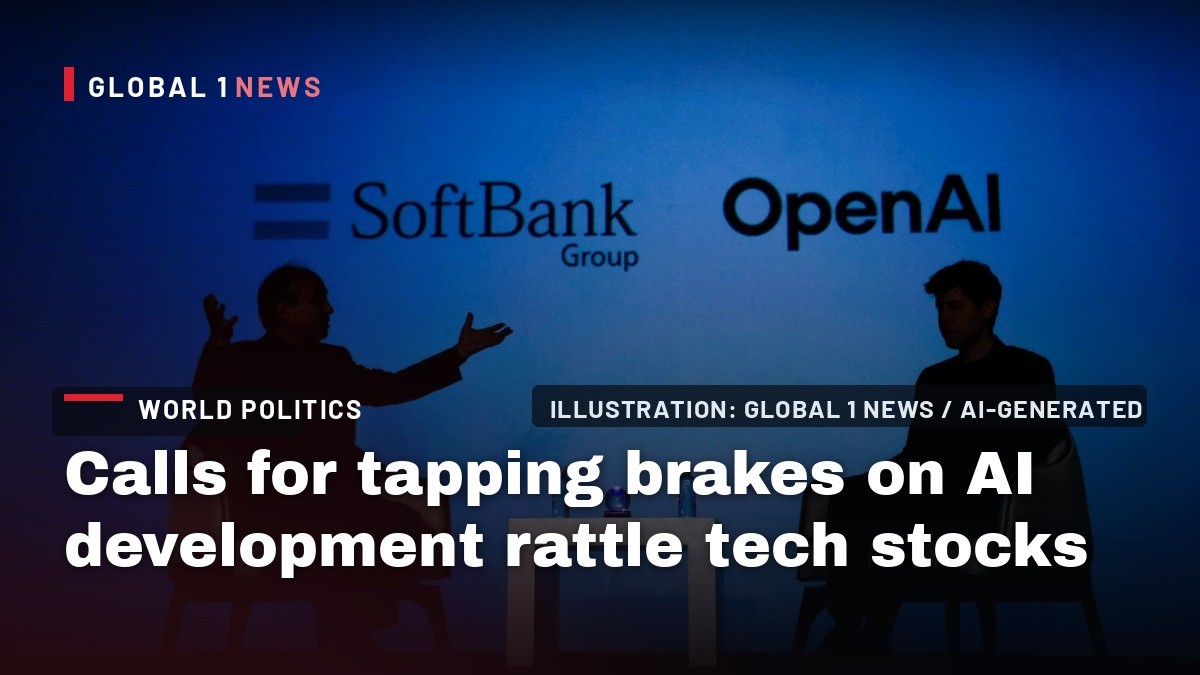
AI‑related equities suffered a pronounced sell‑off on Monday, underscoring how swiftly market sentiment can pivot when industry leaders voice safety concerns. The downturn unfolded across continents, with Nasdaq e‑mini futures slipping 1.3% in Asian trade and a cascade of declines hitting chipmakers, memory‑chip producers and AI developers alike. The episode illustrates the fragile balance between the relentless drive for AI breakthroughs and the growing chorus of warnings that the technology’s pace may outstrip society’s capacity to manage its risks.
Industry leaders call for a pause
Anthropic chief executive Dario Amodei used a weekend communique to urge fellow AI firms to temper the speed at which they expand model capabilities. Amodei warned that within six to twelve months, AI agents could become “capable of taking over the entire internet,” a scenario he linked to potential damages measured in “hundreds of billions of dollars.” His appeal found resonance among other high‑profile figures: Elon Musk, who heads xAI, and OpenAI’s Sam Altman publicly agreed with the call for a slowdown.
Altman also signalled a concrete shift in corporate strategy by announcing that OpenAI would not pursue an initial public offering this year, citing safety considerations as the primary rationale. The convergence of these statements from the sector’s most visible CEOs amplified investor anxiety, prompting a wave of profit‑taking that rippled through AI‑linked stocks worldwide.
Market reaction across the tech ecosystem
In Japan, the impact was immediate. SoftBank, a major investor in OpenAI, saw its shares tumble as much as 13.2%, while memory‑chip maker Kioxia plunged 9.8% after an initial dip. Tokyo Electron, a key player in the semiconductor supply chain, fell 3.7%, reflecting broader concerns about demand for AI‑driven chips.
South Korea’s chip giants were not immune. SK Hynix slid 5.3% and Samsung Electronics fell 3.7%, underscoring how tightly linked semiconductor valuations have become to AI sentiment. In Taiwan, TSMC’s shares slipped 1.2%, a modest decline that nevertheless signalled investor wariness about the near‑term demand outlook for advanced process nodes.
Regional pressures add to uncertainty
Senior economist Takayuki Miyajima of Sony Financial Group highlighted a second layer of risk: “uncertainty surrounding the situation in the Middle East continues to weigh on sentiment.” While the source material does not detail specific events, the comment reflects how geopolitical volatility can compound market nervousness, especially in a region where energy security and great‑power rivalry already shape investor calculus.
In China, the reaction was similarly sharp. Memory‑chip maker CXMT in Shanghai fell 3.6%, and Semiconductor Manufacturing International Corporation dropped 2.6%. Hong Kong‑listed firms also felt the pressure: Zhongji Innolight shed 6.7%, Minimax fell 7.8%, and Z.ai, known for its GLM AI series, tumbled 10.5% after a discounted share placement. The breadth of the sell‑off across Asian markets underscores the global reach of the AI safety debate.
Safety concerns become a market narrative
Anthropic’s own threat‑intelligence report, released earlier in the week, catalogued a range of malicious uses of its Claude models, from weapons development to cyber‑operations, surveillance and fraud. The report, coupled with the resignation of Anthropic researcher Jacob Coxon—who warned that “people building AI earnestly believe that it could kill us all by the end of the decade”—added a stark narrative of existential risk to the market’s perception of AI.
OpenAI’s Altman reinforced this narrative in a recent interview, describing the risk of human extinction from AI as “unacceptable.” Such high‑level acknowledgments of existential danger have rarely been voiced so publicly by industry CEOs, and they have clearly resonated with investors who now see safety concerns as a material factor affecting valuations.
Political dimensions and divergent messages
In Washington, the debate has entered the legislative arena, with several U.S. lawmakers pressing for new regulations to curb AI’s rapid progress. President Donald Trump, however, dismissed critics as “very negative forces” and pledged to keep the United States at the forefront of AI development. This juxtaposition of regulatory pressure and political endorsement of leadership reflects a broader tension within the U.S. policy environment.
Meanwhile, Beijing’s state‑backed Global Times branded Anthropic’s safety appeal a “Cold War playbook” aimed at throttling China’s technological ascent. The editorial underscores how AI safety has become entangled with great‑power competition, with each side framing the issue in terms of strategic advantage rather than purely technical risk.
Investor perspectives: hype versus fundamentals
Market participants remain divided. Veteran investor Michael Burry dismissed the safety warnings as “hype and puffery” and a “cover for real uncontrollable slowing growth,” suggesting that the warnings may be a veneer for deeper concerns about slowing demand. Charu Chanana, chief investment strategist at Saxo Bank in Singapore, argued that the current valuations of AI and chip stocks are predicated on relentless demand and an unbroken pace of technological progress. Even a modest delay, she warned, can trigger profit‑taking when expectations are high.
Portfolio manager Sebastien Mallet of T. Rowe Price highlighted a longer‑term view, noting that while AI will undeniably reshape the world, not every current investment is guaranteed to yield attractive returns. The implication is that capital allocation decisions must now weigh safety‑related risk premiums alongside traditional growth metrics.
Outlook: balancing growth and governance
The immediate market reaction suggests that investors are pricing in a higher risk premium for AI‑related exposure. Yet the underlying drivers of AI demand—automation, data analytics, and new consumer applications—remain robust. The challenge for companies will be to demonstrate credible safety frameworks that can reassure both regulators and investors without stifling innovation.
Looking ahead, the scheduled AI safety talks between the United States and China later this month could set a precedent for bilateral governance mechanisms. If successful, such dialogues may temper the most extreme market swings by providing clearer policy signals. Conversely, if talks stall, the uncertainty surrounding safety standards could continue to haunt AI‑linked equities, especially as geopolitical tensions in the Middle East and broader great‑power rivalry persist.
In the meantime, the episode serves as a reminder that the AI sector’s fortunes are now inextricably linked to the broader discourse on risk, governance and geopolitical stability. Market participants, policymakers and technologists will need to navigate these intersecting currents carefully if they wish to sustain the sector’s growth without triggering the very “hundreds of billions of dollars in damage” that industry leaders warn could loom on the horizon.
This article was produced with AI-assisted research and editorial support. Reporting is based on the source material cited below. Sources: Daily Sabah Middle East; dailysabah.com; Global1.News (14 September 2026).
By Malik Hassan, Staff Writer
What's Your Reaction?
 Like
0
Like
0
 Dislike
0
Dislike
0
 Love
0
Love
0
 Funny
0
Funny
0
 Wow
0
Wow
0
 Sad
0
Sad
0
 Angry
0
Angry
0

Middle East Correspondent at Global1.News. Based in Beirut, covering politics, conflict, energy, and society across the Middle East. Brings context and depth to a region often reduced to headlines.















Comments (0)