
Caixa Workers Reject Third Offer, Strike Enters Day 12
Employees of Caixa Economica Federal voted on 21 September 2026 to reject the bank's third collective-agreement proposal, extending a national strike into a twelfth day with no end date set and leaving 102 union bases opposed to 30 in favour.
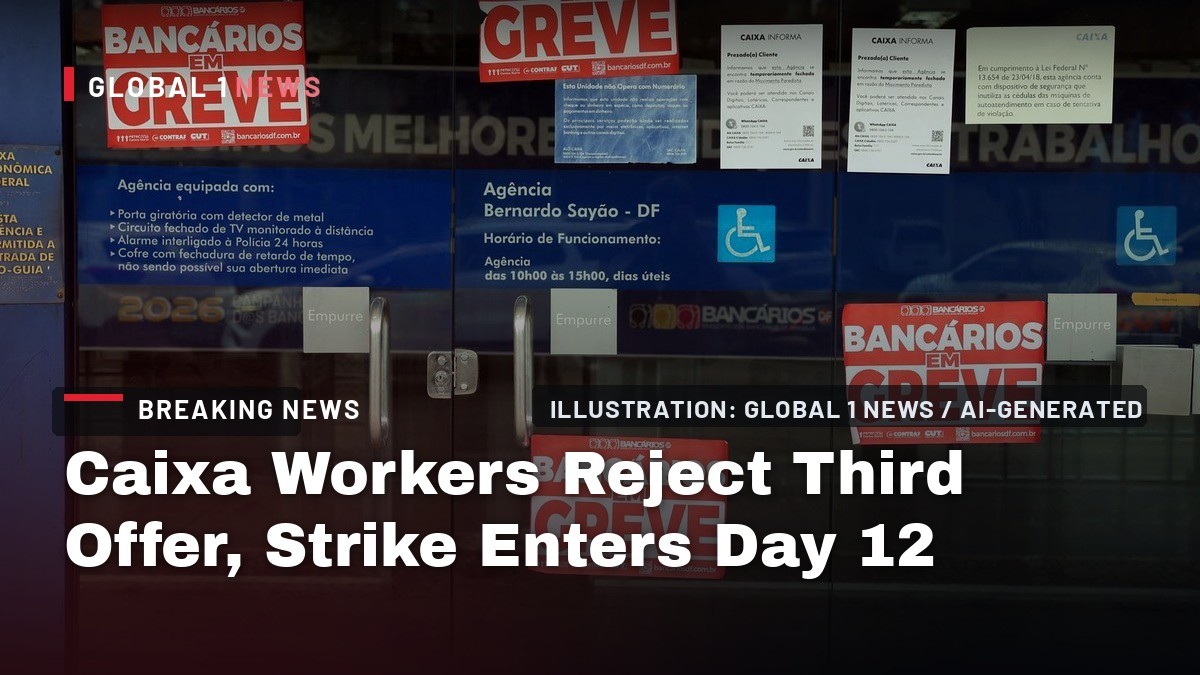
Caixa Econômica Federal's employees voted on Monday 21 September 2026 to reject the bank's third collective-agreement proposal, leaving the state-owned lender on strike for a twelfth day with no end date set. The rejection puts the workforce at odds with its own national leadership, which had recommended approval. The stoppage now runs straight into a benefit system serving roughly 35 million people a month, in the final stretch of a presidential election campaign.
Caixa Workers Reject Third Offer, Strike Enters Day 12
São Paulo, Brazil - The virtual assemblies closed at 18h, in the São Paulo, Osasco and Region base and across the country, and the answer was no. Caixa Econômica Federal's employees turned down the bank's latest proposal to renew their Acordo Coletivo de Trabalho, the bank-specific collective agreement, and chose to stay out. The strike that began on Thursday 10 September is now in its twelfth day.
What the Rank and File Decided
In the São Paulo, Osasco and Region base, 59.3 per cent of votes cast were against renewing the ACT, according to the Sindicato dos Bancários de São Paulo, Osasco e Região. Nationally, Contraf-CUT, the banking union confederation affiliated to CUT, said 102 union bases had reported rejection while 30 had approved. Bases reporting rejection included São Paulo, Brasília, Belo Horizonte and Porto Alegre. Voting in the São Paulo base ran from 11h to 18h; the assemblies were electronic, run through the VotaBem app in Rio de Janeiro. Contraf-CUT said the workers had chosen not to adhere to the category-wide Convenção Coletiva de Trabalho or to the Caixa-specific ACT, and to maintain the strike.
A Leadership Outvoted by Its Own Members
The result ran against the recommendation of the institutions that negotiate for the workforce. The Sindicato dos Bancários de São Paulo, Osasco e Região, the Rio de Janeiro bank workers' union, the Comando Nacional dos Bancários and Contraf-CUT had all recommended that members approve the new proposal, while acknowledging it did not meet every demand. The Sindicato dos Bancários de Campo Grande-MS e Região also recommended approval. Juvandia Moreira, president of Contraf-CUT and coordinator of the Comando Nacional dos Bancários, had called the proposal an advance, especially on the funding cap. She said the mobilisation had shown more company money was needed in Saúde Caixa and that the plan's intergenerational pact had to be preserved, and that this was won at the negotiating table thanks to the workers' mobilisation. The members disagreed.
The Offer They Turned Down
The bank presented the proposal in the early hours of Thursday 17 September 2026, a third version. On Saúde Caixa, the staff health plan, Caixa's cap on its own contribution would rise from 6.5 per cent to 9 per cent of payroll from 2027, up from 8 per cent in the earlier version of the week. The intergenerational pact would be kept, and the plan would stay inside the collective agreement under a solidário model. The previous proposal's differentiated charge by age bracket was dropped. There would be no increase in monthly Saúde Caixa contributions during 2026, with Caixa absorbing the plan's deficit that year. From 2027 the account holder would contribute 3.7 per cent of base remuneration; direct dependants R$560 a month; indirect dependants and children aged 21 to 24 R$660; children aged 24 to 27 and remaining parents R$900. The family-group ceiling would be 9 per cent. The emergency-room consultation charge would fall from R$150 to R$120, and copayment exemption for telemedicine would be maintained. Elsewhere, the initial Super Caixa qualification award would rise from 25 per cent to 50 per cent for the second half of 2026, with no penalties in 2026 for the Figital and Genesys programmes, and an extraordinary bonus of R$3,000 per employee tied to the bank surpassing its 2026 Operational Efficiency Index.
Why the Health Plan Is the Fault Line
Saúde Caixa has been the main impasse from the start. Workers interviewed by Folha on condition of anonymity said the plan has been in difficulty for years and is running a deficit, and that new rules are driving doctors away, with medics de-registering from it. They said the Caixa proposal, with the increases and what employees would have to pay, would cancel out the real wage gain the category had already secured. Workers want an end to the thirteenth monthly instalment of the health plan, because they are also obliged to pay it. In the earlier version the bank had proposed anticipating its share of that instalment for 2028, 2029 and 2030 to help cover the deficit, and had proposed raising the contribution over base salary from 3.5 per cent to 5.5 per cent, with employees paying between 2.30 per cent and 4.10 per cent of base salary according to age, plus R$480 to R$660 per dependant. The bank had also offered R$236 million in health-prevention actions from January 2027.
Twelve Days, and No End in Sight
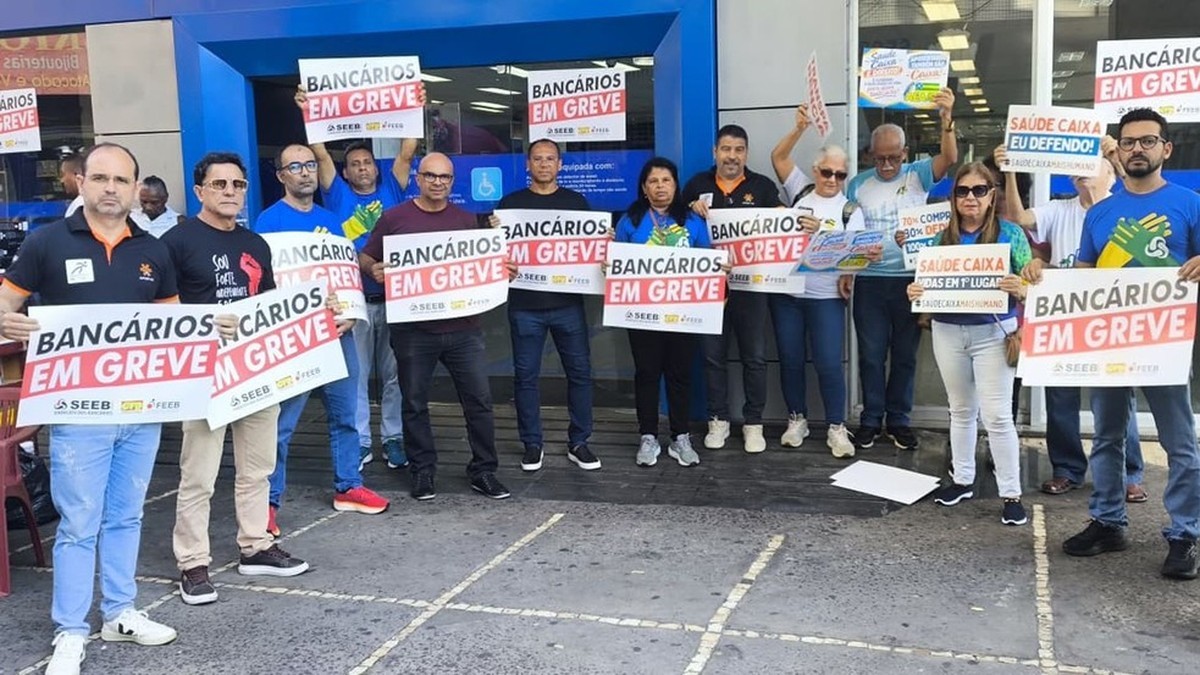
The strike began on Thursday 10 September 2026, national and for an indefinite period, after employees rejected the bank's previous ACT proposal. It had been approved in an assembly on 4 September 2026. According to the Comissão Executiva dos Empregados, more than 90 per cent of union bases rejected that earlier offer. The scale has been visible in the agencies. On day five, Monday 14 September, 268 of 303 workplaces in the São Paulo, Osasco and Region base were closed, out of 299 agencies plus four administrative centres, and more than 700 employees joined a protest outside the Caixa building at 750 Avenida Paulista. By day eight, Thursday 17 September, 285 of 299 agencies in that base remained closed. The union put the closure rate at 95 per cent of agencies in the base on 14 September.
Where the Bank Stands
Caixa initially announced administrative measures against strikers and threatened to take the dispute to the TST for a dissídio coletivo. It backed off. Responding to a letter from Contraf-CUT, the bank said on the night of Sunday 13 September that it was reopening the negotiating table and would suspend the administrative measures it had announced, a suspension that holds while talks with employee representatives continue. It also cancelled a communication it had sent staff. Caixa's public line is that, believing dialogue is the best path to building agreements, it reopened the negotiating table, and that it seeks a solution preserving the interests of employees, the institution, clients and society. By mid-September, 54 negotiation rounds had been held; the last before the vote took place on Wednesday 16 September. The bank has guided clients to digital and remote channels, including the Caixa app, Internet Banking, WhatsApp Caixa, Caixa Tem, the FGTS and DPVAT apps, Alô Caixa phone lines, self-service ATMs, lottery houses and the Banco24Horas network. Physical branches are the part of the service affected.
The Rest of the Banking Sector Already Settled
On Wednesday 9 September 2026, Fenaban and union bodies signed the new category-wide CCT, covering the banking category nationally. It provides correction of inflation by the INPC plus a real increase of 0.6 per cent, for two years, for around 500,000 bank workers, with the same percentage applied to meal vouchers, food vouchers and childcare assistance, and provisions on mental health, combating harassment and the right to disconnect. Banco do Brasil's workers approved their own ACT; Contraf-CUT announced the approval on 11 September 2026 and said the agreement would be signed that day with profit-sharing to be paid on Wednesday 16 September. Most BB unions approved the bank's proposal and worked normally on Friday 11 September, with the stoppage remaining in 18 union bases at that point, and in Belo Horizonte BB employees approved the proposal, ending their strike. By 21 September the Caixa workforce was the holdout, adhering neither to the category CCT nor to its own ACT.
Thirty-Five Million People in the Middle
Roughly 35 million people receive social benefits through Caixa every month. The bank said payment of social benefits continued normally during the strike and that money could be moved without going to a branch, through the Caixa Tem app, the Caixa app or the debit card linked to the account, for PIX, bill payments and purchases, plus cash withdrawal at available channels. For those who do not receive the benefit into a bank account, withdrawal is possible with the programme card and password at self-service terminals, lottery houses and Caixa Aqui correspondents. The September Bolsa Família calendar ran from Thursday 17 September for NIS ending 1 through 30 September, with NIS 2 paid on 18 September, 3 on 21 September, 4 on 22 September, 5 on 23 September, 6 on 24 September, 7 on 25 September, 8 on 28 September, 9 on 29 September and 0 on 30 September. Exame reported the strike could reduce the speed of some processes, especially operations depending on Caixa financing, while the bank said contracting of financing continues and clients can send documents and complete stages remotely via WhatsApp and the Habitação Caixa app. The strike was reported to be delaying credit under the Move Brasil programme and housing finance.
An Election Breathing Down the Calendar
Brazil holds its presidential election first round on 4 October 2026, with a possible runoff on 25 October. President Luiz Inácio Lula da Silva is running against Senator Flávio Bolsonaro, son of former president Jair Bolsonaro. On 18 September 2026 Lula announced a 15 per cent increase in Bolsa Família, with the minimum monthly benefit rising to R$691 from R$600, taking effect on 19 October, after the first round and before the likely runoff. Planning Minister Bruno Moretti said the increase would cost 5.8 billion reais in 2026 and 22 billion reais in 2027, and the government also announced a debt-relief programme for overdue balances, still in development. Flávio Bolsonaro called the welfare increase an act of desperation and said Lula was trying to buy the votes of the poor. The journalist Miriam Leitão wrote in O Globo that whereas both Lula's and Bolsonaro's adjustments were made out of electoral interest, Lula's increase was limited to inflation over the previous four years, during which there had been no adjustment. The strike is at a state-owned bank, and its effects fall on a benefit system the government is actively expanding in the run-up to the vote. Neither Lula nor the federal government had commented on the rejection by the time of writing.
What Comes Next
The strike command was meeting as the result came in, discussing the outcome of the assembly and the movement's next steps. No next step had been announced, and no date has been set for the strike to end. Caixa said it maintains open dialogue with employee representatives and returned to the negotiating table to build an understanding covering the interests of all parties. Whether a fourth proposal follows, and when, is not known.
What is known is the arithmetic of the moment: twelve days of stoppage, a third offer rejected, 102 union bases against and 30 in favour, and a workforce that has now declined both the category-wide agreement its peers signed and the bank-specific deal its own leaders urged it to take. The doors of the agencies in the São Paulo base have stayed shut through most of the past two weeks, and the calendar of benefits and the calendar of the election keep moving regardless.
By Jessica Ali, Staff Writer
This article was produced with AI-assisted research and editorial support. Sources: Exame, Folha de S.Paulo, G1, Estado de Minas, Jornal do Comercio, Agencia Brasil, UOL Economia and the Sindicato dos Bancarios de Sao Paulo, Osasco e Regiao.
What's Your Reaction?
 Like
0
Like
0
 Dislike
0
Dislike
0
 Love
0
Love
0
 Funny
0
Funny
0
 Wow
0
Wow
0
 Sad
0
Sad
0
 Angry
0
Angry
0

Editor-in-Chief at Global1.News. Atlanta-based journalist who cuts through the BS and tells it like it is. Lead anchor, host, and the voice you hear when the spin stops and the truth starts.











Comments (0)