
Cabin Pressure Alert Forces Philippine Airlines 777 to Divert to Alaska
Philippine Airlines flight PR116 bound for Vancouver diverted to Anchorage, Alaska, after the crew detected an indication in the cabin pressurization system. The Boeing 777 landed safely with no injuries, and the aircraft is undergoing a technical assessment.
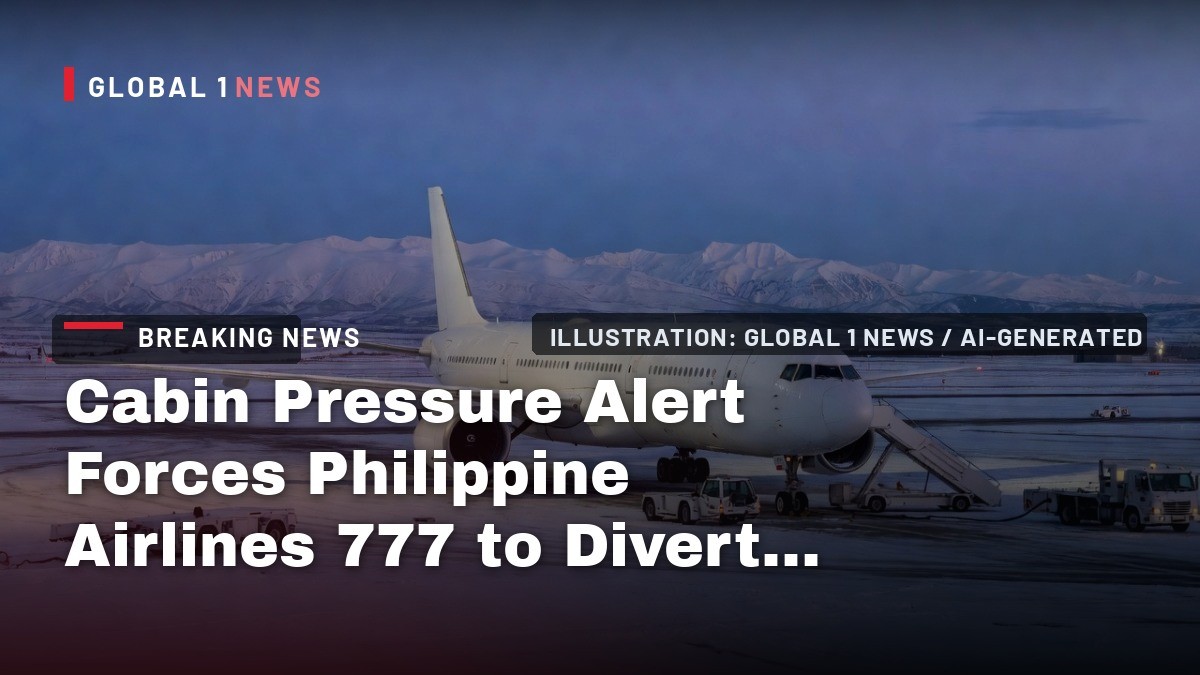
A Philippine Airlines Boeing 777 bound for Vancouver with a full load of trans-Pacific passengers turned around over the North Pacific on Tuesday and put down safely in Alaska after the flight deck reported a problem with the aircraft's cabin pressurization system. Nobody was hurt. The jet was not damaged. And the reason that last sentence is the real story is exactly what most coverage of this incident is going to skip.
Cabin Pressure Alert Forces Philippine Airlines 777 to Divert to Alaska
Atlanta, Georgia — Flight PR116 left Manila's Ninoy Aquino International Airport on September 8 for Vancouver. It never got there. Instead, it landed at Anchorage's Ted Stevens International Airport, where it now sits while engineers tear into the pressurization system that sent it there.
The Alert Over the North Pacific
Philippine Airlines confirmed the diversion in an advisory dated September 9, saying the crew detected an indication involving the aircraft's cabin pressurization system and followed established procedures.
"As safety comes before everything else, the flight crew followed established safety procedures and diverted the aircraft to Anchorage," the airline said. "The aircraft landed safely, and all passengers and crew on board are safe."
The Aviation Safety Network's incident database, which logged the occurrence, records the aircraft as a Boeing 777-3U3ER registered RP-C7784, en route over the Pacific Ocean when the pressurization issue forced the crew to initiate a descent to 10,000 feet — written in aviation shorthand as FL100 — before diverting to Anchorage. The database places the aircraft at roughly 325 nautical miles south of the Aleutian island chain when the incident occurred, and classifies it as a system or component failure, non-powerplant — the category used for mechanical faults that have nothing to do with the engines. That entry carries a caveat worth repeating: its confidence rating notes the information comes only from news, social media and unofficial sources.
That is the whole of the hard, verified flight data. Everything else — including the passenger count — PAL has declined to release.
What a "Pressurization Indication" Actually Means
Here is where this story becomes understandable to anyone who has ever looked out a window at 35,000 feet and wondered what is holding the air in.
At cruising altitude, the air outside an airliner is thin enough that a human being cannot stay conscious without supplemental oxygen for more than a short time. Cabin pressurization systems exist to solve that: they bleed hot compressed air off the engines, condition it, and pump it into the fuselage to hold the cabin at an altitude equivalent that people can breathe and function in normally.
When that system behaves abnormally — whether the pressure is genuinely rising toward the outside ambient, a sensor is sending a false signal, or a valve is stuck — the flight deck gets an indication. Not necessarily a catastrophic failure. An indication. A warning that the system is not behaving the way the book says it should.
That wording matters, and it is the phrase PAL used deliberately: the crew detected an "indication." It is the aviation equivalent of a check-engine light. Sometimes it means the engine is about to fail. Sometimes it means a sensor is dirty. Either way, at 35,000 feet over open ocean, you do not gamble on which one it is.
Why the Crew Went to 10,000 Feet
The descent to FL100 is the standard, drilled-in response, and it is a good illustration of how commercial aviation actually works.
Below roughly 10,000 feet, the outside air is dense enough that passengers and crew can breathe without any pressurization at all. So when pressurization is in question, the playbook is simple and unambiguous: get down to breathable air as fast as safely possible, level off, and then decide where to land.
That is precisely what the crew did. Descend to FL100, stay there, and divert. No emergency descent into a screaming dive, no oxygen masks dangling from the ceiling for an hour — at least none that the airline has disclosed — and no attempt to press on to Vancouver with a system the crew no longer trusted.
This is the unglamorous machinery of aviation safety, and it is worth naming plainly: a system flagged a problem, the crew followed a checklist, the airplane went where it needed to go, and everyone walked off. The outcome that does not make headlines is the outcome the system is designed to produce.
Why Anchorage
Anchorage is not a random choice of diversion airport. It is the established gateway for trans-Pacific traffic crossing the northern route between Asia and North America — a long-standing technical stop, fuel stop and emergency field for exactly this kind of situation.
For a jet that has already crossed most of the Pacific and needs to be on the ground sooner rather than later, Ted Stevens International is the obvious answer. It has the runways, the weather infrastructure and the maintenance capability to handle a widebody, and it sits in the right place on the map.
It also means the aircraft was well into its journey when it turned for Alaska — a useful detail for passengers wondering why they ended up in a state that is not on the flight plan. The alternative would have been pressing on toward Vancouver with a pressurization system sending abnormal readings, which is exactly the kind of decision that turns a diversion into an investigation.
What PAL Is Saying — and What It Isn't
Philippine Airlines has been measured in what it released. In its advisory, the carrier said it is providing assistance to passengers and crew and arranging their onward travel while the aircraft undergoes a thorough technical assessment.
"We understand that an unexpected diversion can be a difficult and unsettling experience, particularly for our passengers and their families," the airline said. "We apologize for the inconvenience and disruption this has caused. Our teams are working closely with those affected to provide the assistance they need and to get them to Vancouver as soon as practicable."
PAL closed with a line that reads like boilerplate but is worth taking at face value: "The safety and well-being of every passenger and crew member will always come first."
What the airline has not disclosed is equally notable. It has not given the number of people on board. It has not described the nature of the pressurization indication. It has not said whether the passengers will continue to Vancouver on the same aircraft after the technical assessment, or be moved onto another flight. And it has not put a number on how long the delay will run.
That silence is not automatically suspicious. Airlines routinely withhold operational detail until a technical assessment is complete, because early statements have a habit of being wrong. But it does mean the public record right now is thinner than the headlines suggest.
The Aircraft: A 2013 Boeing 777-300ER
The jet involved is not a marginal machine. According to the Aviation Safety Network's record, RP-C7784 is a Boeing 777-3U3ER manufactured in 2013 — an extended-range, long-haul variant of the 777 fitted with General Electric GE90-115B engines, the most powerful commercial turbofan ever put into service.
The 777-300ER is the workhorse of long-haul fleets worldwide and, for years, the backbone of trans-Pacific flying, including on the Manila-to-North-America runs. It is a mature, heavily flown airframe with an enormous service record. That matters here: this is not an incident involving an unproven design, but a mechanical or sensor problem on an aircraft type that has carried hundreds of millions of passengers.
The safety database records no aircraft damage from the event and zero fatalities, and PAL has reported no injuries among passengers or crew.
Zero Injuries, Zero Damage — and Why That Matters
It is tempting to file a story like this under "nothing happened." Resist that instinct.
What happened is that a pressurization system performed the function it exists to perform — flagging an anomaly — and a crew responded by following a published procedure rather than improvising. The reason aviation accidents are rare is not that nothing ever goes wrong at 35,000 feet. It is that the things that go wrong get caught by layered defenses: sensors, checklists, training, alternate airports and crews that treat an indication as a reason to act, not a reason to hope.
Compare this to where the risk actually lives. An airliner that diverts to Anchorage with everyone safe is a system working. An airliner that presses on through a warning light because the schedule says so — that is where disasters come from.
What Happens Next
Three things to watch.
The technical assessment. Engineers will determine whether the issue was a genuine pressurization failure, a faulty sensor or a valve problem, and whether the aircraft can be returned to service. Until that is done, the jet stays in Alaska.
The passengers. PAL says it is arranging onward travel to Vancouver. For travelers, the practical questions are rebooking timelines, hotel arrangements and whether the eventual trip happens on the same aircraft or a substitute. Keep your receipts, and keep your boarding documents — those are what compensation claims are built on.
The record. Aviation regulators and the airline's own safety management system will log this event. Diversions of this type are tracked, analyzed and fed back into maintenance programs. That is not bureaucracy. That is the mechanism that keeps an "indication" from ever becoming the other kind of headline.
PR116 will fly again, with a different tail number or the same one, and most passengers on board will remember it as the day they spent in Alaska instead of Vancouver. That mild inconvenience, on a Tuesday over the North Pacific, is what a well-run safety culture looks like from the inside.
By Jessica Ali, Staff Writer
This article was produced with AI-assisted research and editorial support. Sources: Philippine Airlines advisory, GMA News Online, The News, Manila Bulletin Insider, Aviation Safety Network incident database, FlightRadar24.
What's Your Reaction?
 Like
0
Like
0
 Dislike
0
Dislike
0
 Love
0
Love
0
 Funny
0
Funny
0
 Wow
0
Wow
0
 Sad
0
Sad
0
 Angry
0
Angry
0

Editor-in-Chief at Global1.News. Atlanta-based journalist who cuts through the BS and tells it like it is. Lead anchor, host, and the voice you hear when the spin stops and the truth starts.















Comments (0)