
Oil Tops $100 as Iran Widens Hormuz No-Go Zone and IAEA Refers Iran to UN
Iran fired on more than a dozen vessels in and around the Strait of Hormuz and widened its no-go zone into the Gulf of Oman, pushing Brent crude back above $100 a barrel. Hours later, the IAEA board voted to refer Tehran to the UN Security Council for the first time in 20 years.
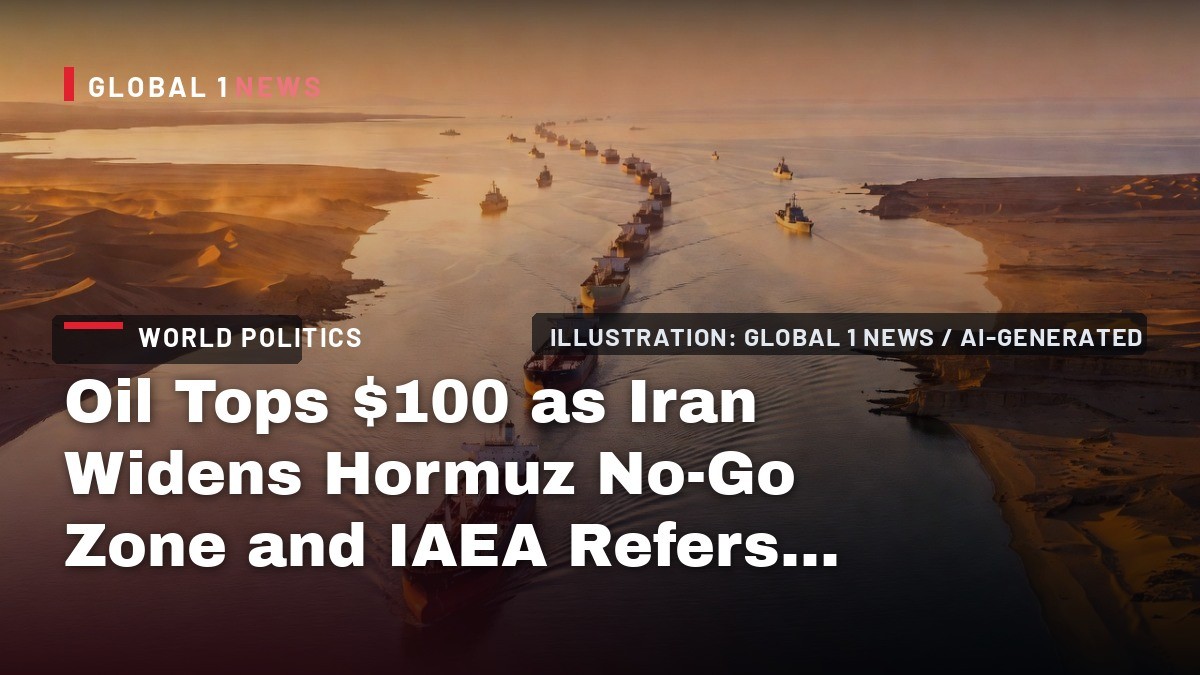
Iran widened its chokehold on the world's most important oil route on Wednesday, firing on more than a dozen vessels in and around the Strait of Hormuz and, for the first time, extending a "prohibited zone" into the Gulf of Oman and the Arabian Sea. Within hours, Brent crude closed above $100 a barrel again — and in Vienna, the United Nations' nuclear watchdog voted to haul Tehran before the Security Council for the first time in 20 years.
Oil Tops $100 as Iran Widens Hormuz No-Go Zone and IAEA Refers Tehran to UN Security Council
Atlanta, Georgia — Two escalations landed on the same day, on two different continents, and they are not separate stories. They are the same war, pressing on two pressure points at once: the world's oil supply and Iran's nuclear file.
Iran Escalates Its Grip on the Strait
Iran's Revolutionary Guards said Wednesday that they attacked two U.S. vessels, eight oil tankers and 10 "non-compliant vessels" that were attempting to transit the Strait of Hormuz, according to Iranian state media. The Guards, the ideological arm of Iran's military, framed the strikes as enforcement of the blockade they have maintained over the waterway for months.
The United Kingdom Maritime Trade Operations, the British-run maritime security clearing house that tracks shipping threats in the region, said "several" vessels in the Gulf of Oman and the Gulf were "subject to disabling fire as part of ongoing military activity in the region." That language matters. Disabling fire is not a warning shot. It is an attempt to stop a ship dead in the water.
The most consequential move came in the fine print. For the first time, the Guards added parts of the Gulf of Oman and the Arabian Sea — waters outside the strait itself — to a new "prohibited zone," saying the exact coordinates would be announced later. Guards spokesman Hossein Mohebi told state television that any vessel entering the area without coordination "will be subject to our sanctions."
Read that again. Iran is not just blockading a chokepoint anymore. It is claiming the right to police the approaches to it, in international waters, on coordinates it has not yet published. That is a recipe for exactly the kind of miscalculation that turns a shipping crisis into a shooting war between major navies.
Why Oil Crossed $100 Again
Brent crude closed at $101.21 a barrel on Wednesday, AFP reported, and market data tracked by Trading Economics put the international benchmark at $101.27 on Thursday. Oil has now crossed the $100 line repeatedly since the fighting flared, and each time it has done so on the same driver: the fear that Hormuz stops moving.
Understand what is at stake in that narrow stretch of water. The Strait of Hormuz normally carries roughly a fifth of the world's oil and liquefied natural gas. There is no cheap reroute. Pipelines can move some crude around the bottleneck, but not the volumes the world actually burns, and not the LNG that powers Asia and Europe.
So when Iran says it attacked eight oil tankers in a single day, the market does not wait for confirmation of insurance claims. It prices the risk immediately. Freight and war-risk premiums spike, refiners pay up for alternative barrels, and the cost travels down the chain to diesel, jet fuel, shipping and, eventually, the shelf price of nearly everything.
Here is the part politicians rarely say out loud: a sustained $100-plus oil price is a tax on every household in America, arriving roughly two months before a midterm election. That is not a coincidence worth ignoring. It is the central fact of this war's politics.
The IAEA Vote: A Referral, Not a Verdict
In Vienna, the International Atomic Energy Agency's board of governors voted to refer Iran to the UN Security Council over its nuclear "non-compliance," a diplomatic escalation that puts Tehran's file back in front of the world's most powerful body.
The resolution, proposed by the United States, Britain, France and Germany, passed with 23 votes in favor, three against and eight abstentions, diplomats at the closed-door meeting told Agence France-Presse. Russia, China and Niger cast the three votes in opposition. Al-Monitor and Middle East Eye reported the same breakdown from the same diplomats.
It is the first time Iran has been referred to the Security Council in 20 years for failing to comply with its nuclear reporting obligations — a symbolic milestone that carries real weight precisely because it is symbolic. Russia and China hold vetoes. Any binding action is effectively dead on arrival. What the vote does instead is lock in a public, on-the-record consensus that Iran is in breach, and it keeps the file alive for whatever comes next.
Iran's response was immediate and dismissive. Reza Najafi, Iran's ambassador to the UN in Vienna, called the resolution a "political tool" and said Iran "will cooperate only to the extent that circumstances and safety permit." Iran's mission to the IAEA went further on social media, calling the vote a political resolution "nonconsensually adopted" by the board and declaring that what it described as Washington's objective to force Iran to "surrender" and "plunder its oil" "will never happen."
What the Inspectors Still Cannot See
Behind the vote is a blunter problem, and IAEA Director General Rafael Grossi has stopped soft-pedaling it.
Iran has not allowed inspectors back to the sites bombed by Israel and the United States, including the three uranium-enrichment plants at the heart of its program, which were destroyed or badly damaged in the strikes. It has also not accounted for its enriched uranium stockpile.
Grossi told his board this week that the agency's lack of information about those facilities "and our inability to conduct verification activities at these facilities is a matter of serious proliferation concern," adding that "the situation needs to be rectified with the utmost urgency."
The numbers explain why. The IAEA estimated that Iran held 440.9 kilograms of uranium enriched to up to 60 percent before the U.S.-Israeli attacks. That is a short technical step from the roughly 90 percent needed for weapons-grade material. By the agency's own yardstick, that quantity — if enriched further — is enough for 10 nuclear weapons. How much survived the bombing is unclear. The IAEA has said it believes more than 200 kilograms remain at one site.
That is the gap the Security Council referral is meant to expose: the world is being asked to accept a nuclear standoff's resolution without any ability to verify what is left.
U.S. Forces Drawn Deeper Into the Fight
The military exchange did not stay at sea.
The Guards said they struck a U.S. military base in Jordan in retaliation for U.S. forces destroying five Iranian oil tankers a day earlier. Jordan's army said it shot down 18 missiles fired at the kingdom. The Jerusalem Post, citing reporting by CBS News correspondent Jennifer Jacobs, reported that an A-10 Thunderbolt was left with a missing wing and roughly eight F-15s sustained light damage in overnight strikes on Muwaffaq Salti Air Base in Jordan. Further details on the extent of the damage or potential casualties were not immediately available.
On the American side, the U.S. military said it was responding to an Iranian attack targeting an American warship — the second such incident in less than a week. Iran's foreign ministry condemned the U.S. strikes on its oil tankers as "an overt threat to regional and international peace and security," saying the attacks "increase the dangers of tensions in the region," and described its own targeting of U.S. military facilities as "self-defence."
Both sides now describe their actions as responses to the other's. That is how escalation loops work: each strike is justified, each justification invites the next strike.
Iran's Terms for Ending the War
The Guards have laid out what they want, and the list is long enough to make clear this does not end quickly.
Mohebi, quoted by the Fars news agency, said Washington must refrain from renewed threats, withdraw Israel's army from Lebanon, end the blockade of Yemen, release $24 billion in Iran's frozen assets, and refrain from any interference in the country's nuclear and missile capabilities.
Some of those demands are aimed squarely at the United States. Others — Lebanon, Yemen — are aimed at Israel and at the wider regional file. Taken together, they amount to a demand that Washington unwind a decade of policy across the Middle East as the price of reopening a single waterway. That is not a negotiating position. That is a statement of intent to keep fighting.
Trump Ties the War to November
President Donald Trump, facing an unpopular war and an unpopular price at the pump, said Wednesday that the conflict will conclude right after the U.S. midterm elections in November.
Set aside the obvious question — why the timing should depend on a domestic election calendar rather than a military or diplomatic objective — and look at what the statement reveals. The White House is signaling that it wants the war off the front pages before voters decide control of Congress, and that it believes it has until November to get there.
That gives Tehran enormous leverage. If Washington's clock is political, Iran's strategy can simply be to wait it out and drive the cost of waiting higher — through oil, through shipping, and through American service members stationed within range of Iranian missiles.
What Happens Now
Three things to watch, and each one matters more than the daily strike tallies.
First, the coordinates. When Iran publishes the boundaries of its expanded prohibited zone, the world will learn how far into the Gulf of Oman it intends to enforce its claim. If foreign navies escort convoys through waters Iran has declared off-limits, the next incident will not be a tanker hit. It will be a direct confrontation between warships.
Second, the Security Council. The referral returns to a body where two of Iran's closest partners hold vetoes. A Russian or Chinese veto would hand Tehran a propaganda win and hollow out the IAEA's vote. Even a debate that ends in nothing is a signal that the diplomatic track is exhausted.
Third, the price at the pump. Brent above $100 is already priced into futures. What has not been priced in is a full week of Hormuz disruption, or a single successful strike on a laden supertanker. Keep an eye on your fuel bill, your grocery bill, and the diesel surcharge on everything that moves by truck. This war is not happening to someone else. It is being passed to you, line by line, at the register.
Iran has blockaded the strait for months, expanded its no-go zone for the first time on Wednesday, and now faces a formal Security Council referral it intends to ignore. Washington says it is responding. Tehran says it is defending itself. And the only thing both sides agree on is that the waterway stays closed.
Folks, that is not a stalemate. That is a countdown.
By Jessica Ali, Staff Writer
This article was produced with AI-assisted research and editorial support. Sources: Agence France-Presse, Al-Monitor, Middle East Eye, The Jerusalem Post, Yahoo News Singapore, IAEA board statements, UKMTO maritime advisories, Trading Economics.
What's Your Reaction?
 Like
0
Like
0
 Dislike
0
Dislike
0
 Love
0
Love
0
 Funny
0
Funny
0
 Wow
0
Wow
0
 Sad
0
Sad
0
 Angry
0
Angry
0

Editor-in-Chief at Global1.News. Atlanta-based journalist who cuts through the BS and tells it like it is. Lead anchor, host, and the voice you hear when the spin stops and the truth starts.











Comments (0)