
Bolsonaro Memo Ties Brazil Rare Earths to US-China Rivalry
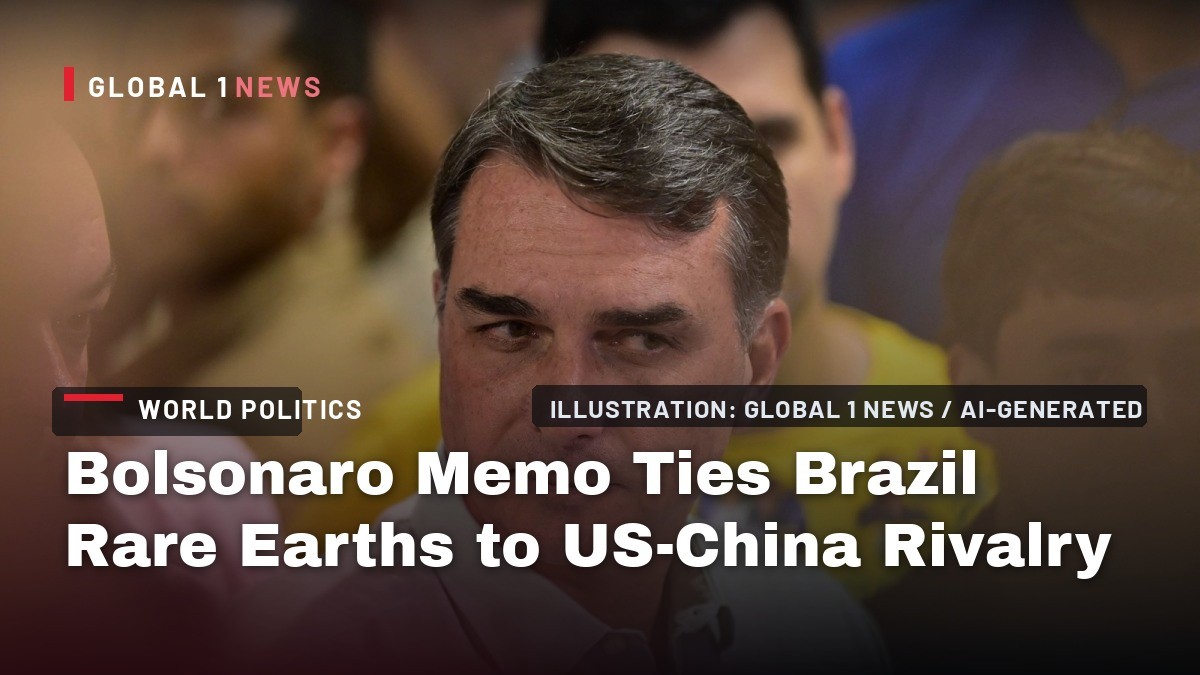
A leaked Bolsonaro campaign memo offered Washington a Brazil-to-US rare earths chain to weaken China's grip. With the Pentagon pouring $1.55 billion into a Goias mine and Beijing counter-offering partnership, Brazil's October 4 election is the newest front in the minerals war.
A Donor Pitch, a Mine in Goias and China at the Centre
Andre Marinho wrote the document in English, dated it March 19 and addressed it to a room of wealthy American conservatives. Twenty-two pages long, it offered Washington something US officials had spent months seeking from Brasilia without success: a rare earth supply chain rooted in Brazil, built to loosen China's grip on the metals that go into electric vehicle motors, wind turbines, fighter jets and guided missiles.
What the file also offered, according to the report by Brazilian news site Amado Mundo that surfaced on Saturday, was political alignment. It carried the branding of Flavio Bolsonaro's 2026 presidential campaign on every page, above the slogan "Prosperity Partnership", and it tied the minerals plan to support for his bid three weeks before Brazilians vote.
Marinho confirmed the same day that he wrote the presentation, but insisted it was "never shown to an American official and had nothing to do" with the campaign. The document's disclosure has nonetheless done what Brazil's geology has been doing all year: pulled the country's election into the contest between Washington and Beijing over the minerals of the next industrial era.
Inside a 22-Page Offer to Rewire the Rare Earths Map
The presentation's case rested on three commitments, all aimed at China. A Bolsonaro government would stop selling raw ore abroad, would refuse to become "structurally dependent on Chinese processing chains", and would align with Washington behind what the text called a "parallel supply system", according to Amado Mundo.
It dismissed President Luiz Inacio Lula da Silva's foreign policy as pro-China and guided by "deliberate geopolitical ambiguity", warning that four more years of it would leave Brazil a mere "supplier of raw materials to Chinese industry". For the United States, it promised reduced dependence on China and secure inputs for artificial intelligence, defence and the energy transition, projecting that Brazil could become "one of the three largest suppliers outside China" and draw up to US$100 billion into its mines over a decade.
The author is a recognisable figure in Rio de Janeiro politics. Marinho built a television career impersonating Flavio's father, Jair Bolsonaro, and is now running for governor of Rio state. His route into the Republican donor circuit runs through his family: his sister, the singer Giulia Be, is married to Conor Kennedy, the son of US Health Secretary Robert F. Kennedy Jnr, and that connection helped broker a meeting with Vice-President J.D. Vance in April, Amado Mundo reported.
Marinho said he flew to Dallas in March at the invitation of the Rockbridge Network, the conservative donor group Vance founded in 2019, to discuss opening a Brazilian arm, and dropped the idea in May. Nine days after the document was reportedly written, Flavio Bolsonaro told the Conservative Political Action Conference in Dallas that Brazil could be "the American answer to Chinese mineral dominance".
Washington Already Bought the Mine
Whatever the memo's fate, American capital has been moving into Brazilian rare earths at speed. Brazil holds the world's second-largest rare earth reserves, roughly 21 million tonnes, and about 10 per cent of global critical mineral reserves, but its deposits are largely untapped. Its one producing rare earth operation is the Pela Ema mine and processing plant in Goias state, owned by Serra Verde Group.
Serra Verde ended long-term supply contracts with Chinese buyers in December. Within two months it had closed a US$565 million financing package with the US International Development Finance Corporation, a deal that carried an option for Washington to take a minority stake. In April, USA Rare Earth agreed to acquire the group for about US$2.8 billion, paying US$300 million in cash and 126.8 million shares.
The Pentagon then removed the last commercial risk. On August 24, the Department of War announced it would pay US$750 million through US SIIE LLC to buy rare earths from Pela Ema, part of a US$1.55 billion capitalisation that also includes a US$300 million five-year purchase contract and a US$500 million bank credit facility. First deliveries are expected early in the fourth quarter. The structure guarantees Serra Verde a buyer and price floors for neodymium, praseodymium, dysprosium and terbium, the four magnetic rare earths that China refines at more than 90 per cent of global capacity, according to the International Energy Agency.
Western governments have set their own yardstick. At the Group of Seven summit in France in June, leaders pledged that no more than 60 per cent of rare earth imports should come from any single country by 2030.
Scale is the next hurdle. Pela Ema is projected to produce an average of about 6,400 tonnes of total rare earth oxides a year from its first phase, with the option to double throughput later, against Chinese output measured in the hundreds of thousands of tonnes. USA Rare Earth has said the combined company expects to generate roughly US$1.8 billion of EBITDA in 2030. Those are the economics that make a guaranteed buyer from the Pentagon worth more to Serra Verde than any market price.
Why Beijing Is Not Being Shut Out
Brazil's federal government has spent the year resisting exactly the choice the memo proposed. In April, a senior official at the industry ministry, Leonardo Durans, said foreign partners would be required to process minerals domestically as a condition of access to Brazilian reserves. "We are open to the United States, the European Union and China," he said. "We will talk to everyone."
Lula has held that line. He told US President Donald Trump in May that Brazil's reserves were "open to China and any other nation" willing to mine them, and he told voters this month that "traitors wanted to hand the country's reserves to foreigners", without naming the United States. Brazil's refusal to accept exclusivity has frustrated Washington, which sent a bilateral proposal in February and, according to the New York Times, has yet to receive an answer.
Beijing has positioned itself accordingly, offering Brasilia a partnership rather than a demand, according to the South China Morning Post. It also holds the strongest hand in the midstream. China accounts for about 90 per cent of global processed rare earth output, and its export controls extended in October cover not only ores and metals but processing technology. A separation line built with Chinese equipment or know-how can still require Beijing's approval. For a country that wants to sell oxides and magnets rather than soil, that is the binding constraint. The European Union entered the bidding in June, when its international partnerships commissioner, Jozef Sikela, pitched Brazil a "more beneficial" partnership than those on offer from Washington or Beijing.
Japan Pays for the Same Lesson
Tokyo reached Goias first, and through quieter means. The Japan Organization for Metals and Energy Security, known as JOGMEC, signed a memorandum of understanding with the state government of Goias, extending a strategy that Japan's ambassador to Brazil, Teiji Hayashi, has described as aligned with the country's economic security policy. Goias wants Japanese capital and technology to build higher-value processing at home.
Japan's caution is born of experience. China's 2010 suspension of rare earth shipments during the Senkaku Islands dispute pushed Tokyo into two decades of diversification, cutting its reliance on Chinese supply from about 90 per cent to roughly 60 per cent on the conventional measure. JOGMEC's own benchmark, which combines eight customs categories into contained rare earth content, is less flattering: China held 75 per cent of Japan's rare earth imports in 2025, easing only to 72.5 per cent in the first half of 2026, with Vietnam a distant second at 12.4 per cent.
Heavy rare earths remain the exposed flank. Beijing's export controls tightened from December 2025 halted shipments of dysprosium, terbium and yttrium to Japanese buyers, prompting Tokyo to draw down stockpiles and accelerate alternatives. Under a revised agreement, Australia's Lynas Rare Earths will reserve 75 per cent of its heavy rare earth output for Japan through the Japan Australia Rare Earths joint venture, alongside 7,200 tonnes a year of neodymium and praseodymium through 2038. Japan has also subsidised Shin-Etsu Chemical's first domestic refinery since 2008 with 17.5 billion yen, taken a stake in France's Caremag refinery securing half its planned output, designated critical minerals under its 2022 Economic Security Promotion Act, extended stockpile horizons to as much as 180 days, and dispatched a survey ship in January to probe rare earth mud six kilometres beneath the seabed near Minamitorishima.
The lesson Tokyo draws is that ownership matters less than optionality. Japan's model is non-exclusive, price-supported and deliberately spread across Australia, Malaysia, France, Namibia and now Goias, which is precisely the arrangement Lula's government says it wants, and precisely the one the Bolsonaro memo set out to replace.
The Election Variable Three Weeks Out
Flavio Bolsonaro entered the weekend level with the incumbent. A Datafolha poll published on September 11 put Lula at 39 per cent in a first-round scenario and Flavio at 35 per cent, little changed from 38 and 33 previously, with the first round scheduled for October 4.
The funding allegations matter more than the polling arithmetic. Renan Santos, a rival candidate who co-founded the Free Brazil Movement, said the Rockbridge Network had put money into Flavio Bolsonaro's run. He named two Brazilian operators; both denied it, and one, entrepreneur Tallis Gomes, filed a criminal defamation complaint. A lawmaker from the governing party has asked federal prosecutors to examine the claim, and Marinho said not a single cent was transacted. Campaign filings show 48.17 million reais, about US$9.4 million, of which 95 per cent came from Flavio's own party. Brazilian law bars foreign entities from funding candidates, and proof of foreign donations could cost a candidate their registration and trigger a criminal inquiry.
Flavio's campaign has not commented publicly on the document. His father, Jair Bolsonaro, is serving 27 years for plotting a coup. The US embassy in Brasilia did not respond to a request for comment.
What to Watch For
First, Goias. The state's governor moved ahead of Brasilia with his own rare earth policy and a bilateral understanding with Washington, and JOGMEC's memorandum shows a third government working the same seam. Watch whether Japan converts its memorandum into equity, offtake or a refinery stake, because that would answer the question the memo raised without needing an American donor network at all: whether Brazil can be supplied with capital and still keep its options open.
Second, the numbers. Watch whether China's share of Japanese rare earth imports, 72.5 per cent in the first half of this year, falls below 70 per cent in the next JOGMEC reading. Japan's heavy rare earth exposure is the honest measure of whether two decades of diversification have actually worked.
Third, October 4. If Flavio Bolsonaro forces a runoff, expect the minerals file to become a campaign issue in its own right, and expect Washington's engagement with Brazilian mining to continue regardless of who wins, because the Serra Verde offtake is already contractual.
Fourth, the Xi Jinping and Donald Trump meeting planned in Washington this month. If rare earths appear on that agenda, the leverage Brazil thinks it holds becomes clearer to everyone, including the Brazilians.
By Kenji Tanaka, Staff Writer
This article was produced with AI-assisted research and editorial support. Sources: South China Morning Post; Amado Mundo; Reuters; USA Rare Earth; Bloomberg; New York Times; The Star; Lowy Institute; Japan Organization for Metals and Energy Security; International Energy Agency; Datafolha.
What's Your Reaction?
 Like
0
Like
0
 Dislike
0
Dislike
0
 Love
0
Love
0
 Funny
0
Funny
0
 Wow
0
Wow
0
 Sad
0
Sad
0
 Angry
0
Angry
0

Japan Correspondent at Global1.News. Tokyo-based voice covering Japanese politics, technology, economy, and culture. Tracks the intersection of tradition and innovation in one of the world's most dynamic societies.











Comments (0)