
Venus' mysterious haze is actually cosmic dust
For decades the yellow‑tinged “lower haze” that cloaks the base of Venus’s thick atmosphere has been a stubborn puzzle for planetary scientists. Over the ensuing decades, researchers proposed several theories, most notably that volcanic ash from Venus’s prolific volcanoes was the culprit.
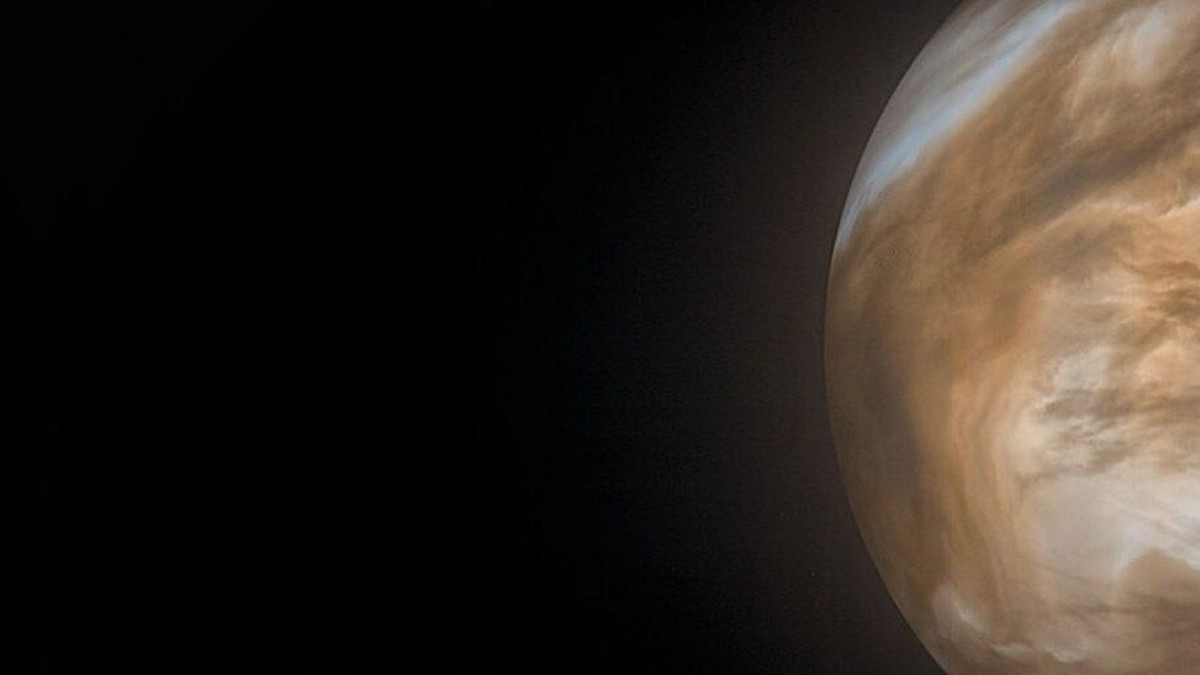
For decades the yellow‑tinged “lower haze” that cloaks the base of Venus’s thick atmosphere has been a stubborn puzzle for planetary scientists. Discovered by the Soviet Venera probes and NASA’s Pioneer Venus missions in the 1970s, the haze lingered as an enigmatic veil, its origin unconfirmed despite decades of speculation. Now a team led by planetary scientist Hiroki Karyu of Tohoku University has cracked the case, showing that the haze is not volcanic ash or surface dust at all, but a fine spray of cosmic dust left behind by meteoroids that burn up in the planet’s crushing air. The finding, published in *Nature Astronomy*, redefines how we think about cloud formation on Venus and may reshape our understanding of haze processes on the giant planets and even distant exoplanets.
From the 1970s to 2026: A lingering mystery
The lower haze first caught scientists’ attention when the Venera landers and Pioneer Venus atmospheric probes sent back their first images of the planet’s lower atmosphere. Those early missions revealed a faint, yellowish veil hovering a few tens of kilometers above the surface, but the instruments could not explain its composition. Over the ensuing decades, researchers proposed several theories, most notably that volcanic ash from Venus’s prolific volcanoes was the culprit. The idea seemed plausible: Venus is the most volcanically active planet in the Solar System, with the Magellan spacecraft in the early 1990s first mapping extensive volcanic features, and later studies suggesting even higher levels of activity.
Yet each hypothesis fell short under scrutiny. Volcanic ash, while abundant, could not account for the observed particle‑size distribution recorded by the entry probes. Likewise, surface dust, even if present in larger quantities, would not interact with the sulfur‑rich atmosphere in the way required to generate the haze. The mystery persisted, a reminder that even with decades of data, some planetary processes remain stubbornly opaque.
Cosmic dust: The missing piece
Karyu’s breakthrough came from applying a microphysical model—a simulation that tracks the tiniest particles and their interactions, the same kind of model used to study cloud formation on Earth. By feeding the model with realistic influx rates of meteoroid material, the team demonstrated that the continuous rain of cosmic dust is sufficient to sustain the lower haze layer. “The continuous influx of cosmic dust is sufficient to sustain this lower haze layer with the particle size distribution observed by the entry probes,” Karyu said in the study.
The process is straightforward yet elegant. As meteoroids plunge through Venus’s dense atmosphere, friction with the gas heats them to the point of ablation. The resulting “shooting stars” shed a trail of microscopic particles that linger in the atmosphere. Sulfuric acid—abundant in Venus’s clouds—condenses on the surfaces of these particles, forming the observed haze. In effect, the dust particles act as condensation nuclei, the same way dust, soot, sea‑salt, or volcanic ash seed cloud droplets on Earth.
Why volcanic ash doesn’t fit
Previous speculation that the haze derived from volcanic ash rested on Venus’s hyper‑active geology. However, Karyu’s model showed that ash particles, even if plentiful, would not provide the right chemical surface for sulfuric acid to adhere. The team also examined the possibility that larger surface dust could be the source, but found that such particles would not survive long enough in the harsh lower atmosphere to serve as effective nuclei. “Even if there were much larger influxes of volcanic or surface dust on Venus, the particles would still not be able to interact with the atmosphere’s sulfur in the right way to form the haze,” Karyu explained.
This distinction matters because it shifts the focus from internal planetary processes (volcanism) to external, solar‑system‑wide phenomena (meteoroid influx). It also explains why the haze’s particle‑size distribution matches that expected from a steady drizzle of cosmic dust rather than the broader size range typical of volcanic ash.
The role of condensation nuclei and cloud formation
The microphysical model also illuminated how these dust particles influence the broader cloud deck of Venus. On Earth, condensation nuclei are essential: water vapor condenses onto tiny aerosol particles, forming droplets that coalesce into clouds. Venus’s clouds, composed primarily of sulfuric acid, follow a similar principle. The meteoroid‑derived particles provide abundant nucleation sites, encouraging sulfuric acid droplets to form even far from the original dust source.
Interestingly, the study found that adding more particles does not linearly increase cloud droplet numbers. Instead, particles tend to aggregate into clusters before sulfuric acid condenses around them, creating larger “super‑nuclei.” These clusters then grow heavier and eventually sink into the scorching lower atmosphere, where temperatures can reach 100 °C (212 °F) and the acid evaporates. This nuanced behavior underscores the complexity of haze dynamics and the importance of particle‑size distribution in governing cloud evolution.
Solving the ultraviolet absorber puzzle
One lingering enigma on Venus has been the identity of the substance that absorbs ultraviolet (UV) radiation high in the atmosphere. Earlier missions, including Venera and Vega, detected atmospheric iron, while Pioneer Venus’s mass spectrometer identified iron sulfate. Yet the exact absorber remained speculative. Karyu’s work links the UV absorber to the same meteoritic dust that forms the lower haze.
Metallic components of meteoroids—magnesium, silicon, and iron—behave differently under UV exposure. Magnesium and silicon are poor UV absorbers, but iron compounds, especially iron sulfate, are strong UV absorbers. The study showed that iron sulfate matches the optical properties of the observed UV‑absorbing layer, tying together the dust influx, haze formation, and UV absorption into a single coherent picture.
Implications for the outer planets
The discovery that cosmic dust can seed haze layers on Venus has broader ramifications for planetary science. Upper hazes on gas giants like Jupiter and Saturn have been studied extensively, but the microphysical processes beneath their main cloud decks remain less understood. If meteoritic dust can act as condensation nuclei on Venus, similar mechanisms may operate on the giant planets, where external dust could settle onto cloud layers and influence haze composition.
Karyu emphasized this potential, noting that observing metal layers in the atmospheres of outer planets could help determine deposition rates of extraterrestrial material and, by extension, the resulting haze abundances. “As on Venus, observing the metal layers in the atmosphere of the outer planets would help [determine] the deposition rates of [metals] within their atmospheres and, by extension, the resulting haze abundances,” he said. This line of inquiry could also inform models of exoplanetary atmospheres, where cosmic dust may play a similar role in shaping cloud and haze structures.
Looking ahead: Cosmic dust as a climate factor
The identification of cosmic dust as a key player in Venus’s atmospheric chemistry reshapes how scientists view planetary climates. Dust influx is not merely a background nuisance; it can actively drive cloud formation, alter radiative balance, and even affect UV shielding. For Venus, the haze created by meteoritic particles helps sustain the planet’s dense cloud deck, which in turn reflects sunlight and traps heat, reinforcing the runaway greenhouse effect that makes the surface inhospitable.
Future missions to Venus—such as the upcoming DAVINCI+ and VERITAS orbiters—will have the opportunity to directly sample the lower haze and measure dust influx rates, providing ground truth for Karyu’s model. Meanwhile, laboratory experiments replicating Venusian conditions could further refine our understanding of how iron sulfate and other meteoritic compounds interact with sulfuric acid. In the broader context, recognizing cosmic dust as an essential component of planetary climates invites a re‑examination of atmospheric models across the Solar System and beyond, ensuring that the tiny particles streaking through space are given the credit they deserve.
This article was produced with AI-assisted research and editorial support. Reporting is based on the source material cited below. Sources: Ars Technica; arstechnica.com; Global1.News (02 October 2026).
By Jessica Ali, Staff Writer
What's Your Reaction?
 Like
0
Like
0
 Dislike
0
Dislike
0
 Love
0
Love
0
 Funny
0
Funny
0
 Wow
0
Wow
0
 Sad
0
Sad
0
 Angry
0
Angry
0

Editor-in-Chief at Global1.News. Atlanta-based journalist who cuts through the BS and tells it like it is. Lead anchor, host, and the voice you hear when the spin stops and the truth starts.













Comments (0)