
Ben Gvir Unveils Execution Facility for Palestinian Prisoners
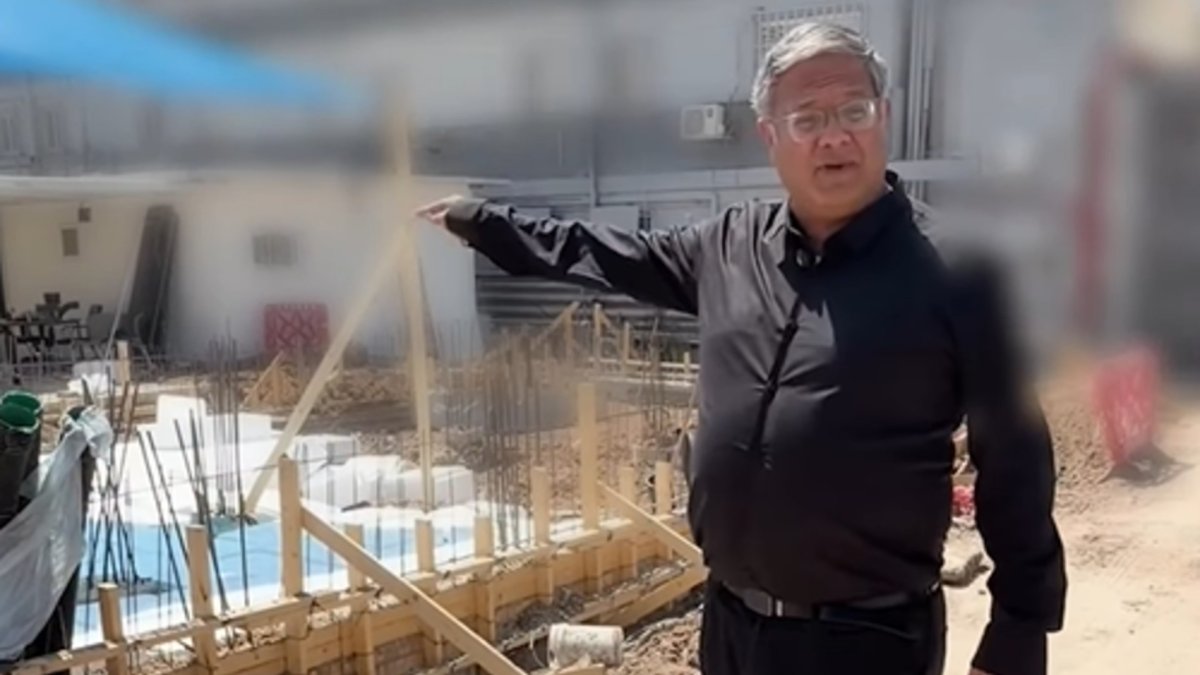
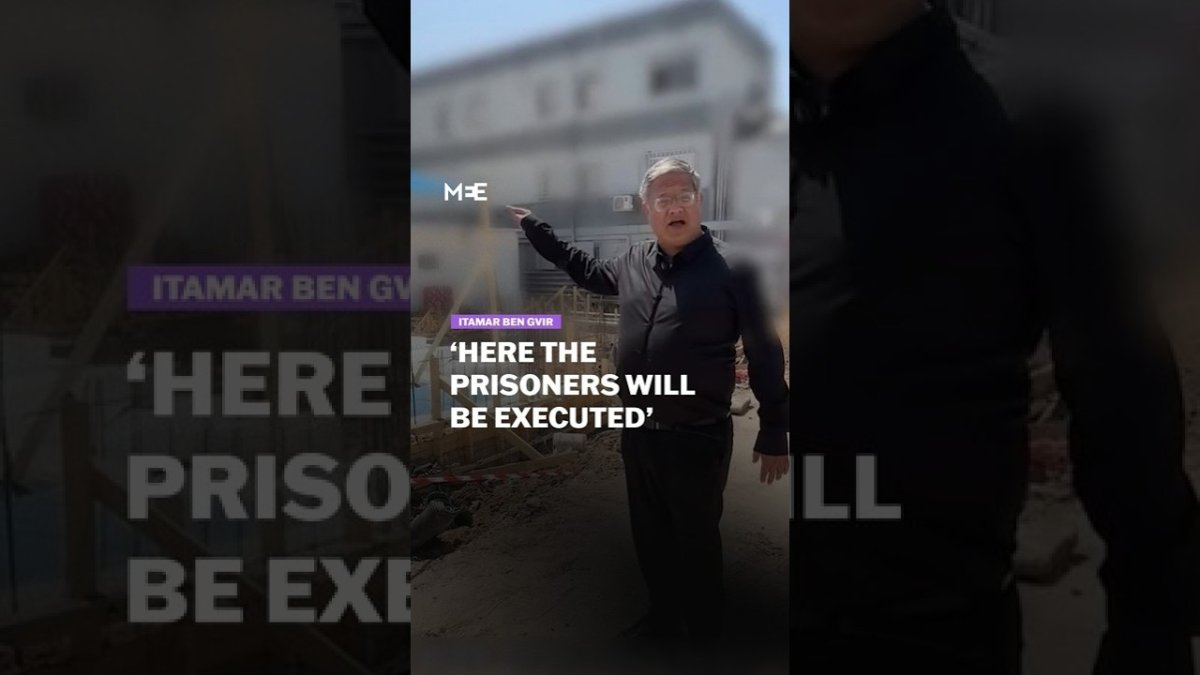
In a Middle East Eye video report published Wednesday, Israeli National Security Minister Itamar Ben Gvir is shown boasting on Tuesday about the construction of a facility intended for the execution of Palestinian prisoners, pointing toward an active building site and declaring, "In this place, the terrorists will be executed." The footage, posted to his Instagram account where he has around 150,000 followers, offers a rare glimpse into what the far-right minister describes a
In a Middle East Eye video report published Wednesday, Israeli National Security Minister Itamar Ben Gvir is shown boasting on Tuesday about the construction of a facility intended for the execution of Palestinian prisoners, pointing toward an active building site and declaring, "In this place, the terrorists will be executed." The footage, posted to his Instagram account where he has around 150,000 followers, offers a rare glimpse into what the far-right minister describes as a fulfillment of his long-promised policy of state-sanctioned killing.
Ben Gvir Unveils Execution Facility for Palestinian Prisoners, Promises 'Viewing Chambers' for Victims' Families
Jerusalem, Occupied Palestinian Territories - 19 August 2026 - Israeli National Security Minister Itamar Ben Gvir has unveiled a newly constructed execution facility inside a prison in central Israel, boasting that it will include gallows and "viewing chambers" where families of Israeli crime victims can watch Palestinian prisoners being hanged. The announcement, made in a video posted to social media on Tuesday, marks the most concrete step yet toward implementing Israel's controversial Death Penalty for Terrorists Law, passed by the Knesset in March. The exact location of the facility has not been disclosed, and the Israel Prison Service (IPS) has not commented on operational timelines, but Ben Gvir presented the site as evidence that he has delivered on his political promises ahead of national elections scheduled for 27 October.
A 'Historic' Announcement and a Promise Fulfilled
In the video, which Ben Gvir posted on Tuesday 18 August, the minister is seen walking through what appears to be an active construction site, gesturing toward the structure behind him. "In this place, the terrorists will be executed," he says, according to the Middle East Eye report. He goes on to describe the complex as including "viewing chambers where crime victims will be able to come and watch" Palestinians being hanged. "We are fulfilling what we promised," he added, celebrating what he described as a victory over opponents who "ridiculed" and "giggled" at his plan.
His office issued a statement the same day confirming that the execution site is being built inside a newly completed death-row wing at a prison in central Israel. The facility will include gallows within the wing and separate viewing booths where families of victims will be permitted to observe executions. "We are making history," Ben Gvir said in the statement. "Terrorists deserve only one thing: death by hanging." He argued that similar systems exist in other countries, including the United States, and framed the facility as a necessary deterrent against attacks on Israelis.
The announcement drew immediate attention not only for its content but for its timing. With national elections less than ten weeks away, Ben Gvir's decision to showcase the execution site appears calculated to energize his far-right base, presenting himself as the only politician willing to take the most extreme measures against Palestinian prisoners. The minister has long made the death penalty a cornerstone of his political identity, and the video serves as a visual confirmation that his agenda is moving from rhetoric to reality.
The Law Behind the Gallows: A Legislative History
The execution facility is the direct product of the Death Penalty for Terrorists Law, passed by Israel's parliament, the Knesset, on 30 March in a 62-48 vote. The legislation, sponsored by Ben Gvir's Otzma Yehudit party, regulates the execution of Palestinian prisoners convicted of involvement in deadly attacks. Under the law, the Israel Prison Service will be the agency responsible for carrying out executions, which are to be conducted by hanging within 90 days of sentencing.
Critics have described the law as discriminatory, arguing that it applies exclusively to Palestinians and not to Israeli Jewish citizens who commit similar offenses. The measure was later extended to West Bank military courts through security regulations approved by IDF Central Command chief Maj.-Gen. Avi Bluth, further entrenching a two-tier legal system in which Palestinians face a separate and harsher judicial framework.
Notably, the IPS had already begun preparing sites and personnel to carry out executions before the Knesset passed the law in March, according to Israeli media reports. Three IPS volunteers are reportedly expected to serve as executioners, a detail that underscores how quickly the state apparatus has moved to operationalize the legislation. The fact that preparations were underway prior to the law's passage has raised questions about the extent to which the policy was pre-planned, regardless of legislative approval.
Human Rights Groups: A 'Network of Torture Camps'
Human rights organizations have long accused Israel of pursuing a de facto policy of executing Palestinians, and the new facility has only intensified those concerns. In March, Yuli Novak, executive director of the Israeli human rights group B'Tselem, said Israel "already kills Palestinians systematically and faces no demands for accountability." B'Tselem has documented that under Ben Gvir's leadership, IPS detention facilities have become "a network of torture camps where inmates are subjected to continuous abuse and violence."
The death penalty law, the group has argued, "adds another official killing mechanism to the existing practices." As of June, at least 104 Palestinian prisoners have died in Israeli custody since 2023, according to figures compiled by Palestinian and Israeli rights monitors. The causes of death have ranged from alleged medical negligence to what Israeli authorities describe as natural causes, but human rights groups have consistently called for independent investigations that have not been forthcoming.
The construction of the execution facility represents a qualitative escalation in this pattern. While Israel has carried out only one execution in its history - the 1962 hanging of Nazi war criminal Adolf Eichmann - the infrastructure now being built signals a willingness to use capital punishment as a routine tool of occupation. For Palestinian prisoners, many of whom are held under administrative detention without trial or convicted in military courts with conviction rates exceeding 99 percent, the threat of execution adds a new layer of terror to an already brutal system.
International Condemnation and Calls for Sanctions
Ben Gvir's comments have sparked international condemnation, with European leaders expressing alarm at the minister's language and the policy it represents. German Vice Chancellor Lars Klingbeil, co-leader of Germany's Social Democratic Party, called on the European Union to sanction the minister, telling German media: "These are statements that we, as the German government, cannot accept in any way." Klingbeil described Ben Gvir's language as "dehumanising" and urged the EU to take concrete action against the Israeli minister.
The diplomatic fallout comes at a sensitive time for Israel-EU relations, which have already been strained by the ongoing war in Gaza and Israel's expanded settlement activity in the West Bank. While the EU has historically struggled to adopt unified positions on Israel, the prospect of a minister openly celebrating the construction of execution facilities may force a more decisive response. Whether that translates into actual sanctions, however, remains uncertain, given the bloc's internal divisions and the strong support Israel enjoys from several member states.
The United States, Israel's closest ally, has not yet issued an official response to Ben Gvir's announcement. The minister's reference to American execution practices as a model is likely to complicate any criticism from Washington, though human rights groups in the US have pointed out that the comparison is misleading - American executions are carried out after lengthy appeals processes and are subject to constitutional review, whereas the Israeli law applies only to Palestinians and allows for executions within 90 days of sentencing.
Election Politics and the Far-Right Agenda
The unveiling of the execution facility comes ahead of Israel's national elections on 27 October, giving Ben Gvir another opportunity to appeal to his far-right supporters. He presented the facility as evidence that he had delivered on political promises, a message aimed squarely at voters who have grown skeptical of politicians who make extreme statements but fail to follow through. By showing a physical structure, Ben Gvir is attempting to demonstrate that his policies are not mere rhetoric but tangible achievements.
This is not the first time Ben Gvir has used his position to impose harsh measures on Palestinian prisoners. In 2023, he introduced restrictions on security prisoners, including reducing shower times, closing prison bakeries and limiting family visits. His separate policy blocking Knesset members from visiting prisoners was overturned by Israel's Supreme Court in April 2026, a rare judicial rebuke of the minister's authority. Several Israeli-Arab lawmakers sought in June to join a High Court petition challenging the death penalty legislation, arguing that it is unconstitutional and violates rights to life, dignity, equality and due process.
The election context is crucial to understanding Ben Gvir's strategy. Polls suggest his Otzma Yehudit party remains a key component of Prime Minister Benjamin Netanyahu's governing coalition, and the minister is positioning himself as the most reliable voice for Jewish supremacy and anti-Palestinian policies. By showcasing the execution facility, he is not only appealing to his base but also attempting to pull the entire political discourse further to the right, forcing even mainstream parties to respond to his agenda.
Implications for Palestinian Prisoners and the Region
The construction of the execution facility has profound implications for the approximately 9,000 Palestinian prisoners currently held in Israeli jails, according to figures from the Palestinian Prisoners' Society. For these detainees, the threat of execution is not abstract - it is a concrete possibility that could be realized within months of a conviction. The law's application to military courts in the West Bank, where Palestinians are tried without juries and often without access to adequate legal representation, raises the specter of rapid, opaque proceedings ending in state-sanctioned killing.
Last week, Ben Gvir promised Rom Braslavski, a former Israeli soldier who Hamas held in Gaza, that he would do everything possible to allow him to execute Palestinians, after Braslavski said he wanted to kill them with his "own hands". Ben Gvir told Braslavski that Palestinian prisoners held under his supervision "don't deserve to live". During the same interview, the minister also called for the killing of Palestinians in Gaza and their expulsion from the territory. These statements, made openly and without apparent consequence, illustrate the extent to which dehumanizing language has become normalized at the highest levels of Israeli government.
For Palestinians on the ground, the execution facility is another marker of their dispossession - a physical structure built to kill them, celebrated by a minister who holds direct authority over their detention. The psychological impact on prisoners and their families cannot be overstated. Knowing that a state has built gallows specifically for your people, with viewing chambers for those who wish to watch you die, is a form of terror that extends far beyond the prison walls. It is a message to every Palestinian that their lives are considered expendable, and that the Israeli state is willing to institutionalize their killing.
As the international community grapples with how to respond, and as Israeli elections approach, the execution facility stands as a grim monument to a policy that has moved from the margins to the mainstream. Whether the law will actually be applied remains to be seen - no executions have been scheduled, and legal challenges are pending - but the infrastructure is now in place. For Palestinian prisoners, their families, and the broader society that lives under occupation, the message is clear: the threat of death is no longer theoretical. It has been built, brick by brick, in a prison in central Israel, waiting for its first victim.
By Fatima Al-Rashid, Staff Writer
This article was produced with AI-assisted research and editorial support. Reporting is based on sources cited in the article.
What's Your Reaction?
 Like
0
Like
0
 Dislike
0
Dislike
0
 Love
0
Love
0
 Funny
0
Funny
0
 Wow
0
Wow
0
 Sad
0
Sad
0
 Angry
0
Angry
0

Gulf/MENA Correspondent at Global1.News. Based in Doha, covering Gulf politics, energy markets, diplomacy, and development across the Middle East and North Africa. Tracks the economic transformation of the Gulf states.













Comments (0)