
The mirage of “Greater Israel” and the structural mechanics of imperial collapse
In the weeks following the devastating Israeli campaign that razed much of Gaza in July 2026, the human toll has become a stark reminder that the conflict is not merely a battlefield dispute but a profound violation of international law and human rights.
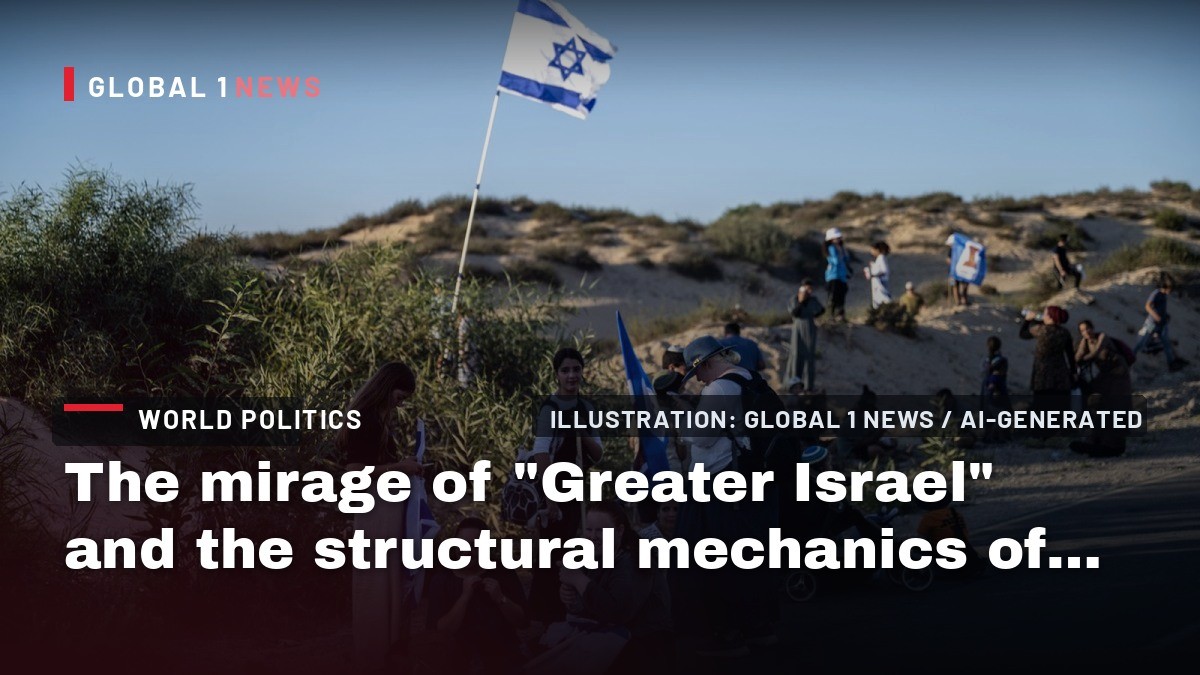
In the weeks following the devastating Israeli campaign that razed much of Gaza in July 2026, the human toll has become a stark reminder that the conflict is not merely a battlefield dispute but a profound violation of international law and human rights. The recent march of Israeli settlers, accompanied by far‑right ministers, from the Yad Mordehay area toward the Gaza border underscores a disturbing ambition to cement new Jewish settlements on land that has already been reduced to rubble. This drive for territorial expansion, framed by some in Israel as a realization of a biblically inspired “Greater Israel,” is now being met with an unprecedented diplomatic rebuke that threatens to isolate the Zionist project from the broader community of nations.
The Human Cost of the Gaza Onslaught
The July 19, 2026, attack on Yad Mordechai, located ten kilometres south of Ashkelon, exemplified the scale of destruction inflicted on Gaza. Images and testimonies from the ground reveal entire neighbourhoods flattened, health facilities targeted, and water supplies cut off, leaving civilians to endure forced starvation and a lack of basic medical care. The systematic flattening of urban centres, as described in the source material, constitutes a direct breach of the Genocide Convention, which obliges states to prevent and punish acts intended to destroy, in whole or in part, a national, ethnical, racial or religious group. The suffering of families who have lost homes, loved ones, and the very means to survive underscores the urgent need for accountability under international humanitarian law.
Beyond the immediate physical devastation, the psychological trauma inflicted on Gaza’s population is profound. Children who have witnessed the destruction of their schools and the death of neighbours are now living with the spectre of loss and insecurity. The forced displacement of thousands, combined with the denial of access to potable water, has created a humanitarian crisis that the international community is legally bound to address. Yet, as the source material notes, Israel’s actions have been framed as a strategic “military necessity,” a narrative that masks the reality of widespread war crimes.
International Legal Violations
The source material outlines several specific breaches of international law. The settlement expansion in the occupied West Bank and East Jerusalem, now exceeding 700,000 settlers, directly contravenes Article 49 of the Fourth Geneva Convention, which prohibits an occupying power from transferring its civilian population into occupied territory. This illegal transfer is not a peripheral issue; it is a core element of the broader system of racial enclosure that the source identifies as meeting the criteria of the 1973 International Convention on the Suppression and Punishment of the Crime of Apartheid.
Moreover, the dual legal system—civil law for Israeli settlers and harsh military law for Palestinians—reinforces a regime of discrimination that the source material argues fulfills every technical and legal criterion for apartheid. The International Court of Justice’s provisional measures on genocide and the International Criminal Court’s arrest warrants for top political and military figures further cement the view that Israel is no longer a “normal” state actor but an outlaw ethnostate operating outside the bounds of the post‑World War II legal order.
Diplomatic Isolation at the United Nations
The most visible sign of Israel’s growing isolation came during the 81st Session of the United Nations General Assembly, where Prime Minister Benjamin Netanyahu faced an “ocean of empty seats” as delegations from the Global South—including Latin America, Africa, and Asia—stood and walked out in unified protest. This collective walk‑out, as the source material emphasizes, is more than a symbolic gesture; it represents a formal expulsion from the consensus of civilized nations and a repudiation of the moral authority Israel once claimed in Western capitals.
Such a diplomatic snub signals a shift in global perception. The United Nations, traditionally a forum for dialogue, has become a stage where Israel’s reliance on “raw industrial violence and American diplomatic coercion” is laid bare. The source material argues that this reliance underscores Israel’s transformation into a militarized garrison state, dependent on external protection rather than legitimate sovereign legitimacy.
The Role of Western Imperial Support
Western powers, particularly the United States and European nations, have historically underpinned Israel’s expansionist agenda. The source material details how the United States acts as the “explicit imperial guarantor,” regularly bypassing domestic oversight to supply heavy munitions, deploy naval strike groups, and wield its veto power in the UN Security Council to shield Israel from accountability. This backing, however, is reaching its limits. Even with American protection, Israel cannot overcome the “physical and economic limits of imperial overextension.”
European states, meanwhile, are portrayed as hypocritical. While publicly urging “restraint,” they continue to trade in lethal military components and suppress domestic pro‑Palestinian dissent, criminalising solidarity movements. This double‑standard erodes the credibility of Western commitments to human rights and the “rules‑based international order,” as the source material notes, further alienating these nations from the broader global consensus that now condemns Israel’s actions.
The Collapse of Israel’s Deterrence Doctrine
Israel’s security doctrine has long rested on the premise of “absolute deterrence”—the belief that overwhelming kinetic force would terrorise surrounding populations into permanent submission. The source material explains that under Prime Minister Netanyahu, Israel has pursued a “multi‑front struggle,” attempting to project power simultaneously against Gaza, the West Bank, Lebanon, Syria, Iraq, Yemen, and Iran. This strategy, intended to enforce regional hegemony and secure territorial ambitions, has instead exposed Israel to a “profound li”—a strategic overreach that weakens its capacity to maintain deterrence.
Analyst Robert Inlakesh, cited in the source, observes that Israeli officials frame these operations as defensive responses to an “existential ring of fire.” In reality, the source material argues, Israel has chosen to wage expansionist, colonial wars on multiple asymmetric fronts, thereby stretching its military resources thin and inviting broader regional resistance. The resulting “structural, compounding decay” threatens the internal political, economic, and social viability of the state.
Human Rights Implications and the Path Forward
For the Palestinian people, the convergence of military devastation, legal violations, and diplomatic isolation translates into an urgent humanitarian emergency. International law obliges the global community to protect civilians, ensure access to essential services, and hold perpetrators of war crimes accountable. The source material’s reference to the International Court of Justice’s provisional measures and the International Criminal Court’s arrest warrants underscores the legal mechanisms available to pursue justice.
Yet accountability alone will not heal the wounds inflicted on Gaza’s residents. A sustainable resolution must address the root causes identified in the source: the settler‑colonial logic of “Greater Israel,” the racialized legal system, and the external support that sustains the occupation. International actors, especially those in the Global South who have already demonstrated solidarity through the UN walk‑out, must continue to press for a comprehensive ceasefire, the withdrawal of settlement expansion, and the restoration of Palestinian self‑determination.
In the meantime, humanitarian organisations are calling for immediate access to Gaza’s health infrastructure, the restoration of water supplies, and the safe passage of aid convoys. The human cost of the conflict—families torn apart, children growing up amid ruins, and a population living in constant fear—must remain at the centre of any international response. As the source material poignantly illustrates, the true measure of any political solution will be its ability to restore dignity, safety, and rights to the Palestinian people, whose suffering has been amplified by a system that has become increasingly isolated on the world stage.
This article was produced with AI-assisted research and editorial support. Reporting is based on the source material cited below. Sources: Middle East Monitor; middleeastmonitor.com; Global1.News (29 September 2026).
By Fatima Al-Rashid, Staff Writer
What's Your Reaction?
 Like
0
Like
0
 Dislike
0
Dislike
0
 Love
0
Love
0
 Funny
0
Funny
0
 Wow
0
Wow
0
 Sad
0
Sad
0
 Angry
0
Angry
0
Gulf/MENA Correspondent at Global1.News. Based in Doha, covering Gulf politics, energy markets, diplomacy, and development across the Middle East and North Africa. Tracks the economic transformation of the Gulf states.












Comments (0)