
Anutin Dismisses Cambodian Call for Arrest Over Border Visit
Prime Minister Anutin Charnvirakul on Wednesday brushed off a call in Cambodia for legal action against him over his recent visit to a disputed border area, saying he had acted in accordance with Thai law and a bilateral Joint Statement.
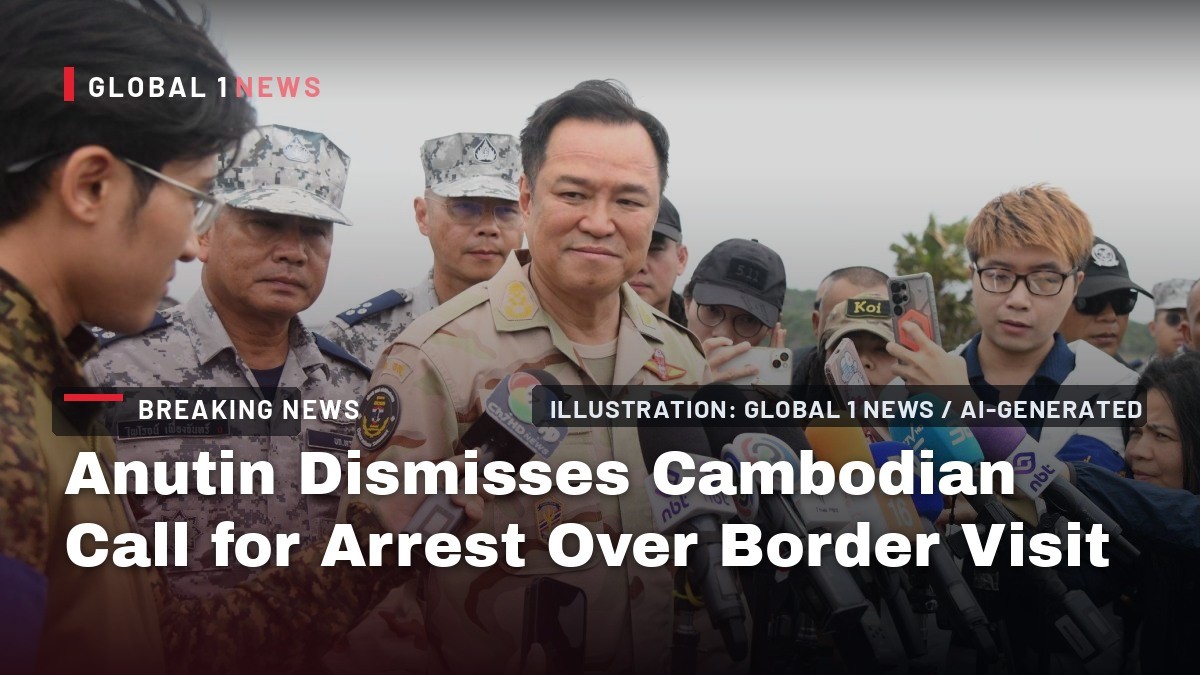
Prime Minister Anutin Charnvirakul on Wednesday brushed off a call in Cambodia for legal action against him over his recent visit to a disputed border area, saying he had acted in accordance with Thai law and a bilateral Joint Statement. The Thai leader’s remarks came in response to a commentary published by The Phnom Penh Post following his 23 August visit to Chong An Ma in Ubon Ratchathani province, which alleged that Cambodian authorities should file charges and seek an arrest warrant against him for allegedly trespassing on Cambodian territory.
“Really? What should I say?” Anutin told reporters when asked about the reported call. “I followed the law. I have the Joint Statement, signed by the leaders of both countries,” he said, referring to the 2025 bilateral agreement on border management between Thailand and Cambodia. The prime minister’s tone was measured but firm, reflecting a government stance that Bangkok has acted within its rights under existing diplomatic frameworks.
Chong An Ma Visit and the Disputed Overlapping Claims Area
The visit that sparked the controversy took place on 23 August, when Anutin traveled to Chong An Ma, a mountainous pass in Ubon Ratchathani’s Nam Yuen district, near the Thai-Cambodian frontier. The area sits within the overlapping claims zone that has been a point of friction between the two neighbors for decades. During the trip, the prime minister inspected military readiness along the border, a move that Phnom Penh has characterized as provocative.
Anutin, however, framed the visit as a routine administrative duty. “I went there as the prime minister of Thailand to check on our troops and our border communities,” he said. The inspection included briefings from Royal Thai Army officers stationed in the region, who detailed troop deployments and surveillance operations along the 800-kilometer shared border. For local residents in Ubon Ratchathani, the visit was a rare show of high-level attention to a frontier area often overshadowed by more prominent border crossings in Si Sa Ket or Sa Kaeo provinces.
Joint Statement as the Cornerstone of Thai Defense
Central to Anutin’s rebuttal is the Joint Statement signed by Thai and Cambodian leaders in 2025, which established a framework for managing the border without escalating disputes. The agreement commits both sides to maintaining their current positions and refraining from unilateral actions that could alter the status quo. Anutin invoked this document repeatedly on Wednesday, arguing that Thailand’s conduct has been fully compliant.
“If they follow the Joint Statement too, it will lead to discussions. But if they don’t, I don’t know how we can hold discussions,” he said, signaling frustration with what Bangkok perceives as Cambodia’s inconsistent adherence to the pact. The prime minister’s comments suggest that Thailand views the agreement as a binding commitment, not a symbolic gesture, and that any deviation by Phnom Penh undermines the foundation for future dialogue.
The Joint Statement emerged from years of negotiations following the contentious Preah Vihear temple dispute, which saw armed clashes between Thai and Cambodian forces in 2008 and 2011. That conflict, rooted in a 1962 International Court of Justice ruling over the temple’s surroundings, left deep scars in border communities on both sides. The 2025 agreement was hailed as a breakthrough, but its implementation has been uneven, with both nations accusing the other of encroachment in various sectors.
Cambodian Commentary and Regional Reactions
The Phnom Penh Post commentary, which triggered Anutin’s response, represents a sharp escalation in rhetoric from Cambodia’s media landscape. The piece argued that Anutin’s presence at Chong An Ma constituted a trespass onto Cambodian soil and urged authorities to pursue legal remedies, including an arrest warrant. While the commentary is not an official government statement, it reflects a broader sentiment in Phnom Penh that Thailand has been overstepping its bounds in the disputed zone.
Cambodian officials have not publicly endorsed the arrest call, but they have voiced concerns about Thailand’s recent military inspections along the border. In recent weeks, Royal Thai Army units have conducted readiness drills in several provinces, including Ubon Ratchathani and Si Sa Ket, which Phnom Penh has interpreted as a show of force. Thai military spokespersons have insisted these exercises are routine and defensive in nature, aimed at ensuring preparedness rather than signaling aggression.
For ASEAN observers, the spat is a reminder of how fragile border diplomacy can be in Southeast Asia. The region has long prided itself on peaceful dispute resolution, but the Thai-Cambodian dynamic remains a test case. Analysts in Bangkok note that the Joint Statement was designed precisely to prevent such flare-ups, yet its ambiguity over specific boundary lines leaves room for interpretation—and, as seen this week, for public recriminations.
Implications for Thai Border Communities and Local Governance
Beyond the diplomatic posturing, the dispute has tangible consequences for Thai citizens living along the frontier. In Ubon Ratchathani, villagers in Nam Yuen and neighboring districts depend on cross-border trade and family ties that span the invisible line. Any escalation in tensions risks disrupting local markets and daily life, a concern that Anutin acknowledged during his visit by meeting with community leaders and promising continued government support.
The prime minister’s inspection also carried a domestic political dimension. By appearing at Chong An Ma, Anutin reinforced his image as a leader attentive to national sovereignty, a theme that resonates with conservative voters in Thailand’s northeastern heartland. The Isaan region, which includes Ubon Ratchathani, has historically been a battleground for political loyalty, and border security is a potent issue for rural constituencies who feel vulnerable to external threats.
Local officials in Ubon Ratchathani have largely backed the prime minister’s stance, with the provincial governor issuing a statement affirming that all activities during the visit were conducted within Thai jurisdiction. The Royal Thai Police and the Thai Ministry of Foreign Affairs have also coordinated to ensure that Bangkok’s position is clearly communicated to Cambodian counterparts, though no formal diplomatic protest has been lodged as of Wednesday.
Regional Security and the Path Forward
The standoff carries broader implications for regional security in mainland Southeast Asia. Thailand and Cambodia share not only a border but also a complex web of economic ties, including energy exploration in the Gulf of Thailand and cross-border logistics under ASEAN frameworks. A prolonged dispute could deter investment and complicate multilateral initiatives, such as the ASEAN Economic Community’s efforts to streamline connectivity.
Military-to-military communication channels remain open, with both sides maintaining hotlines to prevent accidental clashes. However, the public nature of this week’s exchange suggests that trust is in short supply. Anutin’s pointed remark about the Joint Statement—implying that Cambodia’s compliance is in question—underscores a growing impatience in Bangkok with what it sees as Phnom Penh’s reluctance to fully embrace the agreement.
Looking ahead, the immediate test will be whether both governments can return to the negotiating table without further inflammatory rhetoric. The Joint Statement envisioned a joint boundary committee to address disputes, but that body has not met in recent months, according to Thai diplomatic sources. Reviving those talks could de-escalate the situation, but it requires a willingness from both sides to prioritize dialogue over public posturing.
For Thai readers, the episode is a reminder that border issues are never purely administrative—they touch on national pride, local livelihoods, and the delicate balance of power in Southeast Asia. As Anutin’s government navigates this latest friction, the hope in Bangkok is that the Joint Statement will hold, and that cooler heads will prevail before the dispute spirals further. For now, the prime minister’s message is clear: Thailand has acted lawfully, and the onus is on Cambodia to match that commitment.
By Ann Srisawat, Staff Writer
This article was produced with AI-assisted research and editorial support. Sources: Khaosod English.
What's Your Reaction?
 Like
0
Like
0
 Dislike
0
Dislike
0
 Love
0
Love
0
 Funny
0
Funny
0
 Wow
0
Wow
0
 Sad
0
Sad
0
 Angry
0
Angry
0

Southeast Asia Correspondent at Global1.News. Based in Bangkok, covering Thai and Southeast Asian politics, economy, technology, and culture. Deep regional perspective on one of the world's most dynamic regions.















Comments (0)