
Beneath Bangkok's Subway: The Ancient Palace Foundations Found at Sanam Chai
Beneath one of Bangkok's most ornate MRT stations lies evidence of a much older city — including the foundations of an ancient palace that had remained buried for generations. When workers broke ground for Sanam Chai Station on the Blue Line, they uncovered not just soil and rock, but fragments of a royal landscape that once defined this corner of Rattanakosin Island.
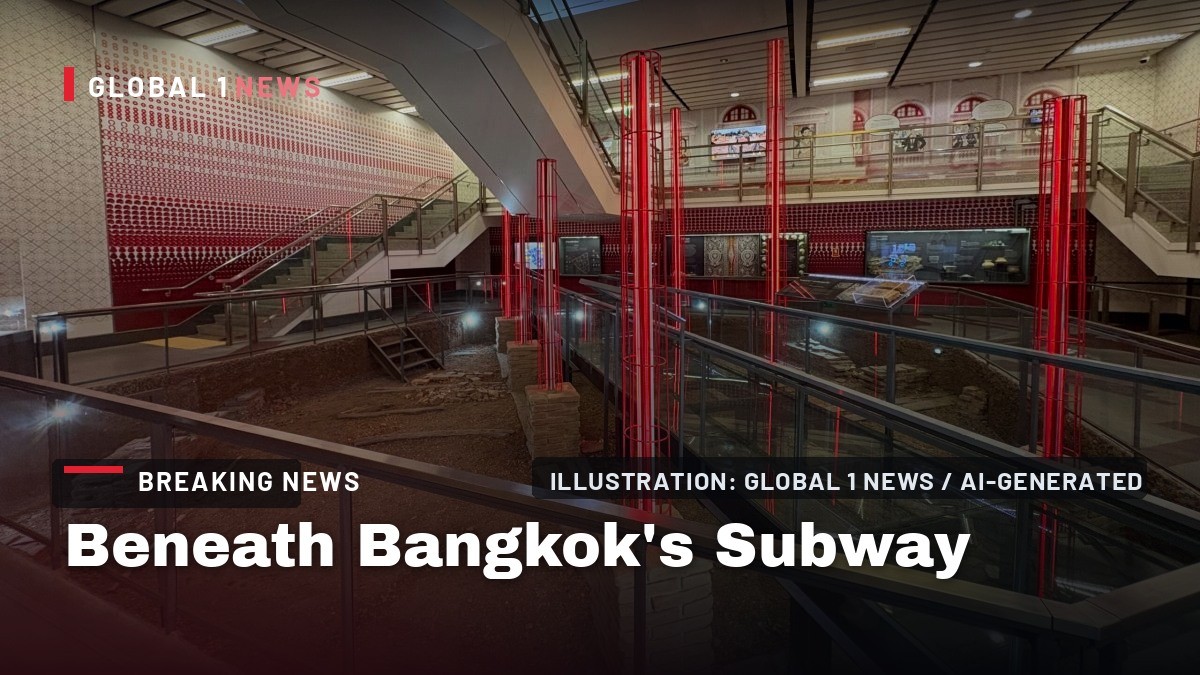
Beneath one of Bangkok's most ornate MRT stations lies evidence of a much older city — including the foundations of an ancient palace that had remained buried for generations. When workers broke ground for Sanam Chai Station on the Blue Line, they uncovered not just soil and rock, but fragments of a royal landscape that once defined this corner of Rattanakosin Island.
A Station Designed to Honor the Past
Sanam Chai MRT Station, which opened in July 2019, sits along Sanam Chai Road in the heart of Bangkok's historic Rattanakosin Island conservation area. The station is located near Wat Phra Chetuphon Wimon Mangkhalaram, better known to most as Wat Pho, and stands within walking distance of the Grand Palace complex. Its interior was designed by National Artist Pinyo Suwankhiri, who created an elaborate early Rattanakosin-style atmosphere meant to evoke a royal audience hall. Visitors stepping off the train are greeted by ornate ceilings, gilded details, and murals that transport them to an earlier era of Siamese craftsmanship.
But the station's most intriguing feature may not be visible at first glance. During excavation work for the station's retaining walls, workers uncovered a significant number of archaeological objects buried in the soil. What began as a routine construction project quickly became an archaeological investigation, revealing layers of Bangkok's history that had been hidden beneath the modern city.
Artifacts From a Forgotten Era
The discoveries included terracotta figurines, bowls, plates, and roof tiles dating to around the 18th–19th Buddhist centuries. Some of these objects bear Thai and Chinese inscriptions, reflecting the area's historical connections and the diverse communities that once traded and settled in this part of the city. The presence of Chinese inscriptions is particularly telling, as it points to the long-standing commercial and cultural ties between Siam and China that shaped Bangkok's early development.
Among the more unusual finds was a 14.5-centimeter metal gun engraved with the Latin phrase MEMENTO MORI, meaning "Remember you will die." The object is a striking reminder of the philosophical currents that reached Siam through European contact, and it resonates deeply with Buddhist teachings on impermanence. For Thai readers, the phrase echoes the Buddha's own emphasis on the transient nature of all things — a theme that runs through much of the nation's religious and cultural life.
Archaeologists also recovered metal coins dating from the reigns of King Rama IV and King Rama V, including one-satang coins featuring royal symbols such as the chakra and elephant. These small objects offer a tangible connection to the monarchy and the administrative changes that modernized Siam during the 19th century. The coins are not merely currency; they are documents of a kingdom in transition, navigating the pressures of colonialism while preserving its sovereignty.
The Ancient Palace Foundation
But the discovery that offered perhaps the greatest insight into the area's history was the remains of an ancient palace foundation. Excavators found foundation trenches and structural remains associated with the palace, providing physical evidence of how such buildings were constructed in the area. For archaeologists, these remains were more than fragments buried in the soil. They offered proof of Bangkok's earlier architectural landscape — a layer of the city that had disappeared beneath centuries of development and urban renewal.
The palace foundation raises intriguing questions about the layout of early Bangkok and the lives of those who inhabited this royal precinct. While the source material does not specify which palace once stood on this ground, its presence confirms that the area was not merely residential but held significant administrative and ceremonial importance. The construction techniques revealed in the foundation trenches also offer clues about the engineering knowledge and labor systems of the time.
Preserving What Was Found
The discoveries changed the station project itself. The Mass Rapid Transit Authority of Thailand and its contractor handed the archaeological objects to the Fine Arts Department and Museum Siam for preservation and further research into their origins. This collaboration between infrastructure developers and cultural institutions set an important precedent for how such discoveries should be handled in the future.
The station was also redesigned to incorporate a dedicated space for displaying archaeological discoveries. Today, Exit 1 features a permanent exhibition where visitors can learn about some of the objects and remains uncovered during construction. This means passengers do not have to visit a distant archaeological site to encounter this part of Bangkok's history. The evidence was found beneath the very ground on which the modern subway station now stands.
The decision to integrate the finds into the station's design reflects a growing awareness in Thailand that heritage conservation and modern development need not be in conflict. Instead, they can complement one another, creating public spaces that educate and inspire. For the thousands of commuters who pass through Sanam Chai Station daily, the exhibition offers a moment of reflection amid the rush of urban life.
A Meeting Point of Old and New
Sanam Chai is already surrounded by some of Bangkok's most important historical landmarks, including Wat Pho and the Grand Palace area. Its underground history adds another dimension to the neighborhood, transforming the station from a mere transit hub into a gateway to the past. The station represents a striking meeting point between modern infrastructure and archaeological heritage: trains move beneath one of Bangkok's oldest urban areas, while traces of an earlier royal landscape remain preserved for visitors above the platforms.
For anyone passing through Sanam Chai, the ornate station is therefore more than an architectural tribute to the early Rattanakosin era. It is also a reminder that Bangkok's history is layered beneath its streets — sometimes waiting to be discovered when the city digs down. The station's design, which was already intended to evoke the grandeur of a royal audience hall, now carries an additional layer of meaning. It is not merely a homage to the past; it is a repository of the past itself.
Why This Matters for Thailand and the Region
The discoveries at Sanam Chai Station carry significance that extends well beyond Bangkok. Across Southeast Asia, rapid urbanization is reshaping ancient cities, and the tension between development and preservation is a pressing concern. Thailand's handling of this discovery offers a model for how other nations in the region might approach similar situations. By pausing construction to document and preserve the finds, and by incorporating them into the final design, Thai authorities demonstrated that heritage conservation can be integrated into infrastructure projects rather than treated as an obstacle to them.
For Thai readers, the story also speaks to a deeper cultural truth. The Buddhist concept of impermanence — reflected in the MEMENTO MORI gun and in the very nature of archaeological discovery — reminds us that all things pass away. Yet the preservation of these objects offers a counterpoint: while nothing lasts forever, we can still honor what came before us. The artifacts unearthed at Sanam Chai are not merely relics of a dead past; they are living connections to the generations who built this city and shaped its identity.
The exhibition at Exit 1 also has implications for cultural tourism. Bangkok draws millions of visitors each year, many of whom come to see the Grand Palace and Wat Pho. The archaeological display at Sanam Chai Station adds a new dimension to the tourist experience, offering visitors a chance to see artifacts that would otherwise be locked away in museum storage. It also encourages visitors to explore the city's public transit system, connecting the historic core with other parts of Bangkok in a sustainable and accessible way.
Looking Beneath the Surface
The story of Sanam Chai Station is ultimately a story about looking beneath the surface — both literally and figuratively. When the Mass Rapid Transit Authority of Thailand began excavation work, no one expected to find the remnants of a royal palace. But the ground beneath Bangkok holds secrets that are still being uncovered, and each discovery adds to our understanding of the city's complex history.
For archaeologists, the finds at Sanam Chai are a reminder that even the most developed urban environments contain hidden layers of the past. For commuters and visitors, the station offers an opportunity to engage with history in a way that feels immediate and personal. And for the broader region, the project demonstrates that modernization and heritage conservation can coexist, enriching rather than diminishing our connection to the past.
As Bangkok continues to grow and evolve, the discoveries at Sanam Chai Station will remain a touchstone — a reminder that progress does not require forgetting. The ancient palace foundations, the terracotta figurines, the coins, and the gun with its sobering Latin inscription all speak to a city that has always been in flux, yet has never lost sight of its roots. For those who pass through the station today, the past is not a distant memory. It is right there beneath their feet, preserved and waiting to be seen.
By Ann Srisawat, Staff Writer
This article was produced with AI-assisted research and editorial support. Sources: Khaosod English
What's Your Reaction?
 Like
0
Like
0
 Dislike
0
Dislike
0
 Love
0
Love
0
 Funny
0
Funny
0
 Wow
0
Wow
0
 Sad
0
Sad
0
 Angry
0
Angry
0

Southeast Asia Correspondent at Global1.News. Based in Bangkok, covering Thai and Southeast Asian politics, economy, technology, and culture. Deep regional perspective on one of the world's most dynamic regions.












Comments (0)