
Burnham Steps Back from Assisted Dying Vote to Protect Free Vote
London, UK — Prime Minister Andy Burnham has announced he will abstain from the next House of Commons vote on the assisted dying Bill, telling Labour MPs in a letter that he does not want to "unduly influence the debate" in his role as head of government.
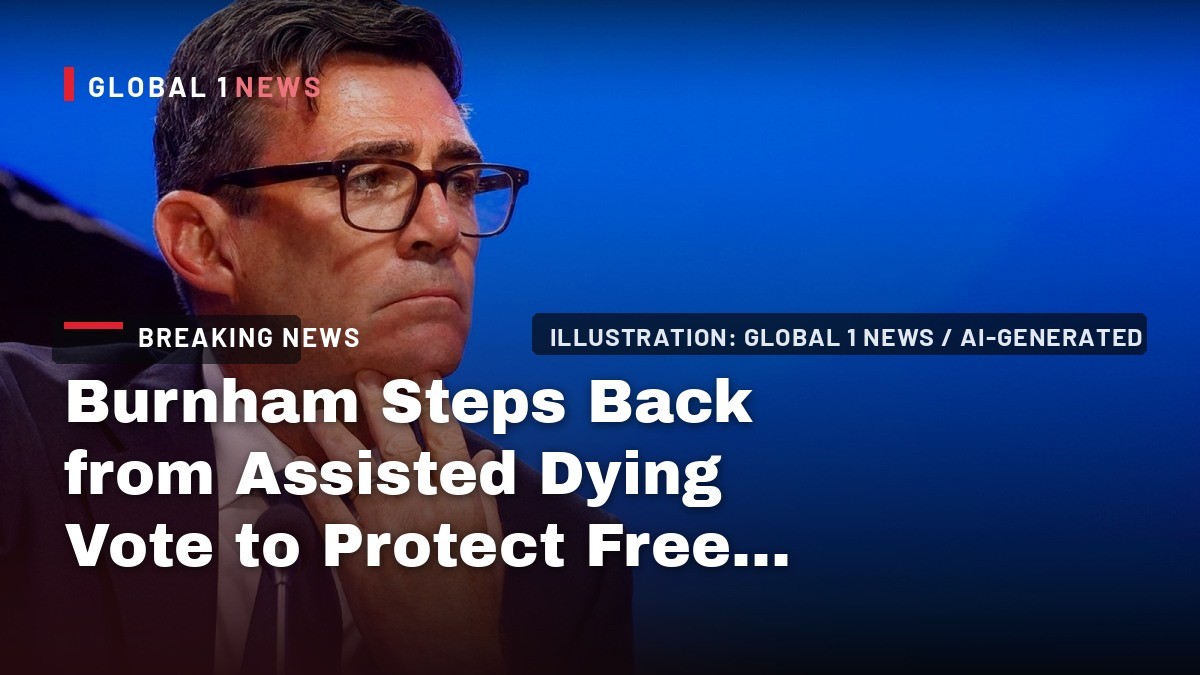
Burnham Steps Back from Assisted Dying Vote to Protect Free Vote
London, UK — Prime Minister Andy Burnham has announced he will abstain from the next House of Commons vote on the assisted dying Bill, telling Labour MPs in a letter that he does not want to "unduly influence the debate" in his role as head of government. The decision, confirmed in a letter to the Parliamentary Labour Party (PLP) this afternoon, marks the first time Mr Burnham has formally set out his position since entering Downing Street, and signals a deliberate attempt to distance the Government from a deeply personal moral question that cuts across party lines.
The Terminally Ill Adults (End of Life) Bill, which ran out of parliamentary time in the last session, is due back in the Commons for its second reading on 11 September. Mr Burnham, who is Catholic, wrote that while he holds personal views on the matter, his role as Prime Minister requires him to lead a Government that implements the will of Parliament, "whether that is to change the law or not". He added: "I also do not want to unduly influence the debate as Prime Minister and for every colleague to know it is a genuinely free vote."
A Deliberate Silence from Number 10
The Prime Minister's letter is being read in Westminster as a carefully calibrated attempt to reset the terms of a debate that has already consumed two parliamentary sessions. No 10 officials confirmed that Mr Burnham had no wish to affect the process in either direction, and in a separate letter to his ministers on Friday, he warned them against attempting to influence the outcome. The instruction is unambiguous: collective responsibility will be set aside under the longstanding conscience convention, frontbenchers are free to vote or abstain, and ministers should avoid becoming part of the public debate.
That directive extends to departmental implications. Ministers have been told they should not express views about the Bill's consequences for their own briefs, though they may restate previously stated positions when asked and correspond with constituents. The aim is to stop the machinery of government being seen as leaning on the legislative process.
Mr Burnham's own history on the issue is nuanced. As an MP in 2015, he abstained on a similar Bill, citing concerns over safeguards and the risk of people feeling under pressure. By 2024, however, he told the BBC he had undergone a change of heart, citing "family experience in the nine years since" and arguing that "we do allow people to suffer and families to suffer too much". He caveated that position by insisting hospices should be "properly funded and sorted out" before any new law was implemented. In July of this year, he told reporters that "something needs to happen first" — namely, the fixing of palliative and social care funding — before the wider debate could proceed.
What the Bill Proposes
The legislation, first introduced by Labour MP Kim Leadbeater in 2024 as a Private Member's Bill, would allow adults in England and Wales who are expected to die within six months to apply for an assisted death, subject to the approval of two doctors and an expert panel. The Bill sets out a four-year implementation period, meaning that if it were to become law next year, the changes would not be fully operational until 2031. Safeguards include a requirement that the person be over 18 and capable of making a voluntary, informed choice.
Opponents have argued that the Bill contains substantial flaws that risk vulnerable people being pressured into ending their lives early. The proposed law applies only to England and Wales; health policy in Scotland and Northern Ireland is devolved. The six-month prognosis requirement has been a particular focus of concern, with critics questioning the accuracy of such predictions and the potential for misdiagnosis. Supporters counter that the four-year implementation period provides ample time to address operational concerns.
A Parliamentary Marathon Nears Its End
The Bill's journey through Parliament has been nothing short of turbulent. It passed two votes in the House of Commons, but the second, held in 2025, saw the majority in favour narrow to just 23, down from a previous majority of 55. The legislation then moved to the House of Lords, where peers tabled approximately 1,200 amendments. In April, the Bill ran out of time to become law before Parliament was prorogued, effectively killing it in the upper chamber.
That collapse was a bitter blow to supporters, who had watched the Bill navigate the Commons with growing anxiety as the majority shrank. The sheer volume of Lords amendments — a record for a Private Member's Bill — was widely interpreted as a deliberate strategy by opponents to run down the clock.
Now, a near-identical version has been tabled by Lauren Edwards, the Labour MP for Rochester and Strood, who came second in May's ballot for Private Members' Bills. The second reading — the first opportunity MPs get to vote on the Bill's principles — is scheduled for 11 September. Ms Edwards has been explicit that her Bill mirrors the Leadbeater legislation, and she has sought to address the care funding objection head-on, arguing that improving social care and legalising assisted dying is "not a case of either/or" — the two "can and must go hand in hand".
Starmer's Shadow and the Free-Vote Convention
The contrast with Mr Burnham's predecessor could hardly be starker. Sir Keir Starmer, who led the Government until this year, voted for the Leadbeater Bill on its second and third readings, while otherwise maintaining a neutral stance on an issue seen as a matter of conscience where MPs were given a free vote. Sir Keir's endorsement provided political cover for those who might otherwise have feared constituency backlash.
Mr Burnham's abstention removes that cover. By stepping back entirely, he has signalled that this is a matter for the legislature, not the executive. His letter to the PLP is explicit: "There is no single right position and I have deep respect for MPs on all sides, and the expertise they bring to this debate." The Government, he wrote, "remains neutral on the question of assisted dying and on the passage of the bill".
That neutrality is constitutionally significant. The free-vote convention — whereby MPs are released from the whip on issues of conscience — has long applied to assisted dying, abortion and capital punishment. But a Prime Minister choosing to abstain entirely is a rarer act, and it carries its own message.
The Palliative Care Funding Battle
The Prime Minister's July remarks — that it is "very challenging" to introduce assisted dying before palliative and social care are improved — have become the central battleground for opponents of the Bill. Jess Asato, the Labour MP and prominent opponent, has warned that MPs have "a responsibility to consider the safety of introducing such a flawed bill into a broken and failing care system". Her argument is that legalising assisted dying without first fixing the funding of end-of-life care would create a two-tier system in which the vulnerable are pushed towards death not out of genuine choice, but because adequate care is unavailable.
Ms Edwards rejects that framing. The Bill's four-year implementation period, she argues, provides a legislative bridge: "if my current bill becomes law next year, we would have until 2031 to fix the status quo." She has pointed to Mr Burnham's own announced plans to reform the social care system, with the aim of creating a national care service and reaching political consensus on funding, as evidence that the two projects can proceed in parallel.
Wes Streeting, who served as Health Secretary before moving to the Defence brief, previously voiced worries about the Bill's impact on the NHS. His concerns centred on the potential for the legislation to place additional strain on an already overstretched service and the difficulty of ensuring consistent medical oversight across the country.
What Happens Next
The second reading on 11 September will be the first test of whether the Bill can command a majority in the new Parliament. The arithmetic is uncertain. The narrow 23-vote margin in the last session, combined with the change of leadership, means neither side can be confident of the outcome. Ms Edwards's Bill is procedurally identical to the Leadbeater version, and its sponsors will be hoping that the four-year implementation period — a direct response to the care funding objection — will persuade wavering MPs.
Opponents, meanwhile, will point to the 1,200 Lords amendments as evidence of the Bill's fundamental flaws, and to Mr Burnham's own stated reservations about the sequencing of reform. The Prime Minister's abstention does not resolve the debate; it merely removes the executive from the centre of it. The decision now rests with the 650 members of the House of Commons, who will cast their votes on a question that has divided families, constituencies and parties.
A Signal of Neutrality, or Something More?
Mr Burnham's decision to abstain is being interpreted in Westminster as an attempt to protect the Government's institutional neutrality while acknowledging the depth of feeling on all sides. But it also carries a subtle political calculus. By declining to vote, the Prime Minister avoids alienating either the supporters of assisted dying within his own party or the significant Catholic constituency that shares his faith.
Whether that position holds will depend on the outcome of the September vote. If the Bill passes, Mr Burnham will be expected to implement it faithfully, regardless of his personal views. If it fails, he will have avoided being on the losing side of a historic decision. Either way, his letter to the PLP has achieved its immediate objective: the debate, for now, belongs to Parliament.
By Erica Thornton, Staff Writer
This article was produced with AI-assisted research and editorial support. Sources: The Independent, BBC News, The Guardian.
What's Your Reaction?
 Like
0
Like
0
 Dislike
0
Dislike
0
 Love
0
Love
0
 Funny
0
Funny
0
 Wow
0
Wow
0
 Sad
0
Sad
0
 Angry
0
Angry
0

US Politics and Policy Correspondent at Global1.News. Based in Washington DC, covering American politics, policy, elections, and the courts. Knows how the system works and tells you what it actually means.












Comments (0)