
AI superpower ambitions take centre stage as Trump and Xi meet
When President Donald Trump and President Xi Jinping sit down this Thursday, the most consequential agenda item will be artificial intelligence, a technology that has become the fulcrum of strategic competition between the United States and China.
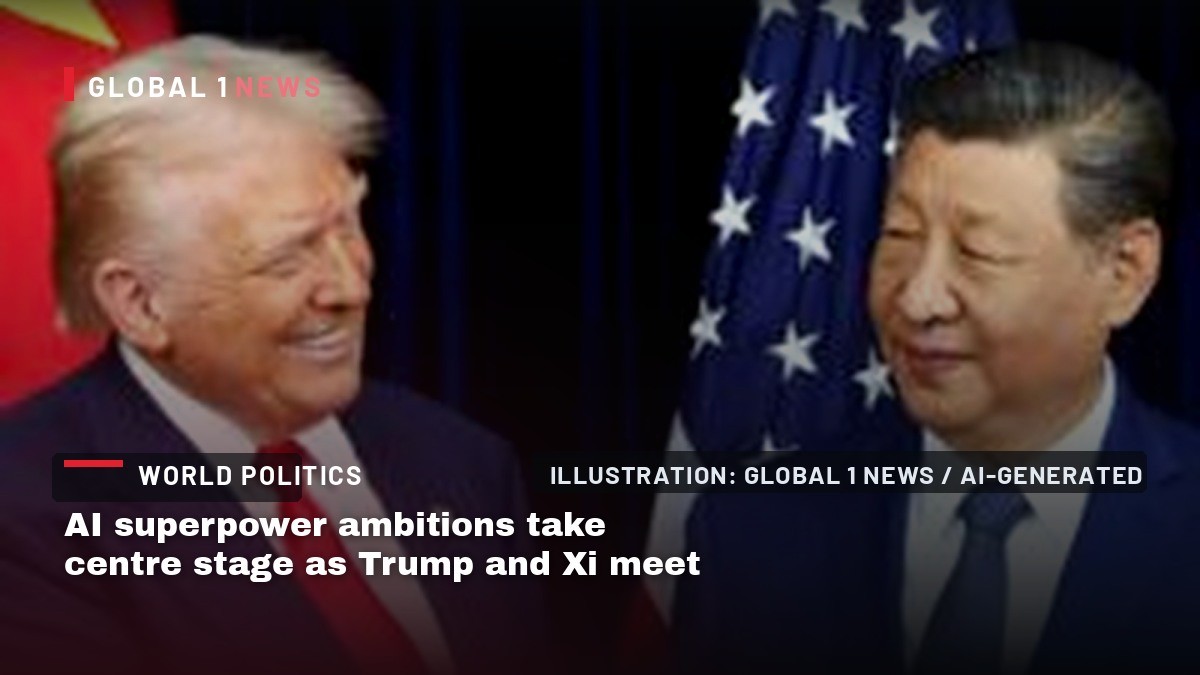
When President Donald Trump and President Xi Jinping sit down this Thursday, the most consequential agenda item will be artificial intelligence, a technology that has become the fulcrum of strategic competition between the United States and China. Both leaders view AI not merely as a commercial frontier but as a decisive lever of national power, and their positions reflect divergent doctrines of how to harness, regulate, and export the technology. The meeting therefore offers a window into the broader trajectory of the AI race, the underlying economic structures that sustain it, and the geopolitical stakes that extend far beyond the laboratory.
Strategic framing of AI as a national power multiplier
Both Washington and Beijing articulate AI as a “power maximiser,” a term echoed by Rebecca Arcesati of the Mercator Institute for China Studies, who noted that China sees the technology as central to its ambition to lead. In the United States, President Trump has framed AI supremacy as essential to national success, describing any cautionary narrative about AI risks as “a hoax” and emphasizing that the United States must stay ahead to secure its economic future. Xi, while less blunt in public, has similarly urged Chinese leaders to keep AI “under human control,” signalling a state‑level commitment to direct the technology’s development while managing its hazards.
The strategic framing matters because it dictates policy levers. In Washington, the emphasis on staying ahead translates into a hands‑off regulatory stance, with officials like Jayant Dave of Check Point Software Technologies asserting that the United States already has sufficient rules and that “the only guardrails AI needs are a high‑IQ president.” By contrast, Beijing’s approach is “relatively cautious and centrally‑coordinated,” deploying non‑binding guidelines on data usage and algorithms to shape the industry while preserving the flexibility to innovate. Both models aim to secure a competitive edge, but they diverge on the balance between control and market freedom.
Comparative performance of frontier and open‑weight models
On the technical front, American firms dominate the “frontier” segment of AI development. Companies such as Anthropic, Google, and OpenAI produce the highest‑performing systems on most benchmark tests, and as of March 2026, Anthropic’s top model led the pack by a margin of 2.7% according to Stanford University researchers. Chinese efforts have briefly closed the gap; a DeepSeek model in February 2025 “briefly matched the top US model,” showing that the gap can be narrowed, albeit temporarily.
China’s strategy, however, diverges from the United States by emphasizing “open‑weight” models—downloadable, modifiable AI that can be freely adapted. Moonshot AI’s Kimi K3 exemplifies this approach, offering performance close to frontier models while remaining open source. Analysts such as Lizzi Lee of the Asia Society Policy Institute argue that this openness could translate into “enormous economic and geopolitical leverage” by making capable AI cheap and ubiquitous across the Chinese economy, even if the models trail the United States by only a few months on benchmarks.
Economic underpinnings and investment dynamics
The United States’ lead in frontier AI is underpinned by massive private investment. Frontier labs are “burning through mountains of cash” to build the compute infrastructure required for training large models, and the AI sector now fuels a substantial share of stock‑market growth and broader economic expansion. This financial firepower enables American firms to maintain a lead in raw model performance despite external constraints.
China, meanwhile, compensates for limited access to advanced American microchips through several advantages. The Chinese government’s restrictions on U.S. chip sales have forced domestic developers to innovate with alternative hardware and to employ techniques such as model distillation, which compresses knowledge from larger models into smaller, more efficient ones. Moreover, China’s lower electricity costs, highlighted by Arcesati, provide a cost advantage for the energy‑intensive training processes, allowing Chinese AI firms to sustain rapid model turnover despite chip shortages.
Industrial deployment and the robotics advantage
Beyond pure model development, China has leveraged AI to dominate related hardware sectors, most notably robotics. The International Federation of Robotics estimates that China houses more than two million robots in its factories, making it the world’s largest robot manufacturer. Chatham House further notes that China accounts for over nine‑tenths of global humanoid robot shipments in the first half of the year. This manufacturing base not only supplies domestic AI‑driven automation but also positions China as a key exporter of advanced robotics, reinforcing its strategic depth in AI‑enabled production.
The synergy between AI software and robotics hardware amplifies China’s capacity to embed AI across its industrial landscape. By integrating open‑weight models into manufacturing processes, Chinese firms can rapidly customize AI solutions for specific production lines, creating a feedback loop that accelerates both AI refinement and industrial efficiency.
Regulatory philosophies and safety considerations
Safety and governance form a divergent axis in the U.S.–China AI rivalry. In the United States, the prevailing narrative among industry leaders and officials is that existing regulations are adequate, and that over‑regulation could stifle the “growth of something that will be bigger than the industrial revolution.” Trump’s confidence in the adequacy of U.S. rules reflects a broader belief that market forces, coupled with limited oversight, will sustain the nation’s lead.
China, while also pursuing rapid development, has instituted a set of centrally‑coordinated guidelines on data usage and algorithmic transparency. Although these guidelines are not legally binding, they establish expectations for developers and signal a state‑level intent to pre‑empt misuse. Chinese researchers appear more concerned with the potential for AI to be weaponised in cyber conflict than with existential risk, a focus that aligns with Beijing’s broader security priorities.
International narratives and diplomatic posturing
The diplomatic dimension of the AI race is evident in the language used by both foreign ministries. China’s foreign ministry warned that “narratives of threat” and confrontation “hinder global AI governance,” calling for cooperation to ensure AI benefits all. This plea for multilateralism contrasts with the United States’ more unilateral emphasis on maintaining a lead, as expressed by Trump’s assertion that the U.S. is “leading now over China by a lot” and will “keep it that way.”
These competing narratives shape how each country seeks to influence global standards. The United States, through its market dominance, can export its proprietary models and set de‑facto standards in AI deployment. China, leveraging its open‑weight ecosystem and manufacturing capacity, can promote a model of accessible AI that appeals to developing economies seeking cost‑effective solutions. The diplomatic tug‑of‑war over AI governance will likely intensify as both powers vie to embed their preferred norms in international forums.
Strategic implications for the global order
The outcome of the Trump‑Xi AI talks will reverberate across the international system. If the United States continues to prioritise frontier model supremacy while eschewing tighter regulation, it may cement a technological edge that translates into economic and military advantages, especially in sectors where raw model performance is critical, such as advanced analytics, autonomous weapons, and high‑frequency trading.
Conversely, China’s emphasis on open, cheap, and widely deployable AI could reshape global supply chains, especially in emerging markets that lack the capital to purchase proprietary U.S. services. By coupling open‑weight models with its dominant robotics industry, Beijing could export a complete AI‑enabled production ecosystem, thereby extending its influence in the Global South and creating a parallel technological bloc.
Both trajectories carry risks. An unchecked frontier race may accelerate the pursuit of artificial general intelligence, raising existential concerns that remain inadequately addressed in either jurisdiction. Meanwhile, the diffusion of open‑weight AI, while democratizing access, could also lower barriers for malicious actors to weaponise the technology, especially given China’s focus on cyber‑war potential. The strategic calculus for both nations, therefore, hinges on balancing the drive for dominance with the imperative to manage global stability.
This article was produced with AI-assisted research and editorial support. Reporting is based on the source material cited below. Sources: BBC News China; bbc.co.uk; Global1.News (24 September 2026).
By Prof. Marcus Chen, Staff Writer
What's Your Reaction?
 Like
0
Like
0
 Dislike
0
Dislike
0
 Love
0
Love
0
 Funny
0
Funny
0
 Wow
0
Wow
0
 Sad
0
Sad
0
 Angry
0
Angry
0
World Politics Analyst at Global1.News. Based in Beijing, covering US-China relations, global trade, and geopolitical strategy. Brings deep analytical perspective to the power dynamics shaping international affairs.















Comments (0)