
AI Data Centers Lose 12% of Every Electron — and Pay for It Twice
Every data center loses roughly 12% of the electricity it buys across four power conversions, then pays again to cool the heat. Onsemi says the power chip shortage is already here — hidden by the memory panic.
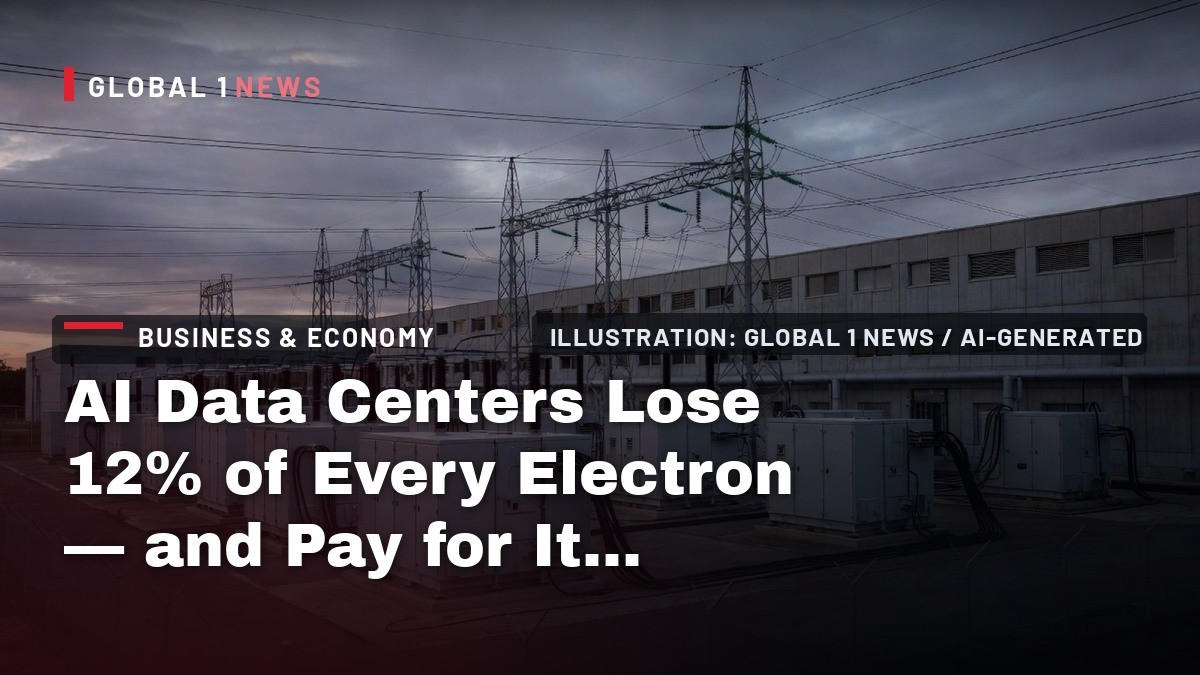
AI Data Centers Lose 12% of Every Electron — and Pay for It Twice
I have been buying electricity for servers for over a decade, and until this week I had never worked out how much of it never does any work. In a typical data centre, power from the grid gets converted at least four times between the property line and the processor — stepped down from medium voltage, rectified to DC, stepped down again, then regulated into the sub-one-volt range the silicon actually wants. At every handoff, a slice of what you paid for becomes heat instead of compute. Onsemi's power solutions president, Simon Keeton, puts the total at about 12%.
Then you pay for it a second time, because heat has to be removed and cooling can consume up to half of a facility's total draw. As Keeton frames it, hyperscalers "get double penalized for these losses." They pay for the electricity that turns into heat, then pay again to get rid of the heat. Twelve percent of a 40-megawatt hall is 4.8 megawatts. Twelve percent of a gigawatt is 120 megawatts.
With the industry on track to consume close to a thousand terawatt-hours inside two years, that is the largest untracked line item in this entire buildout. Here is what made me put the coffee down this week: the company that makes the chips doing those conversions just said out loud that the shortage is already here, and nobody can see it.
Onsemi Just Said Out Loud What Nobody Wanted to Say
Hassane El-Khoury runs Onsemi, a $28 billion power-chip company whose most advanced fab sits in East Fishkill, New York. On Friday, Semafor published an interview where he made two arguments the industry will have to deal with whether it likes them or not.
The first is that blanket data centre bans are the wrong tool. New York's statewide moratorium, the first in the country, is "short-sighted," he said. But he did not defend the industry either. Instead of fighting the pushback, he wants mandatory energy transparency — Onsemi is talking to federal and state lawmakers, starting in Arizona, about a standard for reporting how much raw energy a facility consumes and how efficiently it uses that power.
His example should make every operator sit up. When a hyperscaler announces a "one-gigawatt facility," that number describes only how much electricity the campus is designed to pull off the grid. It says nothing about how much compute that gigawatt produces. His proposed replacement: compute generated per unit of power drawn. When the metric changes, the economics change with it.
The second thing he said is the part everybody skipped. There is already a shortage of power chips; it is invisible only because the market is staring at memory and compute. Demand for power chips is "masked" by the HBM and GPU shortages, he says, and once those clear the industry will "wake up" to find that power is "going to end up hitting the wall." His summary line: "Everything needs more and more power."
Check that against his own numbers. On Onsemi's August 3 second-quarter call, revenue came in at $1.6035 billion, up 9% year over year, with non-GAAP earnings per share of $0.74 — roughly a 40% jump. AI data centre was the fastest-growing piece of the business, and management expects that revenue to more than double this year. They also told analysts supply is tightening, lead times are extending, and some customers are already ordering for delivery into 2028. Power conversion gear sold out into 2028, in a market where every other vendor points the bottleneck somewhere else.
Citi Tripled Its Forecast — and Agentic AI Is the Reason
If you want to know why the power layer is about to get crushed, look at what the demand models did this month. Citi more than tripled its 2031 data centre projection to 370 gigawatts of global IT load, up from a prior estimate of 100 gigawatts by 2030, with China inside the model for the first time. The compound growth rate went from 17% to 25%.
What changed is agentic workloads. Citi's analysts figure an autonomous AI agent burns 20 to 30 times more compute per user than a traditional generative AI query. That is the difference between asking a model a question and asking it to go do a job: plan, call tools, check its own work, try again. Those loops run hot and they run long. Citi now projects agentic CPUs growing at a 185% compound annual rate to $59.4 billion by 2030 — roughly 45% of the entire server CPU market.
The same report raised its per-gigawatt data centre capex assumption for 2026 and 2027 by about 30%, and put global AI industry revenue at $3.3 trillion through 2030 against $8.9 trillion of capex. It also flagged something for anyone doing site selection: projects already approved with allocated energy "could become more valuable." That is banker-speak for a two-tier market where the permit and the megawatt are worth more than the building.
The Real Bottleneck Is That Nobody Is Measuring Output
Here is the secondary bottleneck nobody is talking about, and it is why the first one keeps getting worse: the entire industry reports inputs. Megawatts. Capital. Square footage. Gigawatts of "IT load" describing how much the building can eat. Citi measures the market in gigawatts, the moratorium fights are about gigawatts, the press releases brag on gigawatts. Nowhere in the standard reporting is there a single number for what any of it produces per unit of power. When you do not measure output, you cannot price efficiency, so the market rewards whoever consumes the most electricity — and a community has no way to tell a well-built hall from a sloppy one, because the only number on offer is identical in both cases.
Compare that with the specs that already exist inside the building. The Open Rack V3 standard hyperscalers require calls for 97.5% peak efficiency in a power supply unit. Older kit in existing halls is nowhere near that, and across tens of thousands of servers the gap between the nameplate and the delivery is exactly where the 12% lives.
The Volatility Bill Arrived First — Ashburn Lost 3 Gigawatts in Seconds
While everyone argues about generation, the failures are happening inside the fence. On July 22 this year, a transmission line fault in Ashburn, Virginia — the largest data centre cluster on earth — knocked more than 3 gigawatts of load off the grid in seconds. Two years earlier, a single failed surge arrester dropped roughly 60 Virginia facilities and 1,500 megawatts at once. An AI campus can swing 70% of its load in milliseconds during a training run, then trip itself offline at the first sign of trouble upstream to protect billions in compute. Each behaviour is rational alone. Together, at gigawatt scale, they are a problem the grid has never solved.
Bloomberg reported in August that this volatility is physically damaging the plants themselves — load spikes running as much as 50% above design capacity, wearing out batteries, generators and cooling systems years ahead of schedule. That is a repair bill, a reliability bill, and in the eyes of lenders already nervous about depreciation, a valuation bill. Meanwhile legacy UPS units spend most of their lives in bypass, letting the grid feed the racks directly, because the converters waste enough power that operators run them in eco-mode. So when the grid hiccups, nothing is filtering in either direction.
What This Actually Means for Independent Hosting Providers
First — go find your 12%. Get a real efficiency number for your power train: PSU efficiency at your actual load, UPS mode, transformer loading, true PUE, and how much of the heat load is conversion rather than compute. You cannot fix a loss you have never audited, and most operators have never measured their conversion stack end to end.
Second — benchmark retrofits against new capacity, not last month's bill. New build costs are running into the tens of millions per megawatt. Replacing power supplies and tightening the conversion chain is a fraction of that, and it pays back twice: less electricity lost, less heat to remove.
Third — publish compute per watt before a regulator makes you. Onsemi is lobbying for exactly that standard, starting in Arizona. With twelve months of your own numbers showing tokens per kilowatt-hour, you walk into that fight with a receipt. Without them, you are the person asking a county board to trust you.
Fourth — take the flexible connection the giants will not. Interconnection queues run a median of five years from request to commercial operation, and insurers project 50 to 60% of data centre projects will miss their one-to-two-year timelines. A utility will happily hand you a provisional or interruptible connection, because you can be curtailed and a 1-gigawatt anchor tenant cannot.
Fifth — buy converter gear early and qualify two sources. Onsemi says orders are already going into 2028. Citi's Asia team projects the 800-volt DC transition going from 16% of new capacity additions in 2027 to 79% by 2030, with low-voltage transformer demand dropping from roughly 55,000 MVA in 2027 to 30,000 MVA by 2030 while solid-state transformer demand goes from near zero to over 37,000 MVA. That is a supply chain being rebuilt underneath you.
The Counter-Argument — "Of Course the Power Chip Guy Says Buy Power Chips"
Fair point. A power semiconductor CEO arguing the world needs more power semiconductors is not a neutral witness. Gartner named Infineon the company to beat in this market back in May, and Infineon is targeting €2.5 billion in AI revenue for fiscal 2027. Everybody in this lane has a number with a dollar sign in front of it.
But motivation does not change physics. The four conversions are real, the 12% is real, the double penalty is real, and it is arithmetic governments do too. Lawrence Berkeley National Laboratory has data centres reaching nearly 12% of US electricity by 2030 — about six times their pre-AI share in 2018. One percentage point of efficiency across a thousand terawatt-hours is 10 terawatt-hours a year, roughly the electricity needed to run a million homes. That is the kind of figure that ends up in a rate case.
The Bottom Line
This buildout has spent two years arguing about chips, power plants and land. The layer in between — the conversions, the switchgear, the gear that turns 13.8 kilovolts into one volt — is where the next fight is, and it is already sold out into 2028 while everybody stares at memory prices.
Twelve percent is not a rounding error. It is the thing your competitor has not measured yet, the thing a county commissioner is going to ask you about, and the thing that decides whether the next hall you build is profitable at these electricity prices. Measure it, fix what you can, and publish the number. The operators who can prove what their power actually produces will be the ones still standing when the metric changes.
— Allan Ali, Founder
This article was produced with AI-assisted research and editorial support. Sources: Semafor ("Chipmaker says data centers should report energy waste," September 11, 2026), onsemi (Q2 2026 results and earnings call, August 3, 2026; power solutions and EliteSiC/T10 PowerTrench data centre briefings), Reuters ("Onsemi aims to improve AI power efficiency with silicon carbide chips"), Citi Research data centre and power outlook (September 2026), Bloomberg ("Data Centers Are Being Damaged by AI's Volatile Power Demand," August 6, 2026), MIT Technology Review ("Powering AI is an architecture problem," September 10, 2026), Fortune ("AI wants electricity now. The electric grid needs years to catch up," September 3, 2026), Gartner via Semiconductor Today, IDTechEx, DIGITIMES, Power Electronics News, Lawrence Berkeley National Laboratory, International Energy Agency.
What's Your Reaction?
 Like
0
Like
0
 Dislike
0
Dislike
0
 Love
0
Love
0
 Funny
0
Funny
0
 Wow
0
Wow
0
 Sad
0
Sad
0
 Angry
0
Angry
0

Publisher of Global1.News. Automation architect, systems builder, and the guy making sure the truth gets published.














Comments (0)