
AFP Reveals Chinese Warship Tracking, Warns of Synchronized Pressure Campaign
The Armed Forces of the Philippines has gone public with what it calls a coordinated maritime pressure campaign by Beijing, revealing weeks of covert tracking of a Chinese naval formation near the country's eastern seaboard and confirming a near-miss aerial interception that put Philippine aircraft in a Chinese fighter's crosshairs.
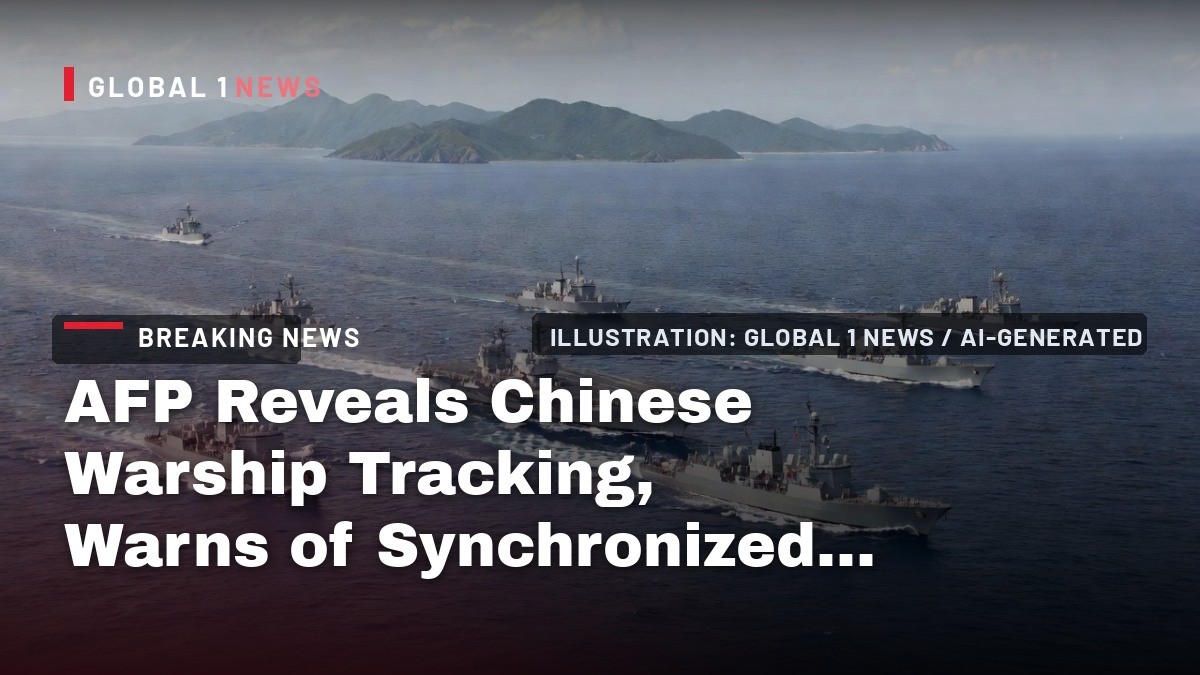
The Armed Forces of the Philippines has gone public with what it calls a coordinated maritime pressure campaign by Beijing, revealing weeks of covert tracking of a Chinese naval formation near the country's eastern seaboard and confirming a near-miss aerial interception that put Philippine aircraft in a Chinese fighter's crosshairs. The disclosures, made Tuesday, paint a picture of synchronized gray-zone pressure stretching from the northern approaches of Batanes to the contested shoals of the South China Sea.
AFP reveals Chinese warship tracking, warns of synchronized pressure campaign
Manila, Philippines – September 8, 2026 — The Armed Forces of the Philippines on Tuesday disclosed that it had monitored a Chinese surface action group of four warships and one replenishment vessel off the island of Samar for nearly three weeks, while simultaneously warning that Beijing is running a synchronized campaign of "malign influence" across multiple fronts in the country's maritime domain. The revelations come as the military confirmed a Sept. 2 incident in which a Chinese fighter jet locked its weapons crosshairs onto Philippine patrol aircraft over Scarborough Shoal, known locally as Bajo de Masinloc.
In a briefing Tuesday, AFP West Philippine Sea spokesperson Rear Adm. Roy Vincent Trinidad detailed the naval tracking operation and framed it as part of a broader pattern of pressure that Manila says is designed to weaken public confidence in the government's ability to protect its sovereignty. The military's statements mark one of the most comprehensive public assessments to date of what it describes as a multi-pronged challenge to Philippine claims in the region.
Chinese surface action group tracked off Samar for weeks
Trinidad told reporters that the AFP monitored a Chinese surface action group in the northeastern part of the country from mid-August until the early days of September. The formation, consisting of four warships and one replenishment vessel, conducted what he described as "a series of surface activities" before eventually reaching the eastern side of Samar, where it was tracked approximately 45 nautical miles from the shoreline.
"We monitored the presence of a surface action group northeastern part of the country from the middle part of August until the early days of September," Trinidad said. "Four warships and one replenishment ship conducted a series of surface activities." The admiral was careful to note that the route itself is not unusual, acknowledging that it is a normal shipping lane for commercial and military traffic alike.
"This is a normal shipping route of ships, not only warships coming from the northern part of the Philippines, specifically mainland China, Japan, South Korea that would like to traverse to Indonesia or Australia," Trinidad explained. He added that historically, the People's Liberation Army Navy has sent ships on exercises following that route down to Indonesian waters and back up through Philippine maritime choke points.
Choke points under closer scrutiny
The AFP's interest in the formation sharpened as it approached what Trinidad identified as critical maritime passages: the Sibutu Passage, the Verde Island Passage just south of Batangas, the Balabac Passage south of Palawan, and the Busuanga Passage north of Palawan. These narrow channels are vital arteries for regional shipping and are considered strategic chokepoints where naval movements warrant heightened attention.
"When they come to these choke points of the Philippines, we keep a closer monitoring on them," Trinidad said. He emphasized that the Chinese vessels remained in international waters throughout their transit, stating, "Yes, innocent passage or freedom of navigation. They were quite far from our shorelines when they passed the eastern seaboard." The warships were tracked at distances ranging from 70 to 120 nautical miles from the Philippine shoreline during most of their passage.
The disclosure of the tracking operation serves as a reminder that while public attention has focused on flashpoints in the South China Sea, China's naval presence also extends to the Philippines' Pacific-facing eastern seaboard, a corridor that connects the industrial powerhouses of Northeast Asia to the resource-rich markets of Australia and Indonesia.
'Synchronized, persistent efforts' of malign influence
Beyond the naval movements, Trinidad delivered a stark warning about what he described as a coordinated information and influence campaign targeting Philippine territorial integrity. He cited a reported claim by Chinese academics that the northern province of Batanes belongs to China as part of a broader narrative strategy linked to disputes over Bajo de Masinloc and Ayungin Shoal.
"The Batanes claim is synchronized with malign influence narratives," Trinidad said. "Let us not look at this as isolated incidents. These are all synchronized, persistent efforts." The retired admiral described the military's observation of "synchronized, persistent efforts of foreign malign influence" designed to weaken public confidence in government protection of sovereignty.
"Foreign malign influence is designed to shape public perception by controlling the narrative. These narratives may be messages or actions in themselves, because actions are also messages," Trinidad said. He argued that the goal of such campaigns is to "sow confusion, to dilute the stand of government, to show to the public that government has failed to protect the integrity of the territory and our claims."
The AFP's framing of the Batanes academic claim as part of a coordinated effort rather than an isolated statement reflects a growing concern in Manila that Beijing is employing narrative warfare alongside naval and coast guard operations to advance its maritime claims without triggering a conventional military response.
Sept. 2 interception over Scarborough: Crosshairs on Philippine aircraft
Trinidad also confirmed details of a Sept. 2 incident in which Chinese fighter aircraft intercepted Philippine government planes conducting maritime patrols over Bajo de Masinloc. In one instance, he said, "the crosshairs of the fighter aircraft had our aircraft on it" — a disclosure that underscores the dangerous proximity of the encounter.
The incident was publicized by Chinese state media, which released footage showing at least three JL-10 advanced trainer jets armed with live PL-5 short-range air-to-air missiles conducting what the PLA Southern Theater Command described as a readiness patrol around the shoal. The video showed the Chinese aircraft locking radar systems onto three Philippine aircraft: a BN-2A Islander, a C-208 turboprop, and a PA-31T twin-engine turboprop.
The Sept. 2 encounter came after the Philippines used the same types of light aircraft in an aerial patrol over Bajo de Masinloc on Aug. 21, according to The Manila Times. Trinidad said the Chinese actions were intended to demonstrate control and weaken Philippine resolve, but instead had the opposite effect. "Rather than weaken our resolve, such actions like this will only further strengthen it," he said. "Our resolve to keep performing our mandate has never been stronger."
The use of live-missile-armed aircraft in an interception of unarmed patrol planes represents a potentially significant escalation in the increasingly frequent air confrontations over the disputed feature, which China has controlled access to since 2012.
Drilling-capable research vessel spent 25 days in Philippine waters
Adding to the multi-front picture, the Philippine Coast Guard has revealed that a Chinese research vessel capable of drilling into the seabed spent 25 days meandering inside the Philippine exclusive economic zone, including the territorial sea of Scarborough Shoal, without a permit. The PCG identified the vessel as the 76-meter Haiyang Dizhi Shihao, operated by the Guangzhou Marine Geological Survey under China's Ministry of Natural Resources.
PCG spokesperson Rear Adm. Jay Tarriela said the ship entered the Philippine EEZ near midnight on Aug. 10, according to satellite tracking, and spent three weeks inside the 12-nautical-mile territorial sea of Scarborough Shoal. "She is not an ordinary research ship," Tarriela said, noting its drilling capabilities. The Department of Foreign Affairs confirmed it issued no permit for scientific research, Tarriela added.
Under the United Nations Convention on the Law of the Sea, foreign marine scientific research inside another state's EEZ requires the coastal state's consent. The 2016 arbitral ruling in Manila's favor struck down China's nine-dash line claim and found that Beijing had violated Philippine sovereign rights in its EEZ. The tribunal also held that Scarborough Shoal is a rock generating only a 12-nautical-mile territorial sea. China rejects the ruling and does not recognize the tribunal's jurisdiction.
The research vessel's extended presence follows a series of incidents at the shoal, including an episode in late May when Chinese vessels towed a 30-square-meter floating platform into the area, prompting a formal protest from the DFA. The platform was dismantled in mid-June. In September 2025, China declared a "national nature reserve" at the shoal, drawing another formal protest from Manila. Most recently, on Aug. 4, 2026, the DFA rejected new Chinese issuances tightening patrols around Scarborough Shoal and demanded their withdrawal.
Context: More than a decade of tension at Scarborough and Ayungin
Bajo de Masinloc, located 124 nautical miles off Masinloc, Zambales, sits within the Philippines' 200-nautical-mile EEZ. China has controlled access to the shoal since a 2012 standoff, and Beijing maintains it holds sovereignty over the feature. The Philippines rejects that claim and continues to conduct maritime and aerial activities in the area, leading to recurring confrontations.
Further southwest, at Ayungin Shoal, the Philippines maintains a permanent presence through the BRP Sierra Madre, a deliberately grounded naval vessel that serves as an outpost. Under a provisional arrangement with China on resupply missions to the shoal, Foreign Affairs Secretary Maria Theresa Lazaro said confrontations have grown fewer. Speaking at a Sept. 3 budget hearing, Lazaro emphasized the arrangement's limits: "One of the important provisions is not to prejudice the positions that we have had. That means UNCLOS and the 2016 Arbitral Award."
"This is a provisional arrangement only in this particular shoal," Lazaro said, "because this is with particular reference only to the Sierra Madre ship." The DFA reported that 16 rotation and resupply missions have been implemented without incident over the past two years under the arrangement. The 2016 Permanent Court of Arbitration ruling in The Hague favored the Philippines, finding that Beijing's historic-rights claims over areas within the Philippine EEZ had "no legal basis." China has refused to recognize the ruling.
Why the choke points and sea lanes matter to the world
The strategic significance of the areas where the AFP tracked the Chinese naval group extends far beyond Philippine territorial concerns. Beijing claims almost the entire South China Sea, a body of water that serves as a conduit for more than $3 trillion in annual shipborne commerce, including areas also claimed by the Philippines, Vietnam, Indonesia, Malaysia, and Brunei.
The Philippine maritime choke points that the Chinese warships transited — Verde Island Passage, Balabac Passage, and Sibutu Passage — are critical not only for regional trade but for global supply chains. Any disruption to these lanes would have immediate consequences for shipping between the Pacific and Indian Oceans, affecting energy supplies, manufactured goods, and raw materials moving between Asia's largest economies and the rest of the world.
The AFP's decision to publicly disclose its tracking of the Chinese formation appears designed to demonstrate both vigilance and transparency, signaling to domestic audiences and international partners alike that Manila is monitoring Chinese activities even in areas far from the more publicized South China Sea flashpoints. The military's framing of the naval transit, the research vessel's presence, and the aerial interception as components of a single synchronized campaign represents an analytical shift that could shape how the Philippines responds to future incidents.
What comes next: Escalation warnings and Manila's balancing act
Trinidad offered a sobering assessment of the trajectory, warning that such activities "will continue to escalate until 2028." He emphasized the importance of persistent pushback against Chinese narratives: "What is important is there is a persistent pushback from the Philippine side for every false narrative, for every malign influence that we notice. Without any pushback, this will slowly gain traction and it will help them shape the narrative."
The Philippines is not responding alone. Trinidad said Manila would continue working with its treaty ally the United States and like-minded countries such as Japan and Australia to support international law in the region. This multilateral approach reflects a deliberate strategy of building what Manila calls a network of partners to counterbalance Chinese pressure without seeking direct military confrontation.
At the same time, the DFA's provisional arrangement on Ayungin resupply missions demonstrates Manila's willingness to manage specific flashpoints pragmatically, even as it maintains its legal positions under UNCLOS and the 2016 arbitral award. DFA Assistant Secretary Robespierre Bolivar, speaking at the same budget hearing, addressed the challenge of correcting false information that China spreads about the disputes, underscoring the information-warfare dimension of the standoff.
The balance Manila is trying to strike is delicate: maintaining a robust defense of its maritime claims and international legal positions while avoiding escalation that could spiral into a broader conflict. With the AFP warning that Chinese pressure will continue to mount through 2028, and with Beijing showing no signs of softening its claims, the coming years are likely to test that balance repeatedly. The gray-zone tactics on display — naval transits, research vessels, aerial interceptions, and narrative campaigns — are designed to operate below the threshold of armed conflict, but each carries the risk of miscalculation that could draw the region's major powers into a confrontation no one says they want.
By Jessica Ali, Staff Writer
This article was produced with AI-assisted research and editorial support. Sources: GMA News, Manila Bulletin, The Manila Times, Philstar.com, Reuters, AP.
What's Your Reaction?
 Like
0
Like
0
 Dislike
0
Dislike
0
 Love
0
Love
0
 Funny
0
Funny
0
 Wow
0
Wow
0
 Sad
0
Sad
0
 Angry
0
Angry
0

Editor-in-Chief at Global1.News. Atlanta-based journalist who cuts through the BS and tells it like it is. Lead anchor, host, and the voice you hear when the spin stops and the truth starts.














Comments (0)