
Anak Krakatau Eruption Grounds Nearly 3,000 Flights as Indonesia Reopens Airports
Anak Krakatau's weekend eruption grounded nearly 3,000 flights and stranded about 341,000 passengers across Indonesia. Jakarta's main airport reopened Tuesday after ash cleanup, but officials warn further eruptions remain likely as schedules slowly recover.
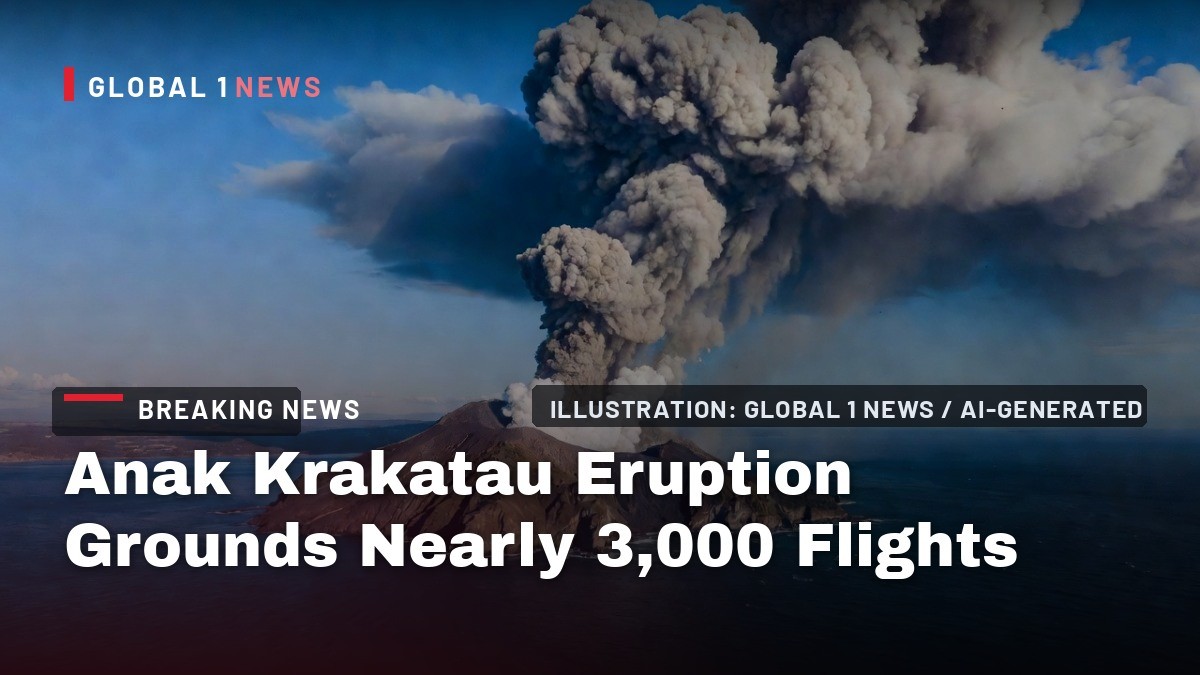
When a volcano erupts with the force of Anak Krakatau, the disruption is not confined to its immediate slopes—it ripples across global air travel, stranding hundreds of thousands of passengers and testing the resilience of one of the world's busiest aviation hubs. Indonesia's weekend of volcanic fury has closed eight airports, grounded nearly 3,000 flights, and forced authorities into a high-stakes race to clear ash and certify aircraft safe for takeoff.
Anak Krakatau Eruption Grounds Nearly 3,000 Flights as Indonesia Reopens Airports
Jakarta, Indonesia — The "child of Krakatoa" roared back to life over the weekend, sending ash plumes up to 15,000 meters into the sky and paralyzing air travel across Java and Sumatra. As of Tuesday morning, the main international gateway has resumed operations, but officials warn that the volcanic crisis is far from over, with the probability of further eruptions remaining high.
A Weekend of Fire on the Sunda Strait
The eruption sequence began late Friday, September 4, 2026, after Indonesia's Geological Agency recorded rising seismic activity from the morning of that day. At approximately 11:07 p.m. local time, Anak Krakatau erupted with "lava fountains," according to agency officials, with seismographs recording an eruption earthquake amplitude of 70 millimeters. The volcano, situated in the Sunda Strait between Java and Sumatra roughly 150 kilometers (90 miles) west of Jakarta, remained seismically active throughout the weekend.
The strongest single explosion came in the early hours of Sunday, September 6, lasting approximately 30 seconds. Officials described it as the most intense burst of unrest since activity first escalated in July 2026. Lana Saria, head of Indonesia's Geological Agency, confirmed that the volcano erupted at least three times on Tuesday morning, September 8, alone, underscoring the ongoing volatility of the system.
Alert Level III and Exclusion Zones
Indonesia's alert status for Anak Krakatau remains at Level III, known locally as "Siaga," the second-highest on the nation's four-tier volcanic warning scale. This alert level has been in place since activity was first raised in July 2026, reflecting months of sustained unrest beneath the island volcano.
Authorities have established a 3-kilometer exclusion zone around the crater, and ships are barred from a 3-kilometer zone in the Sunda Strait. Despite the intensity of the eruption, officials confirmed that no tsunami warning has been linked to the current activity—a critical distinction given the volcano's deadly history. No casualties have been reported, and no evacuation orders have been issued, as the nearest settlement sits more than 10 miles from the crater.
Ash Over Jakarta and Beyond
The meteorological agency BMKG tracked ash reaching approximately 6,000 meters on the Java side of the strait and up to roughly 15,000 meters on the Sumatra side, with parts of Banten province particularly affected. The fine volcanic debris blanketed parts of Jakarta, Indonesia's sprawling capital, as well as Lampung province on Sumatra's southern tip.
The ashfall prompted school closures after reports of eye irritation among residents, and police distributed masks in Cilegon, in Banten province, as a precautionary measure. The visible gray coating on cars, streets, and buildings served as a stark reminder of the volcano's reach, even miles from the eruption site.
The fine gray dust that settled over Jakarta and Lampung was more than a nuisance; it represented a direct threat to aviation safety that pilots and engineers take with the utmost seriousness. Volcanic ash is composed of pulverized rock, glass, and crystalline minerals, and when ingested into a jet engine operating at temperatures of nearly 2,000 degrees Fahrenheit, those particles melt and fuse onto turbine blades, disrupting airflow and potentially causing engine flameout or complete failure. Even ash that does not immediately stall an engine can erode fan blades, clog fuel nozzles, and coat sensors, compromising critical flight instruments. This is why authorities moved so decisively to close airports rather than risk flying through visible plumes or even diffuse ash clouds that can be invisible to radar and the naked eye, making the hazard all the more insidious for crews navigating busy Indonesian airspace.
Nearly 3,000 Flights Grounded
The aviation impact was immediate and severe. Ash forced the closure of up to eight airports, including Jakarta's Soekarno-Hatta International—the nation's main hub—and Halim Perdanakusuma in the capital. Also shuttered were Husein Sastranegara in Bandung, Radin Inten II in Lampung, and several smaller airports in Banten province.
Official figures put the disruption at 2,961 flights canceled or diverted, with approximately 340,000 to 341,000 passengers left stranded. Some outlets had earlier reported a lower figure of 270,000, but transport officials later confirmed the higher numbers. On Sunday alone, closures affected 516 flight movements, 202 of them at Soekarno-Hatta, impacting roughly 22,800 passengers at the main hub, according to transport officials.
Transport Minister Dudy Purwagandhi acknowledged the scale of the challenge, telling reporters, "We cannot ascertain when this will end due to the dynamic weather." His comments reflected the difficulty of managing an unpredictable natural event while trying to restore normalcy to one of Asia's busiest air corridors.
Inside Soekarno-Hatta's departure halls Monday, the scene was one of controlled chaos, with snaking queues stretching from airline counters as thousands of stranded passengers sought refunds, rebookings, and any available information about when they might finally leave. BBC reporters on the ground described weary travelers camped near information desks, clutching mobile phones and scanning for updates that rarely came, while airline staff worked through lists of the roughly 340,000 passengers affected nationwide. The frustration was palpable, but so too was a grudging understanding that nature, not negligence, had upended travel plans. For many, the immediate concern was not just reaching a destination, but securing a seat once operations resumed—a prospect that remained uncertain as officials cautioned that the volcano's behavior, and the winds carrying its ash, could shift at any moment.
Airports Reopen, Recovery Begins
The reopening process began in the early hours of Tuesday, September 8. Soekarno-Hatta resumed operations at approximately 12:30 a.m. Western Indonesia Time, followed by Halim Perdanakusuma at around 12:40 a.m. and Husein Sastranegara at roughly 12:42 a.m., after authorities cleared ash from runways and infrastructure, according to airport operator Angkasa Pura Indonesia.
By Tuesday, all closed airports had either reopened or were in the process of resuming operations. Reuters reported that Jakarta and four other airports had reopened, with Radin Inten II in Lampung following suit by 10 a.m. local time. However, the recovery is far from complete. Approximately 178 to 180 aircraft were parked at Soekarno-Hatta during the closure, and each must now undergo airworthiness checks before returning to service.
Transport Minister Purwagandhi emphasized the importance of these inspections, stating, "We will be operating these aircraft, but before we do so, we want to ensure their airworthiness. So, it may take a bit of extra time." He noted that three planes had departed shortly after reopening, including two commercial flights bound for eastern Indonesia, signaling the start of a gradual return to normal operations.
Lukman F. Laisa, the Transportation Ministry's director general of civil aviation, struck a cautious tone about the broader recovery. "Safety remains our top priority in every operational decision," he said, warning of cascading disruptions that could affect aircraft rotations, fleet availability, and terminal capacity in the coming days. Passengers should expect lingering delays even as airports reopen, as airlines reposition aircraft and crews.
Clearing the runways at Soekarno-Hatta and other affected airports was a labor-intensive operation that involved far more than sweeping dust from tarmac. Angkasa Pura Indonesia, the state airport operator, deployed specialized sweepers and high-pressure water units to remove ash from runways, taxiways, and apron areas, while crews manually inspected lighting systems, navigational aids, and terminal ventilation filters that could be clogged or damaged by the abrasive particles. The work had to be done methodically, with safety inspectors verifying that every operational surface met standards before the first aircraft was cleared to land. Yet even with runways declared fit, officials warned that schedule normalization would take days, not hours, as airlines contend with aircraft stranded at multiple airports, crews reaching legal duty-time limits, and the complex choreography of repositioning planes to match passenger demand across a network still feeling the eruption's aftershocks.
A Volcano With a Deadly History
Anak Krakatau, which translates to "child of Krakatoa," emerged from the caldera left by the catastrophic 1883 eruption of Mount Krakatoa—an event that killed tens of thousands and caused measurable global cooling. The modern volcano has lived up to its parent's volatile legacy. In 2018, an eruption triggered a tsunami that killed at least 430 people on the coasts of Sumatra and Java after part of the volcano collapsed into the sea.
That history looms large over the current crisis, even as officials stress that the present eruption has not generated a tsunami threat. The volcano's location in the narrow, heavily trafficked Sunda Strait means that any significant activity carries outsized consequences for both maritime and aviation routes connecting the islands of Java and Sumatra.
Monitoring and What Happens Next
Indonesia's Center for Volcanology and Geological Hazard Mitigation (PVMBG) continues to track Anak Krakatau through the MAGMA Indonesia platform, a real-time monitoring system that provides data on seismic activity, gas emissions, and ground deformation. Officials from the Geological Agency stated on Monday that the probability of further eruptions "remains high," suggesting that the current lull in activity could be temporary.
Lana Saria's confirmation of at least three eruptions on Tuesday morning reinforces that assessment. The volcano remains in a state of elevated unrest, and authorities are prepared to reimpose closures if ash emissions intensify or wind patterns shift ash toward flight corridors.
For travelers, the situation demands flexibility. Those with upcoming flights to or from Jakarta, Bandung, Lampung, or Banten should check with their airlines for real-time status updates. The reopening of airports does not mean schedules have returned to normal; aircraft rotations and crew positioning will take time to untangle, and residual delays are likely.
Why This Matters
The Anak Krakatau eruption is a reminder that Indonesia sits on the Pacific Ring of Fire, a zone of intense geological activity that shapes life across the archipelago. For the global traveler, it underscores how a single natural event can cascade through the aviation system, stranding hundreds of thousands and disrupting supply chains that depend on air freight.
The response from Indonesian authorities—swift airport closures, methodical ash cleanup, and a commitment to airworthiness checks before resuming flights—reflects lessons learned from past volcanic crises. The priority, as Transport Ministry official Lukman F. Laisa put it, is clear: safety above schedule. As Anak Krakatau continues to rumble, the world watches and waits, knowing that the "child of Krakatoa" has not finished speaking.
By Jessica Ali, Staff Writer
This article was produced with AI-assisted research and editorial support. Sources: Reuters, Associated Press, BBC News, Agence France-Presse.
What's Your Reaction?
 Like
0
Like
0
 Dislike
0
Dislike
0
 Love
0
Love
0
 Funny
0
Funny
0
 Wow
0
Wow
0
 Sad
0
Sad
0
 Angry
0
Angry
0

Editor-in-Chief at Global1.News. Atlanta-based journalist who cuts through the BS and tells it like it is. Lead anchor, host, and the voice you hear when the spin stops and the truth starts.















Comments (0)