
Activists condemn felling of ancient trees for border wall
When the sun rose over the San Rafael Valley on Monday, a centuries‑old cottonwood—known to activists as the “grandmother” tree—fell to the sound of chainsaws and the clatter of a cherry‑picker.
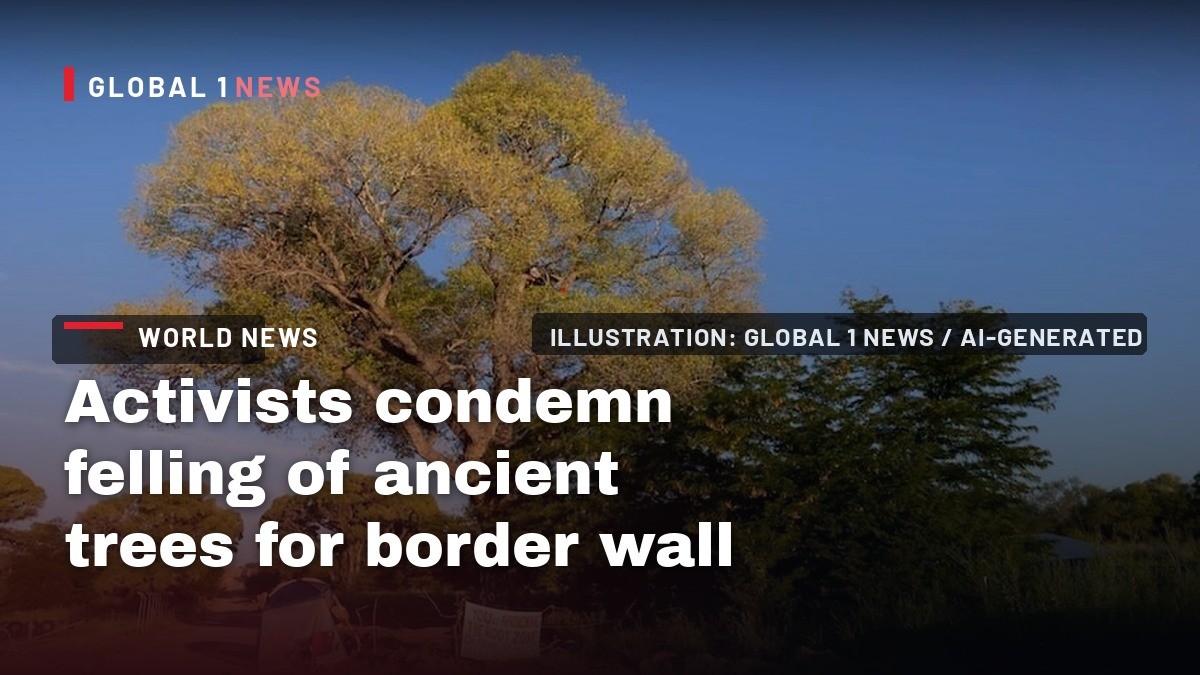
When the sun rose over the San Rafael Valley on Monday, a centuries‑old cottonwood—known to activists as the “grandmother” tree—fell to the sound of chainsaws and the clatter of a cherry‑picker. The tree, estimated by conservation groups at 200 to 250 years old, was the last of four ancient alamos that stood in the path of a new double steel wall the U.S. government is building along the Arizona‑Sonora border. Its removal marks the end of a 70‑day occupation by a rotating group of activists who tried to protect the living monument and, in doing so, highlighted a clash of borders, ecosystems and cultures that reaches far beyond a single tree.
From an ejido of saplings to a symbol of resistance
The cottonwoods in the San Rafael Valley have long served as a natural corridor for migratory birds and a shade‑giving refuge for the jaguar’s dwindling habitat. Their trunks, gnarled by centuries of desert wind, have witnessed the rise and fall of pueblos mágicos, the march of rancheros on the nearby ejido, and the shifting lines of a border that is itself less than two centuries old. When federal contractors first began clearing the area in late July, three of the four trees were felled without protest, prompting a group of environmentalists, human‑rights advocates and local residents to set up a makeshift camp around the remaining alamo.
Activists built a plywood platform perched on the tree’s trunk, receiving food and water by bucket and rope. For roughly ten weeks they rotated through the platform, living in a modest encampment that they said was on private property. Their presence halted construction in the immediate vicinity, turning the tree into a living barricade and a rallying point for dozens of families who saw in its roots a reflection of their own ties to the land.
The felling and the forceful removal
On Monday, near sunrise, U.S. Border Patrol agents entered the encampment, according to protesters, using a cherry‑picker to yank one demonstrator from the tree before contractors moved in to cut it down. Activists reported that ten people were arrested and another ten were cited and released. They also alleged that officers tackled demonstrators, kicked people while they were handcuffed and pushed others into barbed‑wire fences. The agency, Customs and Border Protection (CBP), declined to answer questions from The Washington Post about those allegations or whether agents had a warrant to enter the site.
Federal contractors then felled the ancient cottonwood, an act described by a protester on social media as “brutal.” The tree, older than the border itself, fell in a single sweep, clearing the way for the wall’s steel panels to be installed across the valley. CBP maintained that the four cottonwoods had been identified for removal as part of the wall project and that environmental monitors were present before work began, noting that pre‑construction surveys found no active migratory bird nests in the immediate area.
Land claims and legal gray zones
The clash over the tree also laid bare a dispute over land ownership. Protesters insisted the camp was set up on private property, while CBP asserted that the trees stood on federal land. The agency offered no clarification on the precise legal status of the site, nor did it disclose whether a warrant had been obtained for the early‑morning entry. This lack of transparency has fueled accusations that the federal government is sidestepping due process in the name of border security.
Such ambiguities are not new in borderlands where private, tribal and federal jurisdictions intersect. The Tohono O’odham Nation, whose ancestral lands stretch from Arizona into Sonora, condemned the operation as a “reckless disregard for cultural and natural resources.” Their statement, reported by El Universal, underscores how the wall’s footprint extends into territories that are already contested and that serve as vital migration routes for both people and wildlife.
Ecological stakes in a jaguar corridor
The San Rafael Valley is more than a scenic backdrop; it is a critical wildlife corridor linking habitats across the border. The cottonwoods provide food, shelter and nesting sites for migratory birds that travel along the Santa Cruz River, and they also create shade and water sources that support larger mammals, including the endangered jaguar. Sierra Club borderlands coordinator Erick Meza warned that contractors also plan to remove another cottonwood that straddles the border, further eroding the ecological integrity of the corridor.
Conservationists argue that the loss of these trees weakens the resilience of the ecosystem, making it harder for species to survive in an increasingly fragmented landscape. The removal of the “grandmother” tree, in particular, symbolizes a broader pattern of environmental sacrifice for a wall that many see as a “useless” structure that does not address the root causes of migration or illegal crossing.
Indigenous voices and the broader community
The Tohono O’odham Nation’s condemnation reflects a deep cultural connection to the land that predates the nation‑state. Their territory, a frequent route for migrants crossing into the United States, is also a place of spiritual significance. By labeling the tree’s felling as part of a “hasty pursuit to build this useless wall,” the tribe linked the environmental loss to a broader disregard for Indigenous rights and cultural heritage.
Local families, many of whom work in nearby tianguis or run modest tortillerías, have expressed solidarity with the protesters. For them, the tree’s roots are a metaphor for the roots of their own communities—deep, intertwined, and threatened by policies that prioritize fortified barriers over shared stewardship of the land.
Resistance continues: rallies and future actions
Organizer Kate Scott, speaking on behalf of the protest movement, affirmed that the struggle is far from over. She announced a rally organized by the Tohono O’odham Nation scheduled for Wednesday, emphasizing that “we are resolute” and that “their roots are within us.” The message resonated with activists who see the fallen tree not as an end, but as a catalyst for renewed mobilization.
Across the border, communities in Sonora watch the developments with a mixture of concern and solidarity. The wall’s expansion, which now includes two parallel steel panels crossing the valley, is viewed by many on the Mexican side as an affront to the shared environmental heritage of the region. The protest’s visibility, amplified by coverage from La Jornada, El Universal, KJZZ, The Washington Post and Lookout, has helped to bring international attention to the human and ecological costs of the border wall project.
Looking ahead: what the fallen tree tells us
The felling of the “grandmother” cottonwood is a stark illustration of how border policy, environmental protection and Indigenous rights intersect in the desert frontier. While the wall’s steel panels rise where the tree once stood, the memory of its 200‑plus years of life continues to inspire resistance. As activists regroup and plan new actions, the story of this single tree serves as a reminder that the fight for justice in Mexico and across Latin America often begins with a single, rooted stand.
In the weeks to come, the movement will likely focus on legal challenges over land ownership, demands for transparent permits, and broader campaigns to protect the San Rafael Valley’s wildlife corridor. Whether the wall’s construction proceeds unimpeded or is slowed by continued protest, the “grandmother” tree’s legacy will remain in the hearts of the families, workers and Indigenous peoples who see in its fall a call to defend the natural and cultural commons that bind our communities together.
This article was produced with AI-assisted research and editorial support. Reporting is based on the source material cited below. Sources: Mexico News Daily; mexiconewsdaily.com; Global1.News (07 October 2026).
By Rosa Martinez, Staff Writer
What's Your Reaction?
 Like
0
Like
0
 Dislike
0
Dislike
0
 Love
0
Love
0
 Funny
0
Funny
0
 Wow
0
Wow
0
 Sad
0
Sad
0
 Angry
0
Angry
0

Latin America/Andes Correspondent at Global1.News. Based in Bogota, covering politics, environment, energy, and social movements across the Andean region. Passionate about environmental journalism and communities protecting their land.












Comments (0)