
South Korean DMZ Blast Prompts Regional Security Scrutiny and Economic Ripple Effects
In the latest episode of East Asia Tonight, CNA reported a series of developments that underscore the intertwined security and economic challenges facing the region.
In the latest episode of East Asia Tonight, CNA reported a series of developments that underscore the intertwined security and economic challenges facing the region. The most immediate concern is the parliamentary audit of South Korea’s handling of the recent land‑mine blast in the Demilitarised Zone (DMZ), an incident that has drawn sharp questioning of the government’s response and raised broader questions about the stability of the Korean Peninsula. Simultaneously, Japan’s Prime Minister Sanae Takaichi signalled forthcoming talks with Washington on measures to curb crimes involving U.S. troops, while domestic issues such as cyber‑attacks on major Seoul churches, a sweeping overhaul of Japan’s TOPIX index, and significant losses suffered by South Korean retail investors on leveraged chip‑related products were also highlighted. This article analyses each of these items, focusing on their implications for Japanese policy, the wider Asia‑Pacific economy, and the strategic calculations of the United States and its allies.
Parliamentary Audit of the DMZ Blast and Its Regional Security Implications
The Korean parliamentary audit, launched after the land‑mine explosion in the DMZ last month, reflects growing domestic pressure on Seoul to account for its security posture near the heavily fortified border. According to the CNA footage, senior South Korean ministers were grilled on the circumstances surrounding the blast, including the adequacy of existing de‑mining protocols and the speed of the government’s response. The questioning suggests a perception that the incident may have exposed gaps in the Republic of Korea’s ability to monitor and neutralise explosive remnants of war, a concern that resonates with Japan’s own security calculus.
Japan’s Ministry of Defence has long monitored DMZ incidents as part of its broader assessment of North Korean provocations. While the current audit is a domestic matter for Seoul, the outcome could influence Japan’s own defence planning, particularly in relation to the deployment of surveillance assets and the coordination of joint exercises with the United States. Any indication that South Korea’s de‑mining capabilities are insufficient may prompt Tokyo to advocate for enhanced trilateral security mechanisms, potentially involving greater intelligence sharing and joint contingency planning.
Prime Minister Takaichi’s remarks later in the broadcast, concerning discussions with Washington on preventing crimes involving American troops, also intersect with the DMZ issue. Although the two topics are distinct, they both illustrate how the United States’ security footprint in the region continues to shape policy dialogues among its allies. The Japanese government, through the Ministry of Foreign Affairs, will likely monitor the audit’s findings closely, as any shift in South Korea’s security posture could reverberate through the broader alliance framework, influencing Japan’s own force posture and diplomatic engagement with both Washington and Seoul.
Japan‑U.S. Dialogue on Crime Prevention Involving American Troops
Prime Minister Takaichi’s statement that Tokyo and Washington will discuss measures to prevent crimes involving American troops underscores a persistent concern in Japan about the conduct of U.S. service members stationed on Japanese soil. While the report does not detail the specific agenda, the reference to “preventing crimes” suggests a continuation of discussions that have previously addressed incidents ranging from minor misdemeanours to more serious offences, including the high‑profile murder case in Okinawa that has strained local sentiment.
The Japanese Ministry of Foreign Affairs, in coordination with the Ministry of Defence, is likely to seek clearer protocols for the Status of Forces Agreement (SOFA) that governs the legal status of U.S. personnel. Strengthening preventive measures could involve increased joint training on cultural sensitivity, tighter supervision of off‑base activities, and possibly a revision of jurisdictional arrangements for serious crimes. Such steps would aim to mitigate local opposition, which has periodically manifested in protests and political pressure on the Japanese government to renegotiate aspects of the U.S. base arrangement.
From a broader perspective, the dialogue reflects Japan’s strategic balancing act: maintaining the security umbrella provided by the United States while addressing domestic concerns about the social impact of foreign troops. The outcome of these talks could influence Japan’s future defence policy, especially as the country expands its own Self‑Defence Forces’ capabilities under recent reinterpretations of its pacifist constitution. A more robust framework for managing U.S. troop conduct would likely be welcomed by the Japanese public and could facilitate smoother cooperation in joint operations, including those aimed at deterring North Korean provocations such as the DMZ blast.
Cyber‑Attacks on Seoul Churches and Data Security Risks
The CNA segment also reported cyber‑attacks on two major churches in Seoul, which may have exposed personal data belonging to hundreds of thousands of members. While the report does not identify the perpetrators, the scale of the breach highlights the vulnerability of religious organisations to sophisticated digital intrusions. This incident is illustrative of a broader trend in East Asia, where non‑governmental entities increasingly become targets of cyber‑espionage and data theft, often linked to state‑backed actors seeking intelligence or leverage.
For Japan, the incident serves as a cautionary example of the need to strengthen cyber‑security frameworks across civil society. The Ministry of Internal Affairs and Communications, in conjunction with the National Centre of Incident Readiness and Strategy for Cybersecurity (NISC), has been promoting guidelines for data protection in the non‑profit sector. The Seoul church breaches may accelerate calls within Japan to adopt more stringent standards for personal data handling, particularly as the country prepares to implement its revised Act on the Protection of Personal Information (APPI), which aims to align domestic regulations with global best practices.
Moreover, the attacks underscore the potential for cross‑border cyber threats to affect Japanese organisations, especially those with ties to Korean counterparts or operating in the broader Asian religious and charitable landscape. Japanese think‑tanks such as the Japan Institute of International Affairs (JIIA) have warned that cyber‑attacks can be leveraged to sow social discord, a risk that could be amplified in the context of heightened geopolitical tensions on the Korean Peninsula. Strengthening public‑private cooperation on cyber‑threat intelligence, therefore, remains a priority for Japanese authorities seeking to safeguard both national security and societal stability.
TOPIX Overhaul and Its Impact on Japanese Capital Markets
During the broadcast, CNA highlighted that Japan’s TOPIX index is undergoing what the channel described as “the biggest overhaul in its history.” While the report did not elaborate on the specific changes, the implication is that the index’s composition and weighting methodology are being revised, potentially affecting the representation of various sectors and the overall market benchmark used by investors.
The Ministry of Economy, Trade and Industry (METI) and the Financial Services Agency (FSA) have been involved in recent reforms aimed at improving market transparency and encouraging broader participation in equity markets. An overhaul of TOPIX could involve adjustments to the free‑float criteria, the inclusion of emerging technology firms, and the removal of companies that no longer meet liquidity thresholds. Such changes would align Japan’s benchmark with global trends, where indices increasingly reflect the growth of digital and green economies.
For Japanese investors, the overhaul may have significant portfolio implications, particularly for institutional funds that track TOPIX. A shift in index composition could alter the relative weight of traditional manufacturing firms versus newer sectors such as semiconductors, robotics, and AI‑driven enterprises. This, in turn, could influence capital allocation decisions and affect the valuation of companies that are either added to or removed from the index. The broader market impact will likely be monitored closely by the Bank of Japan (BOJ), which remains attentive to equity market dynamics as part of its monetary policy framework, especially given the BOJ’s ongoing efforts to stimulate investment through low‑interest rates and yield‑curve control.
Financial Fallout for South Korean Retail Investors and Regional Market Sentiment
The CNA report noted that South Korean retail investors have suffered losses amounting to US$1.7 billion on leveraged products tied to chipmakers. While the report does not specify the exact instruments, the reference to leveraged products suggests that many investors were exposed to high‑risk derivatives linked to the performance of semiconductor equities.
This development is significant for Japan because the semiconductor sector is a critical component of the broader East Asian technology supply chain, in which Japanese firms play a pivotal role as equipment suppliers and component manufacturers. A sharp downturn in chip‑related assets could dampen investor confidence across the region, potentially affecting capital flows into Japanese semiconductor equipment makers such as Tokyo Electron and Advantest. Moreover, the episode may prompt Japanese regulators to reassess the adequacy of investor protection measures, particularly concerning the marketing and disclosure of high‑risk financial products.
The incident also highlights the interconnectedness of regional financial markets. South Korean investors’ losses could translate into reduced demand for Japanese equities, especially those perceived as correlated with the semiconductor cycle. The BOJ and the Ministry of Finance may therefore monitor market sentiment closely, considering policy tools to stabilise investor confidence, such as enhanced market surveillance or coordinated communication with foreign regulators. The episode underscores the need for a coordinated approach to financial stability in the Asia‑Pacific, where cross‑border capital movements can quickly amplify localized market shocks.
Broader Geopolitical Context: Taiwan, EU, Singapore and Technological Competition
Beyond the immediate Korean and Japanese issues, the CNA broadcast covered several developments that shape the regional geopolitical environment. Taiwan’s indictment of ten individuals for allegedly reselling US chips to China reflects ongoing concerns about technology leakage and the enforcement of export controls. While the report does not detail the legal outcomes, the case illustrates the heightened vigilance of democratic economies in safeguarding advanced semiconductor technology from unauthorized transfers.
In Europe, the EU trade chief’s visit to China to address a “huge trade deficit” underscores the continent’s strategic interest in balancing trade relations with Beijing while protecting its own industrial base. For Japan, the EU’s approach may serve as a reference point for negotiating its own trade policies with China, particularly in the context of the ongoing semiconductor export restrictions imposed by the United States and allied nations. Coordination with the EU on technology standards and supply‑chain resilience could enhance Japan’s leverage in multilateral forums.
Singapore’s foreign minister’s participation in the Milken Institute Asia Summit, as reported, signals the city‑state’s continued role as a hub for high‑level economic dialogue in the region. Singapore’s emphasis on digital transformation and financial innovation aligns with Japan’s own strategic priorities, suggesting opportunities for bilateral cooperation in fintech, digital infrastructure, and regulatory harmonisation. Such collaboration could be especially valuable as Japan seeks to attract foreign investment and talent to its evolving tech sector.
Finally, the broadcast highlighted broader trends in advanced technology reshaping workplaces in China, the emergence of powerful women leaders in Chinese tech—exemplified by ByteDance’s Kelly Zhang—and the awarding of the Nobel Prize in Chemistry to Japan’s Kenso Soai and France’s Henri Kagan. These items collectively illustrate the rapid evolution of the technology ecosystem across Asia and the importance of talent, innovation, and international recognition in shaping national competitiveness. For Japan, the Nobel accolade reinforces its scientific credibility, while the rise of female leadership in Chinese firms may inspire similar diversity initiatives within Japanese corporations, aligning with METI’s recent calls for greater gender equity in the workforce.
By Kenji Tanaka, Staff Writer
This article was produced with AI-assisted research and editorial support. Reporting is based on the source material cited below. Sources: CNA video report (07 October 2026); CNA; Global1.News
What's Your Reaction?
 Like
0
Like
0
 Dislike
0
Dislike
0
 Love
0
Love
0
 Funny
0
Funny
0
 Wow
0
Wow
0
 Sad
0
Sad
0
 Angry
0
Angry
0
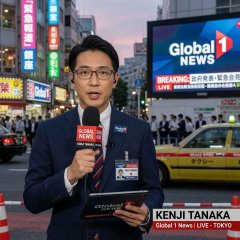
Japan Correspondent at Global1.News. Tokyo-based voice covering Japanese politics, technology, economy, and culture. Tracks the intersection of tradition and innovation in one of the world's most dynamic societies.















Comments (0)