
Vegan Collagen Explained: What Dermatologists Say About Collagen Supplements
Collagen is the most abundant structural protein in the human body, constituting roughly 30% of total body protein and an estimated 70-80% of the skin's dry weight. It is the scaffolding that holds us together—present in skin, bone, cartilage, tendons, and ligaments.
Collagen is the most abundant structural protein in the human body, constituting roughly 30% of total body protein and an estimated 70-80% of the skin's dry weight. It is the scaffolding that holds us together—present in skin, bone, cartilage, tendons, and ligaments. Yet, as the Indian nutraceutical market surges past Rs 4,500-5,000 crore, a new wave of marketing has introduced a confusing term: "vegan collagen." An India Today video feature, published August 29-30, 2026, sought clarity from dermatologists on whether this plant-based alternative is a genuine breakthrough or a cleverly marketed collagen booster. For Indian consumers navigating a booming wellness industry, the distinction is not just scientific—it is financial and practical.
Vegan Collagen Explained: What Dermatologists Say About Collagen Supplements
New Delhi, August 30 — The global beauty supplement industry has found a lucrative foothold in India, with e-commerce platforms like Nykaa, Amazon, and Flipkart, alongside D2C brands such as Mamaearth, Kapiva, and Wellbeing Nutrition, pushing collagen powders, gummies, and liquids into mainstream consumption. But as the market grows at a projected 12-15% CAGR, dermatologists are urging caution. The core question posed by the India Today segment is deceptively simple: What exactly is vegan collagen, and does it work like the animal-derived peptides that dominate clinical studies?
The answer, according to leading dermatologists, hinges on biochemistry. True collagen—a triple-helix structural protein—exists only in animals. What is sold as "vegan collagen" is almost universally a blend of plant-based nutrients designed to stimulate the body's own collagen production. This distinction carries significant implications for efficacy, pricing, and consumer expectations, particularly for Indian skin, which is predominantly Fitzpatrick types III-V and faces unique challenges like post-inflammatory hyperpigmentation and photoageing.
What Collagen Actually Does: The Biology of Ageing Skin
To understand the supplement debate, one must first grasp the biology. Collagen is the primary component of the dermis, the skin's middle layer, providing structural integrity and elasticity. Type I collagen accounts for approximately 80-90% of the collagen found in human skin. This protein is not static; it undergoes constant turnover, but production efficiency declines with age.
After age 25-30, the human body produces roughly 1% less collagen per year. This decline is not linear; it accelerates dramatically in women post-menopause, with studies showing up to 30% collagen loss in the first five years following the cessation of ovarian function. Extrinsic factors compound this natural ageing process. Ultraviolet (UV) radiation from the sun—a significant concern in India's tropical climate—triggers photoageing by breaking down collagen fibres. Smoking, high-sugar diets, and ambient air pollution in cities like Delhi and Mumbai accelerate the degradation via oxidative stress and advanced glycation end-products (AGEs).
This biological reality is why dermatologists view collagen supplements as adjuncts, not miracles. The structural protein is broken down during digestion into peptides and amino acids, which are then theoretically available for the body to reassemble. The question is whether oral supplementation meaningfully increases collagen density in the skin, or whether it merely provides the building blocks that a healthy diet already supplies.
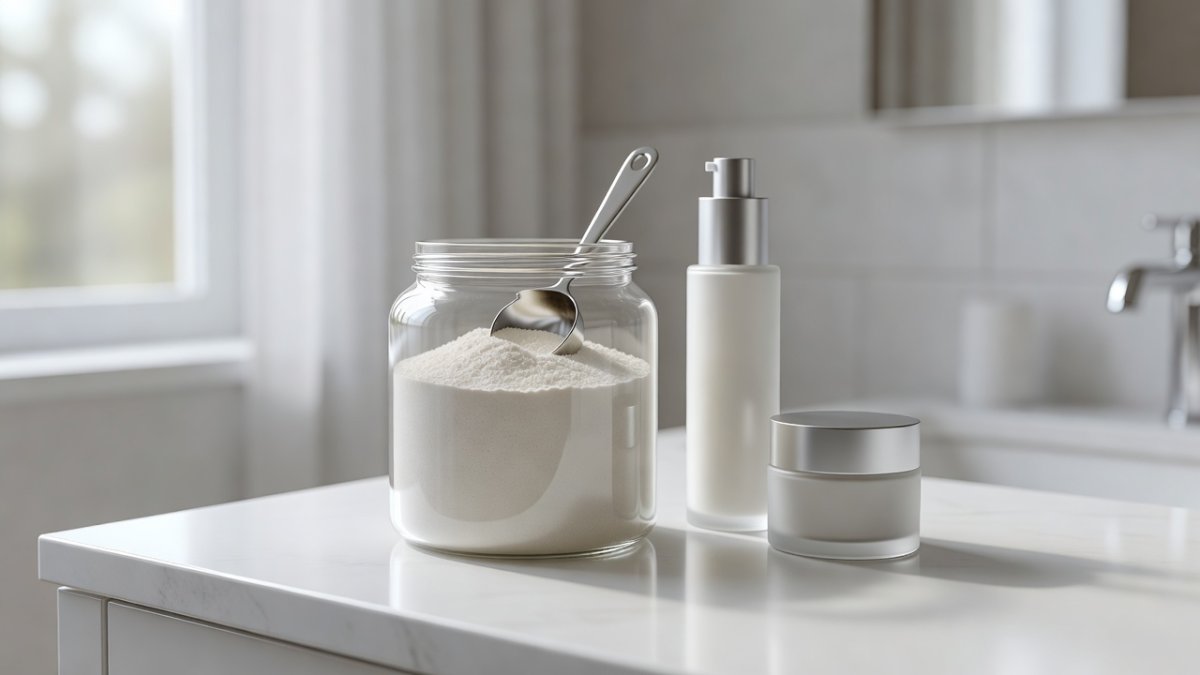
Vegan Collagen: What's Really in the Jar
The term "vegan collagen" is, strictly speaking, a misnomer. Collagen is an animal-derived protein; plants do not produce it. The products marketed under this label in India are predominantly "collagen boosters." These formulations typically contain a synergistic blend of nutrients designed to support the body's endogenous collagen synthesis.
Key ingredients in these vegan formulations include Vitamin C, often sourced from amla (Indian gooseberry), acerola, or camu camu. Vitamin C is an essential cofactor for the hydroxylation of proline and lysine—two amino acids critical for the stability of the collagen triple helix. Without adequate Vitamin C, collagen synthesis is impaired, regardless of protein intake. Other common components include silica from bamboo extract, zinc, biotin, hyaluronic acid, and a profile of amino acids (glycine, proline, lysine) derived from pea or rice protein.
There is, however, a nascent category of true vegan collagen produced via recombinant technology. This involves genetically engineered yeast or bacteria that are programmed to produce actual collagen peptides identical to animal-derived versions, without involving animals. While scientifically fascinating, these products remain niche and expensive, and they are rarely what is found on the shelves of Indian pharmacies or e-commerce beauty stores. For the vast majority of consumers, "vegan collagen" is a sophisticated nutrient cocktail, not a direct replacement for hydrolysed animal collagen.

What the Science Says: Meta-Analyses and Clinical Evidence
The evidence base for collagen supplementation has grown substantially, though it remains a subject of debate. A 2023 systematic review and meta-analysis published in PMC, encompassing 26 randomised controlled trials with 1,721 patients, found that hydrolysed collagen supplementation significantly improved skin hydration (Z = 4.94, p < 0.00001) and elasticity (Z = 4.49, p < 0.00001) compared to placebo. Notably, the analysis indicated that long-term use—exceeding 8-12 weeks—yielded more favourable outcomes than short-term use.
Indian dermatological literature corroborates these findings. A meta-analysis published in the Indian Journal of Dermatology, Venereology and Leprology (IJDVL) reviewed 10 RCTs involving 646 participants, with studies spanning 2010 to 2021. The analysis found that oral collagen supplements, administered at doses of 1-10 g per day (with a median dose of 3.5 g/day), were statistically effective at increasing skin hydration (SMD 1.25, CI 0.77-1.74) and elasticity (SMD 0.61, CI 0.21-1.02).
However, the authors noted significant caveats. The results are more applicable to female populations, and the trials often suffer from industry funding and small sample sizes. The typical effective dose in clinical studies is 2.5-10 g of hydrolysed collagen daily for 8-12 weeks. Crucially, these studies almost exclusively use animal-derived collagen peptides—bovine, porcine, marine, or chicken. There is a conspicuous absence of robust clinical trials validating the efficacy of plant-based "collagen boosters" for skin hydration and elasticity to the same degree.
The Indian Market and Regulatory Reality
India's nutraceutical market is a regulatory patchwork. Supplements fall under the Food Safety and Standards Authority of India (FSSAI), governed by the Food Safety and Standards Act, 2006, and the FSS Regulations of 2016 (Schedule IV/V). Under this framework, products are classified as nutraceuticals or health supplements. Critically, FSSAI does not approve therapeutic claims. A supplement cannot legally claim to treat, cure, or prevent disease, including skin ageing.
Despite this, marketing often skirts the line. The Advertising Standards Council of India (ASCI) has repeatedly pulled up supplement brands for exaggerated claims regarding hair growth, skin whitening, and anti-ageing benefits. For the Indian consumer, this creates a confusing landscape where a Rs 1,000-4,000 monthly supply of animal collagen or an Rs 800-3,000 vegan booster is purchased with the expectation of clinical-grade results.
The economic stakes are high. The Indian nutraceuticals market, estimated at roughly Rs 4,500-5,000 crore in 2024-25, is projected to grow at a 12-15% CAGR. Beauty and skin supplements are among the fastest-growing segments, driven by rising disposable incomes, urbanisation, and the influence of social media skincare trends. This growth, however, is outpacing the regulatory framework's ability to police claims, placing the onus on dermatologists to guide patients through the noise.
What Dermatologists Advise for Indian Skin
Indian dermatologists, including members of the Indian Association of Dermatologists, Venereologists and Leprologists (IADVL) and experts at institutions like AIIMS, adopt a pragmatic approach. The primary concern for Indian skin is not necessarily wrinkle formation, but pigmentation—melasma, post-inflammatory hyperpigmentation (PIH), and uneven skin tone. These conditions are driven by melanin production and UV exposure, not solely by collagen loss.
For this reason, the foundational advice remains unchanged: daily application of a broad-spectrum sunscreen with SPF 30-50+, adequate moisturising, and a balanced diet rich in protein and Vitamin C. Indian diets, which often include amla, citrus fruits, and guava, are naturally high in Vitamin C, an essential cofactor for collagen synthesis. For most patients, fixing these basics yields more visible results than any supplement.
Collagen supplementation, whether animal-derived or vegan booster, is considered a reasonable adjunct for specific patients—those with visible signs of ageing, brittle nails, or specific nutritional deficiencies. However, dermatologists stress that the evidence for collagen's efficacy on hair growth is significantly weaker than for skin. Furthermore, they caution against the assumption that a vegan booster is equivalent to the hydrolysed peptides used in clinical trials. The burden of proof for these plant-based formulations is still pending.
The Bottom Line: Supplements as Adjuncts, Not Substitutes
The India Today segment underscores a critical takeaway for Indian consumers: the term "vegan collagen" is a marketing convenience, not a biological reality. While the nutrients in these products—Vitamin C, silica, amino acids—are beneficial for overall health and can support the body's natural collagen production, they are not a direct replacement for the collagen peptides that have demonstrated efficacy in clinical trials.
For the discerning Indian consumer, the decision should be guided by evidence and budget. If one chooses to supplement, hydrolysed collagen (bovine or marine) has the strongest data behind it, with doses of 2.5-10 g daily for 8-12 weeks showing measurable improvements in hydration and elasticity. If one prefers a plant-based option, it is essential to understand that you are purchasing a nutrient booster, not collagen itself, and to ensure the formulation contains adequate Vitamin C and amino acid precursors.
Ultimately, no supplement can outpace the effects of sun damage, smoking, or a poor diet. The most effective anti-ageing strategy remains sun protection, a nutrient-dense diet, and a consistent skincare routine. Collagen supplements, vegan or otherwise, are a potential adjunct—not a substitute—for the fundamentals of skin health.
— By Dr. Raj Patel, Staff WriterThis article was produced with AI-assisted research and editorial support. Reporting is based on sources cited in the article.
What's Your Reaction?
 Like
0
Like
0
 Dislike
0
Dislike
0
 Love
0
Love
0
 Funny
0
Funny
0
 Wow
0
Wow
0
 Sad
0
Sad
0
 Angry
0
Angry
0

India/South Asia Correspondent at Global1.News. Analytical voice with a background in science and health journalism. Based in New Delhi, covering Indian politics, education, healthcare, technology, and policy. Breaks down complex data into clear, actionable reporting.















Comments (0)