
Russia Sentences Ex-Zelensky Adviser Arestovych to 11 Years in Absentia Over War Comments
A Moscow military court sentenced former Ukrainian presidential adviser Oleksiy Arestovych to 11 years in prison in absentia, convicting him over his 2022 statements about the Kramatorsk strike and calls for railway sabotage.
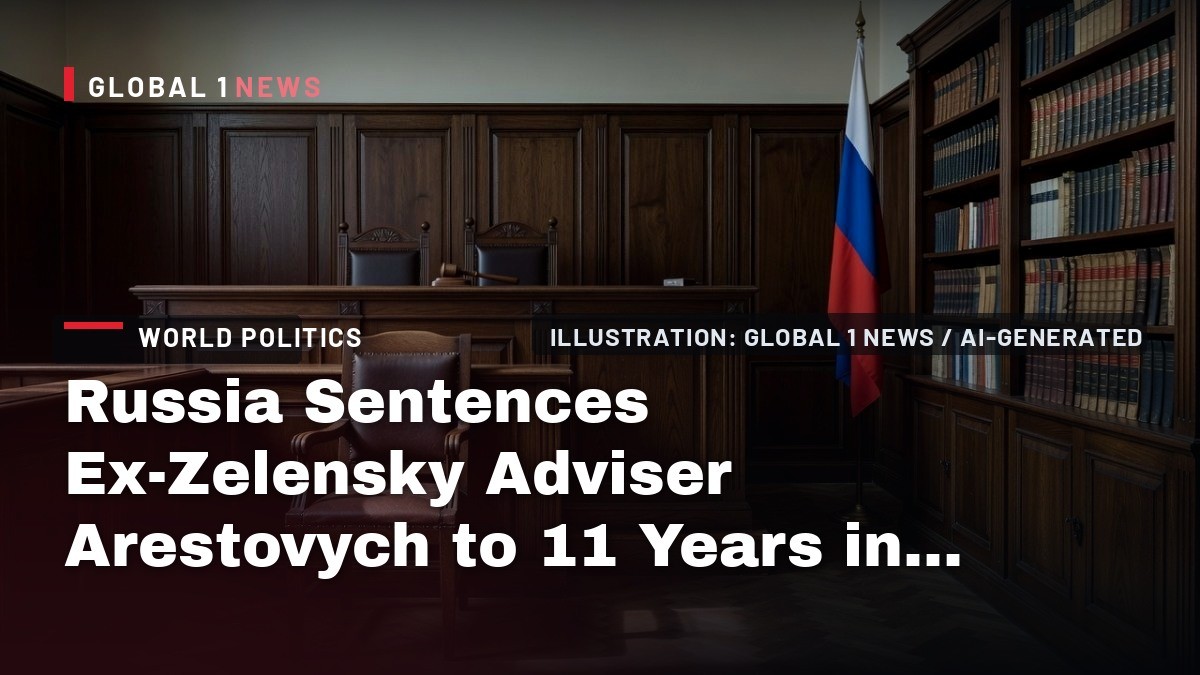
A Moscow military court on Friday sentenced Oleksiy Arestovych, a former adviser to the Ukrainian president's office, to 11 years in prison in absentia, convicting him of spreading false information about the Russian armed forces and publicly calling for terrorism. The verdict, delivered by a judge from the Second Western District Military Court following a closed-door trial, marks the latest escalation in Moscow's legal campaign against Ukrainian public figures. Arestovych, who now lives outside Ukraine and has become a vocal critic of the Kyiv government, dismissed the ruling on Telegram, writing: "What a sophisticated cover-up operation."
Russia Sentences Ex-Zelensky Adviser Arestovych to 11 Years in Absentia Over War Comments
Moscow, Russia – August 28, 2026 — A judge at the Second Western District Military Court in Moscow on Friday found Oleksiy Arestovych guilty of two criminal counts and sentenced him to 11 years in a penal colony, according to the exiled news outlet Mediazona and Russian state news agency TASS. The court also imposed a four-year ban on Arestovych managing websites. Prosecutors had requested a 15-year sentence, Mediazona reported.
Charges Stem From 2022 Statements on Kramatorsk Strike and Railway Sabotage
Russian investigators accused Arestovych of publishing false statements about a deadly Russian missile strike on a railway station in the eastern Ukrainian city of Kramatorsk in April 2022. That attack, which killed dozens of civilians, including children, has been widely attributed to Russian forces by international observers and Ukrainian authorities, and is considered one of the deadliest documented attacks on civilians since the start of the full-scale invasion. Prosecutors also alleged that Arestovych, in a video recorded in March 2022, called on Ukrainians to sabotage railway lines used to resupply Russian troops.
TASS described the charges as "inciting terrorism and spreading fake news about the Russian army." The trial was conducted behind closed doors, a procedure Russian courts have increasingly used in cases involving military-related charges since the start of the full-scale invasion of Ukraine in February 2022.
Arestovych's Response: 'A Sophisticated Cover-Up Operation'
In a Telegram post published shortly after the verdict was announced, Arestovych dismissed the proceedings as politically motivated. "What a sophisticated cover-up operation," he wrote, without elaborating further. The former adviser, who has amassed a substantial following on his YouTube channel, has previously characterized Russian court rulings against him as retaliation for his public criticism of the Kremlin's war effort.
It remains unclear whether Arestovych plans to appeal the verdict. Under Russian law, defendants convicted in absentia have the right to request a retrial if they are later apprehended or voluntarily surrender to authorities.
From Presidential Adviser to Kremlin Target
Arestovych served as an adviser to the head of Ukrainian President Volodymyr Zelensky's office from Zelensky's 2019 election until January 2023. He resigned after suggesting that a Ukrainian air defense missile may have caused a deadly strike on an apartment building in the central Ukrainian city of Dnipro. The January 2023 attack killed 44 people, according to BBC reporting. Ukrainian authorities and Western officials attributed the strike to a Russian missile, and Arestovych's comments sparked widespread outrage in Ukraine.
Since his resignation, Arestovych has recast himself as a critic of the Ukrainian government, frequently questioning military strategy and accusing officials of mismanagement. His YouTube channel has grown significantly, attracting viewers disillusioned with the wartime leadership in Kyiv.
Sanctions and Legal Actions in Ukraine
Ukrainian President Volodymyr Zelensky imposed sanctions on Arestovych by decree No. 267/2025 on May 1, 2025, according to official records. The sanctions include asset freezes and the revocation of state awards. The move signaled a sharp deterioration in relations between Arestovych and the government he once served.
Zelensky's office has not publicly commented on the Russian court ruling. However, Ukrainian officials have consistently dismissed Russian in-absentia prosecutions of Ukrainian citizens as illegitimate and lacking legal standing under international law.
Russia's Expanding In-Absentia Prosecutions
Friday's verdict is part of a broader pattern. Since the full-scale invasion began, Russian courts have convicted dozens of Ukrainian officials, military commanders, and public figures in absentia, and have conducted hundreds of closed-door military trials and in-absentia prosecutions against individuals deemed hostile to the state. The Basmanny District Court in Moscow placed Arestovych in pre-trial detention in absentia in February 2024, and Russia added him to its list of "terrorists and extremists" in May 2023. He was placed on the federal wanted list in October 2023.
Legal experts note that these trials serve multiple purposes for the Kremlin. They create a legal basis for arrest if the individuals ever travel to countries with extradition treaties with Russia, and they generate domestic propaganda narratives portraying Ukrainian figures as criminals. However, the practical enforcement of such sentences remains limited, as most convicted individuals reside in countries that do not extradite to Russia.
Implications for Ordinary Russians and Regional Stability
The case against Arestovych also carries implications for ordinary Russians. The charges of "spreading false information about the Russian military" are the same legal provisions used to prosecute hundreds of Russian citizens who have spoken out against the war. Since March 2022, Russian courts have sentenced numerous individuals to multi-year prison terms for criticizing the armed forces or questioning official narratives about the invasion. Under Article 207.3 of Russia's Criminal Code, penalties for repeat offenses can reach up to 15 years in prison, a fact that has drawn sharp criticism from human rights groups.
Human rights observers have documented a systematic crackdown on dissent in Russia, with independent media outlets shuttered and journalists, activists, and ordinary citizens facing criminal prosecution. The closed-door nature of the Arestovych trial further limits public scrutiny of the evidence presented.
International Reaction and Legal Questions
Western governments and international legal bodies have repeatedly condemned Russia's in-absentia prosecutions of Ukrainian figures as politically motivated and inconsistent with due process standards. The European Court of Human Rights has previously ruled that certain aspects of Russian judicial proceedings in politically sensitive cases violate the European Convention on Human Rights.
Ukraine's government has not indicated whether it will take any diplomatic steps in response to Friday's verdict. Arestovych's status as a sanctioned individual in Ukraine complicates any official response, as Kyiv has distanced itself from his recent activities.
What Comes Next for Arestovych
Arestovych remains outside Ukraine and has not indicated any intention to return to Russian-controlled territory. His legal exposure in Russia is unlikely to affect his daily life, though it may restrict his ability to travel to countries that maintain extradition agreements with Moscow.
For now, the former adviser continues to produce content for his YouTube channel, where he regularly comments on the war and Ukrainian politics. The Russian court's verdict adds another layer to his complex public persona — a man once at the center of Ukrainian power, now sanctioned by Kyiv and sentenced by Moscow, living in exile while the war grinds on.
This article was produced with AI-assisted research and editorial support. Sources: The Moscow Times, Meduza/Mediazona, TASS, BBC News.
By Irina Volkov, Staff Writer
What's Your Reaction?
 Like
0
Like
0
 Dislike
0
Dislike
0
 Love
0
Love
0
 Funny
0
Funny
0
 Wow
0
Wow
0
 Sad
0
Sad
0
 Angry
0
Angry
0

Russia/Eastern Europe Correspondent at Global1.News. Covering Russian politics, energy, security, and the shifting dynamics of the post-Soviet space. Provides clear-eyed analysis on one of the world's most opaque regions.











Comments (0)