
Uzbekistan Courts Both US and China in AI Bloc Rivalry
Uzbekistan has formally asked to join America's Pax Silica AI initiative while remaining in China's WAICO bloc, turning Central Asia into a flashpoint in the US-China contest over AI supply chains, critical minerals and standards.
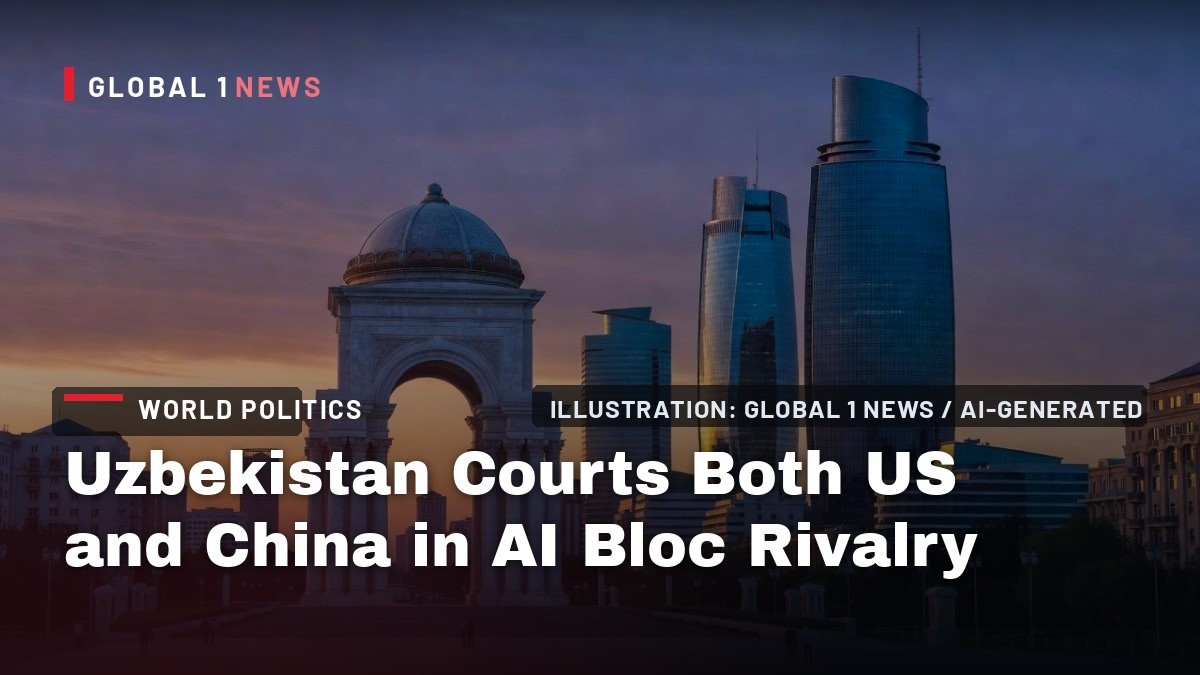
Tashkent's Diplomatic Note Puts Washington's Loyalty Test in the Spotlight
Uzbekistan has formally asked the United States to join Pax Silica, Washington's flagship initiative for artificial intelligence supply chains, just one month after Tashkent signed up to China's rival global grouping, the World Artificial Intelligence Cooperation Organization (WAICO). The move, confirmed by Uzbek Ambassador to Washington Furqat Sidikov, turns Central Asia into the newest flashpoint in the intensifying US-China contest over who will set the standards, supply chains and partnerships of the AI era.
"Now, the US should confirm. We are ready to sign," Sidikov said in Washington on Thursday, adding that countries should have a "chance to be part of any kind of international cooperation" and that drawing red lines around participation would be "counterproductive." For Tokyo, watching from its perch inside Pax Silica, the episode is a vivid demonstration of how a region the size of a continent is refusing to treat AI as a loyalty test.
One Country, Two AI Blocs
Uzbekistan's ambassador said Tashkent had notified the US State Department in a diplomatic note last week requesting to join the American-led initiative. The request comes as Washington prepares to warn partners that they cannot have it both ways. Reuters reported on August 14 that the US planned to warn partners they could not join both Pax Silica and China's AI framework, citing an internal draft document.
Pax Silica, launched by Undersecretary of State for Economic Affairs Jacob Helberg in December 2025, counts 24 members and aims to build AI supply chains independent of China, covering critical minerals, semiconductors and logistics. While the programme does not explicitly target Beijing, one of its key objectives is to reduce "coercive dependencies," a phrase widely understood to mean Chinese dominance in rare earths and other minerals essential to semiconductor production.
Helberg told the South China Morning Post last month that the US was leaning on the private sector rather than copying China's state-led model. "We realise that the US government is not set up in a way to compete with the Chinese tit-for-tat on that same basis. We decided to lean into that strength and leverage the innovative, creative capacity and dynamism of our private sector," he said.
Minerals Are the Magnet in Central Asia
China's WAICO, launched by President Xi Jinping in Shanghai in July during the World Artificial Intelligence Conference, began with 29 founding members and has since expanded to 38. Xi described the body as "a major move by China to answer the call of the Global South" that would be "an important milestone in the history of AI development." Unlike Pax Silica, no G7 economy appears on the WAICO roster, which is tilted toward the Global South.
Uzbekistan's appeal to both camps rests on its mineral wealth. The country holds large reserves of gold, copper, uranium, tungsten and molybdenum, and officials say new mines and processing plants could produce up to 28 types of critical minerals, including rare earths. A US$4.2 billion minerals programme is a key part of Tashkent's industrial policy through 2030.
China already has deep roots: foreign direct investment in Uzbekistan reached about US$10.7 billion as of the middle of last year, according to the Eurasian Development Bank, with projects spanning energy, mining and potential data centres. In February, the US and Uzbekistan signed an agreement on critical minerals and rare earths, followed by a Development Finance Corporation investment framework and a proposed joint holding company.
Washington's Warning Collides With Middle-Power Realities
The problem for Washington is that dual membership clashes with Pax Silica's mandate, which aims to keep critical minerals, processing and transit routes inside a trusted, China-free chain. Middle powers see the opposite challenge: they cannot build a full AI stack alone, and they do not want to treat technology access as a geopolitical loyalty test.
"As a developing country, we want to have access to all available technologies," said Bobur Khodjaev, an aide with Uzbekistan's presidential administration, speaking at the Silk Road Finance and Technology Forum in Tashkent this week. "American tech companies offer cutting-edge AI chips and AI models. China, in turn, offers open-source models that are significantly cheaper than American ones. And we would like to have access to both," he said.
Ken Moriyasu, a senior fellow at the Hudson Institute and a former Nikkei correspondent, said it was "unrealistic" to expect countries such as Kazakhstan and Uzbekistan to make an "exclusive geopolitical choice between American and Chinese technology." He argued that Washington must protect "genuinely sensitive" technologies "without turning technological safeguards into a geopolitical loyalty test," and that the larger objective was not to make the Central Asian states choose America: "It is to make sure they always have a choice, and that they never have to choose China exclusively."
Kazakhstan Is the Live Test the Region Is Watching
Kazakhstan is the only nation so far with membership in both Pax Silica and WAICO, making it the bellwether for whether the US ultimatum will hold. Moriyasu noted that Astana "shares an enormous border with China" and that "no government in Astana can pursue a serious strategy based on excluding Beijing."
Political scientist Zamir Karazhanov told The Times of Central Asia that Astana was "probably closer to the Chinese approach at the moment" on open source and keeping AI out of bloc politics. "Kazakhstan also does not want AI to be used as an instrument of politics, and on this point, we agree with China," he said, adding that an attempt to pressure Kazakhstan would likely fail because Washington could not easily squeeze a country that held minerals it needed.
Hedging Beyond Central Asia
The hedging is not confined to the region. Indonesia has signed on to WAICO while its coordinating minister for economic affairs, Airlangga Hartarto, insists Jakarta is still "involved in the development of Pax Silica" and that the two groupings "should not be pitted against each other." Malaysia, a founding member of WAICO, retains deep US semiconductor ties.
A Chatham House paper on sovereign AI published in February argued that middle powers could not match the US or China in capital, computing power or talent, so they must choose where to compete, where to partner and where to accept dependence. "The critical question is not whether to depend on other nations for AI, but on which nations, to what extent and on what terms," the paper said.
What to Watch For
For Japan, the Central Asian test matters far beyond the Silk Road. Tokyo joined Pax Silica in December 2025 and is conspicuously absent from WAICO, placing it squarely on the American side of the emerging AI divide. Yet Japan's own strategy mirrors the hedging impulse: a government-backed AI Foundation Model Development joint venture, launched in April with SoftBank, NEC, Sony and Honda, is building sovereign Japanese models rather than relying exclusively on either Washington or Beijing.
The near-term question is whether Washington follows through on its reported warning to dozens of partners, and how Tashkent responds when the answer arrives. If Kazakhstan survives dual membership without consequence, Uzbekistan's request becomes far harder to refuse. If Washington enforces the choice, it may push more of the Global South toward Shanghai, which presents itself as the more inclusive host. Either way, the era in which a small Central Asian state could ask both superpowers for a seat at the AI table is being tested in real time, and the outcome will shape how the region's minerals, models and markets align for the rest of the decade.
By Kenji Tanaka, Staff Writer
This article was produced with AI-assisted research and editorial support. Sources: South China Morning Post, Reuters.
What's Your Reaction?
 Like
0
Like
0
 Dislike
0
Dislike
0
 Love
0
Love
0
 Funny
0
Funny
0
 Wow
0
Wow
0
 Sad
0
Sad
0
 Angry
0
Angry
0

Japan Correspondent at Global1.News. Tokyo-based voice covering Japanese politics, technology, economy, and culture. Tracks the intersection of tradition and innovation in one of the world's most dynamic societies.













Comments (0)