
US Strikes Iranian Launchers on Larak Island in First Known Attack Since Late July
US forces struck two Iranian launchers on Larak Island in the first known attack on Iran since late July, after IRGC troops were spotted preparing sea-mine launchers for the Strait of Hormuz.
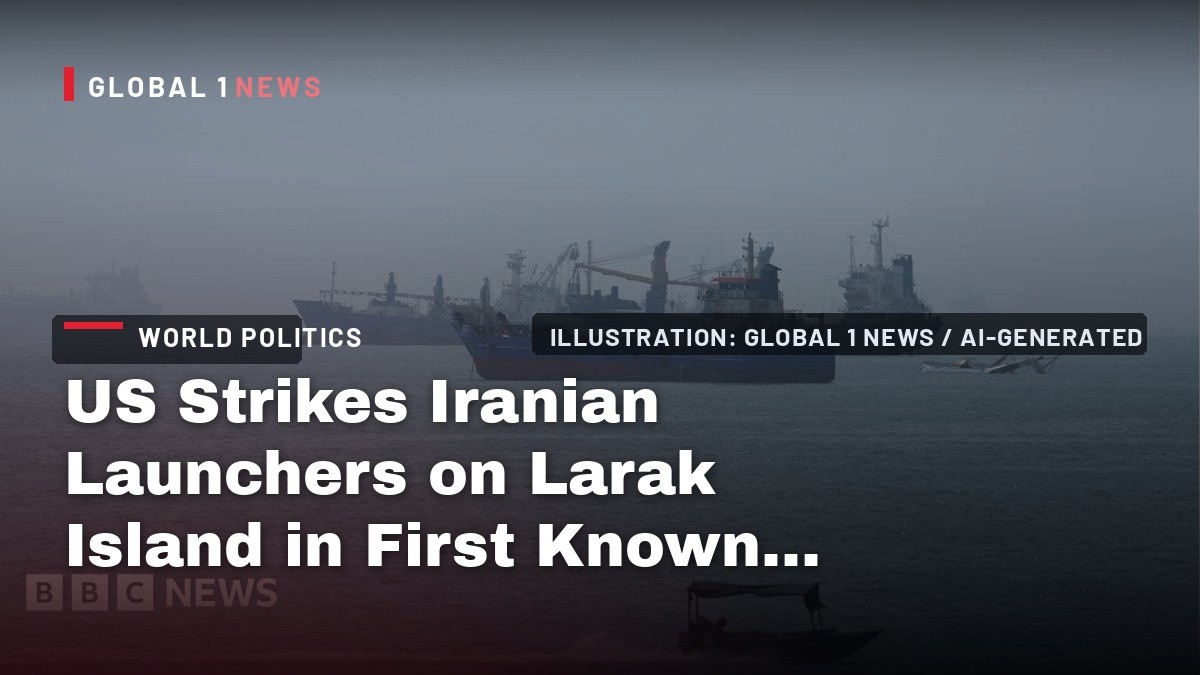
US forces have struck two Iranian launchers on Iran's Larak island, a US official said, marking the first known American strikes on Iran since late July. The attack, which took place on Sunday, targeted Islamic Revolutionary Guard Corps (IRGC) positions that were observed preparing to launch rockets with sea mines into the Strait of Hormuz, according to US Central Command (Centcom) spokesman Cdr Tim Hawkins, as quoted by CBS News.
The strike represents a significant escalation in a conflict that has now crossed its six-month mark, following a period of relative quiet after President Donald Trump paused a renewed military campaign in late July. The IRGC said Sunday's attack killed and wounded several people and vowed "response and punishment," with Iran's Tasnim news agency, affiliated with the IRGC, reporting that two people were killed and two others injured.
The Strategic Significance of Larak Island
Larak Island sits just offshore from the key port of Bandar Abbas and lies directly on the Strait of Hormuz, a vital waterway for global shipping through which roughly 20% of the world's oil and liquefied natural gas used to travel before the war began. The island's position gives Iran significant leverage over maritime traffic in the strait, which Tehran has effectively closed to marine traffic since the conflict began.
Iran is currently making tanker traffic pass by this island for checking and reportedly forcing vessels to pay $2m (£1.5m) to cross. This transit levy represents a direct economic weaponisation of Iran's geographic position, extracting revenue from global shipping while simultaneously asserting Tehran's control over one of the world's most critical energy chokepoints.
The choice of Larak as a strike target signals that Washington is focusing on Iran's mine-laying capabilities specifically, rather than broader military infrastructure. Trump said last week that all mines placed in the Strait of Hormuz by Iran as part of its efforts to blockade the route had been detonated or removed, and warned that any ship or boat deploying new mines would be destroyed.
Iranian Retaliation Against US Bases in Jordan
Hours after the Larak strike, Iranian media carried a statement by the IRGC saying it had attacked the US bases of King Hussein and al-Azraq in Jordan with ballistic missiles in response to the Larak Island attack. The IRGC said it had caused "heavy damage" and targeted "technical infrastructure, maintenance facilities, and enemy fighter jet positions," according to a translation from the AFP news agency.
Jordan's army said shortly after the IRGC statement that it had intercepted eight missiles. "Air defense systems intercepted eight missiles that breached the Kingdom's airspace at dawn today, Monday," Jordan's armed forces said in a statement, quoting the army's spokesperson, reported by the state Petra News Agency. The interception suggests that while Iran's missile capabilities remain a threat, regional air defence systems are functioning effectively against them.
Hossein Mohebbi, the IRGC's spokesman, called the attack a "strategic and fatal mistake by the Trump regime" and said that the "enemy will pay the consequences of this miscalculation in both the economic and military fields." This rhetoric indicates that Tehran views the strike not merely as a military setback but as a challenge to its broader strategic posture in the region.
The Escalation Sequence and Its Implications
The sequence of events — US observation of IRGC preparations, the strike on Larak, and the Iranian missile response against Jordan — illustrates the fragile dynamics of a conflict that has seen multiple cycles of escalation and de-escalation over the past six months. The war began on 28 February with wide-ranging US and Israeli strikes on Iran, with Iran responding by attacking Israel, US bases and allied states in the Gulf, and effectively closing the Strait of Hormuz to marine traffic.
Trump's decision to pause the renewed campaign in late July suggested a possible path toward de-escalation, but the Larak strike demonstrates that Washington remains willing to use military force to prevent Iran from re-establishing its mine-laying capabilities in the strait. The question now is whether this strike represents a one-off action or the beginning of a new phase of military operations.
Iran's Deputy Foreign Minister Kazem Gharibabadi described Trump's claim about mines being cleared as a "propaganda" deception, indicating that Tehran disputes Washington's assessment of the situation in the strait. This disagreement over the facts on the ground complicates any potential diplomatic resolution.
Economic Pressures and the Sanctions Campaign
Iran is facing renewed economic pressure after Washington announced a fresh sanctions campaign on 24 August aimed at further isolating Tehran and expanding secondary sanctions against its allies. Iranian officials and state media have largely dismissed the campaign as a continuation of previous US economic measures, which they argue followed Washington's military failure in the recent conflict.
The timing of the Larak strike — coming less than a week after the new sanctions announcement — suggests that Washington is pursuing a dual-track strategy of economic pressure and military deterrence. The sanctions campaign expands secondary sanctions against Iran's trading partners, a direct warning to Chinese refiners and banks that handle Iranian crude.
The economic dimensions of this conflict extend well beyond Iran's borders. The $2m per-vessel transit levy imposed by Iran on tankers passing Larak represents a direct cost on global shipping, while the broader blockade of the Strait of Hormuz has significant implications for energy prices worldwide. The strait's closure has already disrupted global energy markets, and any further escalation could have severe consequences for the global economy.
China's Strategic Exposure and Response
Beijing has publicly condemned the widening US sanctions as "illegal", and previous Global1.news reporting recorded Beijing vowing countermeasures ahead of a Trump-Xi summit. China's energy security is directly exposed: the Strait of Hormuz carries roughly 20% of the world's oil and LNG, and Beijing relies on Gulf crude as its largest single source of imported oil.
The US has threatened to isolate nations that continue to do business with Tehran, which sells much of its oil to Beijing. This places China in a difficult position, caught between its need for Iranian crude and the threat of US secondary sanctions against Chinese refiners and banks that handle Iranian oil transactions.
China's response to the escalating crisis will be closely watched. Beijing has consistently opposed unilateral US sanctions and military action, advocating instead for diplomatic solutions. However, China's practical dependence on Gulf energy supplies means that it cannot simply stand aside as the conflict intensifies. The Trump-Xi summit, previously reported by Global1.news, may provide a forum for addressing these tensions, though the prospects for meaningful progress remain uncertain.
Regional Dynamics and the Role of Gulf States
Jordan's role in this conflict highlights the complex regional dynamics at play. As a host to US bases, Jordan has become a target for Iranian retaliation, despite not being a primary belligerent in the conflict. The interception of eight missiles by Jordanian air defence systems demonstrates both the threat posed by Iranian missile capabilities and the effectiveness of regional defence cooperation with the United States.
The broader Gulf region remains deeply affected by the conflict. Iran has attacked US bases and allied states in the Gulf since the war began, and the closure of the Strait of Hormuz has had significant economic consequences for Gulf states that rely on the waterway for their energy exports. The conflict has also created opportunities for some regional actors to assert greater influence, while others face mounting economic and security pressures.
The involvement of Gulf states in hosting US military infrastructure makes them potential targets for Iranian retaliation, even as they seek to maintain some degree of diplomatic distance from Washington's more aggressive policies. This tension between security dependence on the United States and the desire to avoid direct confrontation with Iran is likely to shape regional politics for the foreseeable future.
Prospects for De-escalation and the Multipolar Order
The Larak strike and Iran's response underscore the difficulty of finding a diplomatic solution to a conflict that has now persisted for over six months. Both sides appear committed to their positions, with Washington seeking to prevent Iran from re-establishing its mine-laying capabilities and Tehran vowing to respond to any further attacks.
The broader geopolitical context is equally challenging. The conflict has become intertwined with questions about the future of the international order, with China and other powers watching closely as the United States and Iran test each other's resolve. The expansion of secondary sanctions against Iran's trading partners represents a direct challenge to the multipolar order that has emerged in recent years, and China's response to this challenge will have significant implications for global governance.
For now, the immediate risk is further escalation. Iran's vow of "response and punishment" suggests that the Larak strike may not be the last word, and the IRGC's attack on US bases in Jordan demonstrates Tehran's willingness to retaliate against American assets in the region. The interception of those missiles by Jordanian forces may have limited the damage, but it does not resolve the underlying tensions that continue to drive the conflict.
The economic consequences of continued escalation are severe. With the Strait of Hormuz effectively closed and Iran imposing transit levies on the limited traffic that does pass through, global energy markets remain under significant strain. The 20% of the world's oil and LNG that once travelled through the strait must now find alternative routes, at considerable cost to producers and consumers alike.
As the conflict enters its seventh month, the key question is whether either side has a viable strategy for achieving its objectives without triggering a wider regional war. The United States appears determined to maintain military pressure on Iran while simultaneously tightening economic sanctions. Iran, for its part, has shown no willingness to back down, despite the mounting costs of the conflict. The international community, including China and other major powers, faces the difficult task of managing the fallout from a confrontation that shows no signs of resolution.
By Prof. Marcus Chen, Staff Writer
This article was produced with AI-assisted research and editorial support. Sources: BBC News, The Guardian, Axios, France 24, Reuters.
What's Your Reaction?
 Like
0
Like
0
 Dislike
0
Dislike
0
 Love
0
Love
0
 Funny
0
Funny
0
 Wow
0
Wow
0
 Sad
0
Sad
0
 Angry
0
Angry
0

World Politics Analyst at Global1.News. Based in Beijing, covering US-China relations, global trade, and geopolitical strategy. Brings deep analytical perspective to the power dynamics shaping international affairs.












Comments (0)