
US Diesel Prices Hit Record $5.85 a Gallon as Global Refinery Crunch Bites
The national average price of diesel fuel hit an all-time high of $5.85 per gallon last Friday, according to AAA data, and the pain is only beginning to spread through the American economy.
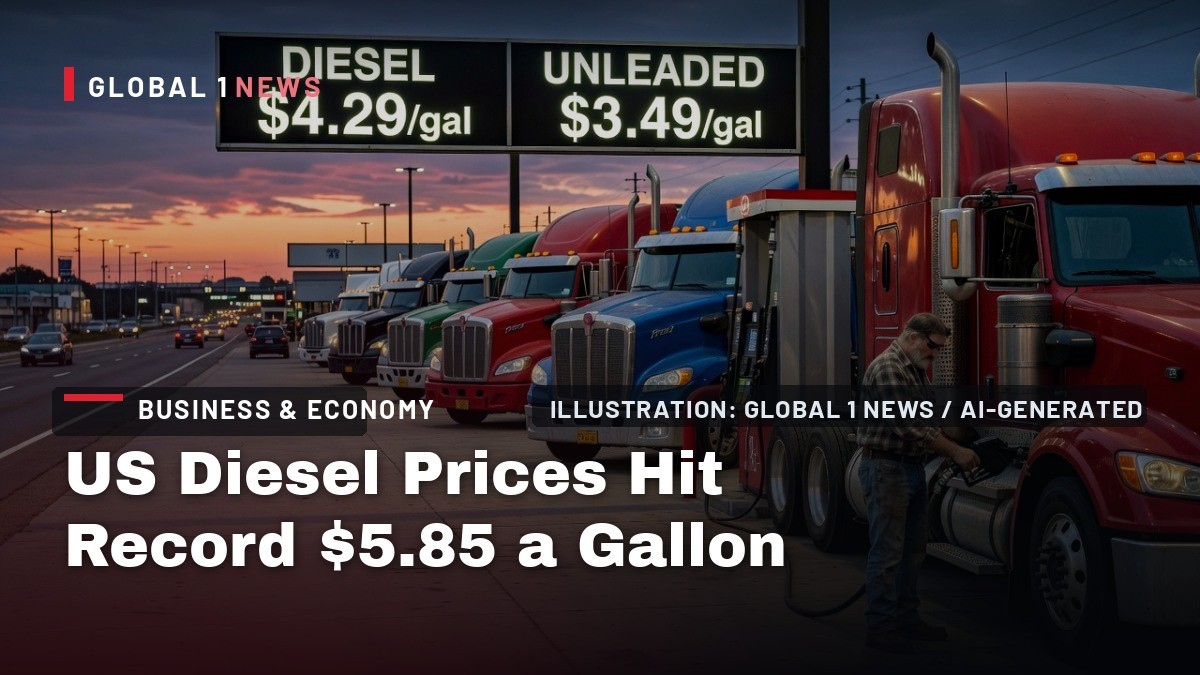
The national average price of diesel fuel hit an all-time high of $5.85 per gallon last Friday, according to AAA data, and the pain is only beginning to spread through the American economy. This is not an abstract statistic for Wall Street traders; it is a stealth tax on every loaf of bread, every school bus route, and every gallon of heating oil that keeps a family warm this winter.
Record-High US Diesel Prices Hit $5.85 a Gallon, Threatening to Raise Costs of Food, School Buses, and Heating
Washington, D.C. - Labor Day weekend 2026 -- The record was set on Friday, September 4, and it still stands as Americans close out the summer driving season. The national average price of diesel now sits at $5.85 per gallon, according to AAA data reported that same day. That figure eclipses the previous record of $5.81 a gallon set in June 2022, just months after Russia's full-scale invasion of Ukraine. But this time, the causes are not singular. They are layered, overlapping, and deeply entrenched in two separate wars that have taken a wrecking ball to global refining capacity.
Diesel is up nearly 60% from the same time last year, when it cost $3.71 a gallon. In California, drivers and businesses are paying about $7.70 a gallon, almost $2 more than the national average. To put that in perspective, a gallon of diesel cost $3.76 on the eve of the Iran war. It is now up more than $2. And while gasoline prices have also climbed -- regular unleaded averaged about $4.14 to $4.15 a gallon, already the highest price ever recorded for September and well above the $3.80 drivers paid around July 4 -- diesel is the fuel that should worry you more.
Why Diesel Matters More Than Gasoline
Gasoline gets the headlines because everyone sees it at the pump. But diesel is the fuel most embedded in the economy. It powers the "three t's" of the American supply chain -- trains, tractors, and trucks -- as Patrick De Haan, petroleum analyst at GasBuddy, put it. When diesel prices spike, the cost does not stay at the fuel pump. It moves through the entire economy, silently and relentlessly.
Bob McNally, founder of Rapidan Energy, calls diesel "the important macro fuel to watch." It is used in transportation, heating fuel, agriculture, and industrial applications. There is no way around it. John Kilduff, partner at Again Capital, put it bluntly: "You can do all the virtual shopping you want, it's all going to come to your house on a truck that ran on diesel fuel so there's no way around it."
That is the core problem. You cannot opt out of diesel. You cannot switch to a different fuel for the truck that delivers your groceries or the tractor that plants your food. Diesel is the circulatory system of the American economy, and right now, that system is under severe strain.
The Stealth Tax on Everything You Buy
Andy Lipow, president of Lipow Oil Associates, described diesel as a "stealth tax." The higher fuel cost is passed on to the consumer in the form of higher prices for the goods and services that are delivered by diesel. You do not see a separate line item on your receipt for fuel surcharges, but they are there, baked into every price tag.
Record diesel prices threaten higher grocery bills, with refrigerated foods among the first to feel the squeeze. Goods from seafood to furniture are affected because nearly everything sold in stores travels by diesel truck at some point. De Haan warned that "there's going to be a trickle down" from these higher costs. That trickle is already becoming a stream.
Consider the path of a simple item like a carton of milk. It starts at a farm, where diesel-powered tractors and milking equipment are essential. It moves to a processing plant on a diesel truck. It travels to a distribution center, then to a grocery store, all on diesel. Every mile of that journey now costs more, and those costs are passed along to you.
School Buses Stretch District Budgets
The pain is not limited to grocery aisles. About 90% of the nation's roughly 500,000 school buses run on diesel, and rising prices have stretched district budgets as the new school year begins. School districts across the country are now facing a stark choice: cut bus routes, reduce extracurricular activities, or find money elsewhere in already tight budgets.
This is not a hypothetical concern for the fall semester. The new school year is underway, and districts that locked in fuel contracts over the summer are now watching those contracts expire. The districts that did not hedge against price spikes are paying the full freight of this record diesel market. Some are considering four-day school weeks to save on transportation costs. Others are asking parents to drive their children to school, which only shifts the burden onto families already struggling with high gasoline prices.
Farming and Food Production at Risk
Farm equipment relies heavily on diesel, so higher fuel costs risk making farming -- and eventually food -- more expensive. The harvest season is approaching, and farmers are facing a brutal math problem. Every acre they plant, every field they irrigate, and every bushel they transport now carries a significantly higher fuel cost.
This is not just about the big agribusiness operations. Small and mid-sized farms, which often operate on razor-thin margins, are particularly vulnerable. When diesel prices rise, farmers have limited options. They cannot simply stop using their tractors. They cannot easily switch to electric equipment. They absorb the cost, or they pass it on, and in a competitive market, passing it on is not always possible.
The result is a squeeze on the entire food supply chain. Higher input costs for farmers will eventually translate into higher prices at the grocery store. The refrigerated foods sector, which relies on diesel-powered cold chains to keep products fresh from farm to table, is among the first to feel the squeeze. But the impact will spread far beyond perishables.
Two Wars, One Global Refining Crisis
So how did we get here? The answer lies in two overlapping conflicts that have fundamentally disrupted global refining capacity. The war with Iran has disrupted shipping through the Strait of Hormuz and regional energy infrastructure. Meanwhile, Ukrainian attacks on Russian refineries have strained fuel exports from the region and forced Moscow to ban diesel exports.
These are not minor disruptions. Russia's diesel export ban affects roughly 800,000 barrels per day of supply. Strait of Hormuz disruptions have affected about 1.2 million barrels per day. And Iran's Houthi allies knocked out Saudi Arabia's Jizan refinery, which produces about 200,000 barrels per day, according to Andy Lipow.
Add it all up, and the wars have shut down refineries totaling about 5 million barrels per day of capacity, according to Gary Simmons, chief operating officer of Valero, speaking on the refiner's July 30 earnings call. That is a staggering amount of refining capacity taken offline. To put it in context, about 8% of the diesel needed to supply global demand of 28 million barrels per day is disrupted right now, Lipow said.
Refining Fundamentals Are Tight and Getting Tighter
The industry saw this coming. Brian Mandell, executive vice president for marketing at Phillips 66, said on an August 5 earnings call that "refining fundamentals are very tight and getting tighter with the issues in Russia and the Mideast." That was a month ago, and the situation has only deteriorated since.
Dan Pickering of Pickering Energy noted that the bigger problem in the global market is diesel specifically rather than crude oil broadly. This is a crucial distinction. Crude oil prices matter, but the refining bottleneck is what is driving diesel prices to record levels. Even if crude prices stabilize, the lack of refining capacity means diesel will remain scarce and expensive.
The refining crisis is not just about the wars, though they are the immediate trigger. The global refining industry has been underinvesting for years, and the pandemic accelerated a wave of refinery closures. When the wars knocked out additional capacity, there was no spare capacity to fill the gap. The system is running on a knife's edge, and any further disruption could push prices even higher.
Who Pays the Price?
The burden of these record diesel prices is not shared equally. US inflation across the economy was up 3.4% over the past year, according to the latest Consumer Price Index data released in August 2026. Energy prices are up significantly, eating into budgets especially among lower-income households, according to an analysis from the Federal Reserve Bank of New York.
Lower-income households spend a larger share of their income on necessities like food and heating. They are less likely to have the flexibility to absorb higher costs or to switch to more efficient vehicles. They are also more likely to live in areas where public transportation is limited, forcing them to drive more. The stealth tax of diesel hits them hardest.
But make no mistake, this affects everyone. The higher cost of diesel will ripple through the economy in ways that are not immediately obvious. Winter heating bills will rise, particularly in the Northeast, where many homes rely on heating oil. The cost of shipping goods will increase, and those increases will be passed on to consumers. The record diesel price is not just a number on a screen. It is a tax on every American who eats food, sends their children to school, or heats their home.
What to Watch Next
The next data point will come from the US Energy Information Administration, which publishes weekly gasoline and diesel price data. Its next release was scheduled for September 9, 2026. That report will show whether the record set last Friday is a peak or a stepping stone to even higher prices.
The key variables are the wars. If the conflict with Iran escalates further, the Strait of Hormuz disruptions could worsen. If Ukrainian attacks on Russian refineries continue, Moscow's diesel export ban could remain in place indefinitely. There is no clear path to de-escalation on either front, and the global refining system has no cushion to absorb further shocks.
For now, Americans are left to navigate a world where diesel costs nearly $6 a gallon on average, and more than $7.70 in California. The record set last Friday is not just a statistic. It is a warning. The cost of everything you buy, everything you eat, and everything you heat your home with is about to go up. The stealth tax is real, and it is not going away anytime soon.
By Jessica Ali, Staff Writer
This article was produced with AI-assisted research and editorial support. Sources: AAA, NPR, CNBC, The Associated Press via Fortune, GasBuddy.
What's Your Reaction?
 Like
0
Like
0
 Dislike
0
Dislike
0
 Love
0
Love
0
 Funny
0
Funny
0
 Wow
0
Wow
0
 Sad
0
Sad
0
 Angry
0
Angry
0

Editor-in-Chief at Global1.News. Atlanta-based journalist who cuts through the BS and tells it like it is. Lead anchor, host, and the voice you hear when the spin stops and the truth starts.















Comments (0)