
Ukraine's Drone War Reaches Deep Into Russia's Heartland
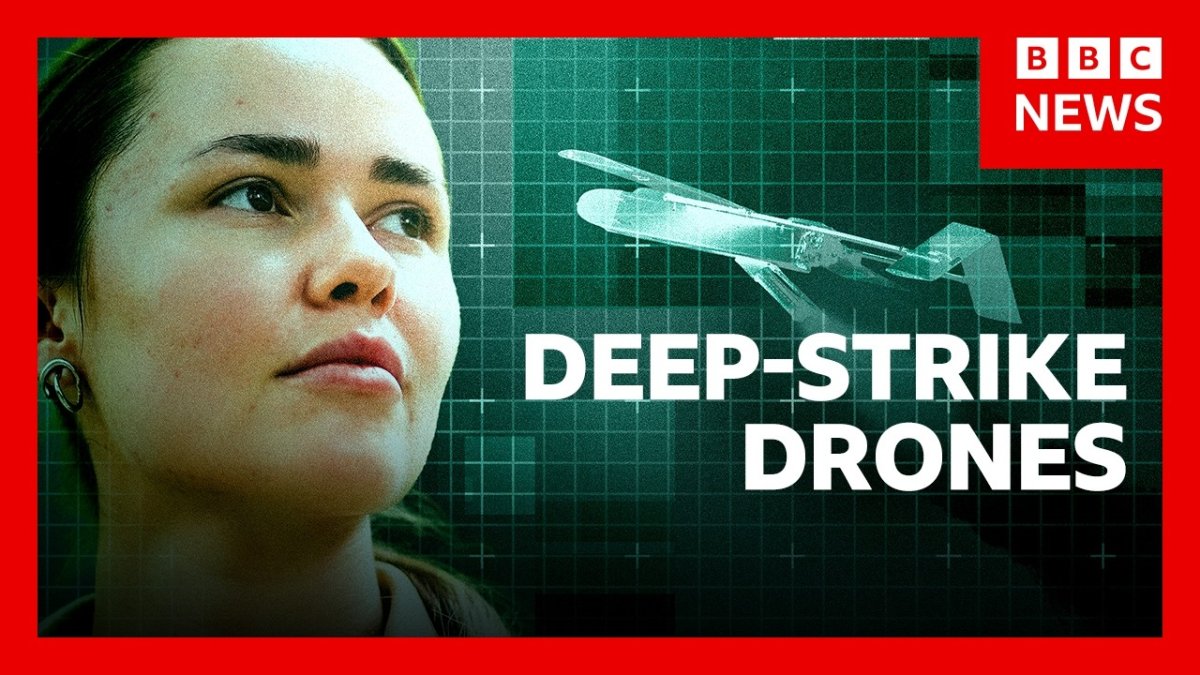
In a recent BBC News Security Brief report, hosted by Christian Fraser with former senior British military officer Mikey Kay, the escalating campaign of Ukrainian attack drones striking deep inside Russia was examined in detail.
In a recent BBC News Security Brief report, hosted by Christian Fraser with former senior British military officer Mikey Kay, the escalating campaign of Ukrainian attack drones striking deep inside Russia was examined in detail. What began as an improvised response to a full-scale invasion has matured into a systematic deep-strike operation reaching from the Black Sea to the Siberian steppe — a campaign that is reshaping the war's economics and forcing NATO to rethink its own procurement priorities.
Ukraine's Drone War Reaches Deep Into Russia's Heartland
Kyiv, Ukraine – 31 July 2026 — Ukrainian long-range drones have spent the week striking oil refineries, military plants and logistics hubs across the Russian heartland, from the Volga to Siberia, in one of the most sustained deep-strike campaigns of the war. Moscow's air defences claim to have intercepted hundreds of drones, yet the attacks continue — and the Kremlin has so far offered no public path toward de-escalation.
The Deep-Strike Campaign Reaches Russia's Heartland
This week, Ukrainian forces struck Russia's largest oil refinery in the Siberian city of Omsk, roughly 2,500 kilometres from Ukrainian territory and close to the border with Kazakhstan. Plumes of black smoke were seen rising over the facility after the attack, which Ukrainian officials described as one of the deepest strikes of the war. President Volodymyr Zelensky seized on the operation to declare that Kyiv's upgraded drone capabilities had put Siberia — long considered a secure rear area — "within reach."
The Omsk attack is not an isolated event but part of a deliberate escalation. In recent months, Ukraine has methodically expanded the range and scale of its strikes against Russian energy infrastructure, military factories and transport networks, seeking to cut the revenues that fund Moscow's war effort and to raise the cost of the invasion for the Kremlin. Ukrainian officials argue that refineries and terminals are legitimate military targets because they sustain the Russian armed forces; the strikes are designed, in Kyiv's telling, to force President Vladimir Putin toward a settlement he has so far refused to contemplate.
The sheer breadth of targets struck in a single week illustrates how far the campaign has come. According to Reuters reporting, drones hit oil refineries and logistics facilities in Perm, Ryazan and Taganrog, as well as targets on the Crimean peninsula, overnight earlier this week — a pattern that stretches across more than a thousand kilometres of Russian territory and suggests a level of planning and coordination that would have been unthinkable two years ago.
From Cheboksary to Volgograd: The Expanding Target Map
The strike map now extends far beyond the border regions. In June, Ukrainian forces used FP-5 Flamingo cruise missiles to hit the VNIIR-Progress military plant in Cheboksary, in the Chuvash Republic, more than 900 kilometres from the front line. Zelensky said the facility supplied the occupier's army with components for drones and missiles, and Ukrainian military officials reported a fire at the site. The Chuvash regional head, Oleg Nikolaev, confirmed that Cheboksary had been attacked and that three people were injured, without saying whether the plant itself was damaged. The FP-5 Flamingo carries a 1,150-kilogram warhead and has a reported range of 3,000 kilometres, placing Moscow and most of European Russia within reach.
This week's wave has also hit the civilian economy in ways that are difficult for the Kremlin to spin. On the night of Wednesday, drones attacked a logistics centre of the Russian online marketplace Wildberries and an oil refinery in Volgograd, sparking fires at both sites. A Wildberries warehouse in Ryazan was targeted earlier in the week, and a Wildberries logistics centre on the outskirts of Penza was hit the following night. Striking e-commerce distribution hubs may seem a strange choice for a military campaign, but analysts suggest it serves a dual purpose: disrupting the supply chains that keep the Russian home front functioning while demonstrating that no part of the country's war economy is beyond reach.
Ukraine has also repeatedly struck the Moscow-occupied port of Mariupol on the Sea of Azov, an oil refinery in Samara, and a "shadow fleet" tanker in the Black Sea — attacks aimed as much at Russia's export earnings as at its battlefield logistics. Together, the strikes form a widening arc that runs from the Black Sea coast, through the Volga region, to the Urals and Siberia.

AI Targeting and the "Logistics Lockdown"
Behind the expanding target map lies a technological leap. BBC Verify has documented how Ukraine is using AI-enabled Hornet drones to strike Russian supply convoys, confirming at least 14 incidents in a single week along routes connecting Russia to Crimea and the occupied territories of southern Ukraine. Defence Minister Mykhailo Fedorov described the strategy as a "logistics lockdown" designed, in his words, to "increase pressure on the Russian military in the rear and deny the enemy the ability to conduct sustained offensive operations."
The numbers suggest the pressure is real. Clément Molin, an analyst at the think tank Atum Mundi, confirmed the destruction of 150 vehicles more than 20 kilometres from the front line, a figure he estimated represented only about half of all incidents. Cristian Vlas of the conflict monitoring group ACLED said Russia had been forced to shorten its convoys as a "quick coping mechanism to reduce potential damage," while Robert Tollast of the Royal United Services Institute noted that Russian brigades require several hundred tonnes of fuel, food and ammunition every day — supplies that are now vulnerable at distance. Nick Brown, a weapons expert at the defence intelligence company Janes, explained that Hornet drones carry AI targeting systems trained on thousands of hours of video of Russian military equipment and can connect to operators through the Starlink network, making them far more resistant to jamming than earlier models.
George Barros of the Institute for the Study of War argues that this drone superiority has helped Ukraine regain more ground than it is losing for the first time since 2023, and has neutralised Russia's advantage in sheer troop numbers. He cautions, however, that the advantage may be short-lived as Moscow develops countermeasures.
Russia's Response and the Fuel Crisis
The Kremlin has responded with public defiance and a familiar script. The Russian military said its air defences intercepted hundreds of Ukrainian drones overnight during the largest attacks, and officials have sought to play down the damage. President Putin has rejected all negotiation proposals and said he saw no point in meeting Zelensky, insisting that Russian forces are advancing along the front — although independent analysis suggests the front line has been largely static for months.
On the home front, however, the evidence of strain is harder to disguise. The campaign against refineries has intensified a fuel crisis that became visible in June, when long queues formed at petrol stations in Moscow and other cities. For ordinary Russians, the war's costs are increasingly arriving at the pump rather than on the battlefield news bulletins. Analysts suggest the Kremlin's response — scaling up its own drone production, deploying nets and interceptor drones, and placing air defence systems on towers and even tall buildings — reflects a recognition that the deep-strike threat is not going away.
NATO's Drone Edge and the Changing Character of War
Ukraine's drone campaign has also begun to reshape Western defence planning. NATO Secretary-General Mark Rutte, speaking at the alliance's summit in Ankara this month, said drones have "fundamentally altered" the character of modern warfare and have become a "decisive factor" on the battlefield, citing the Russia-Ukraine war as the prime example. He announced the launch of the NATO Drone Edge initiative, under which allies are slated to invest more than $40 billion in counter-drone capabilities over the next five years. "Together, we are building a drone-ready Alliance," Rutte said, adding that NATO is "leveraging the latest innovative technologies, investing in our transatlantic defence industries, and learning real-world lessons from the battlefield in Ukraine."
Finnish President Alexander Stubb drew the same lesson in even blunter terms, arguing that Zelensky now "has the cards" for long-range strikes and estimating that Ukrainian attacks have cut Russia's refining capacity to produce and export by roughly 40 percent. Security analysts increasingly describe Ukraine not as a mere beneficiary of Western military aid but as a laboratory and proving ground for the drone tactics that NATO allies themselves now urgently need to master.
Analysis — A War of Attrition at Distance
The deep-strike campaign is, in essence, an attempt to change the war's centre of gravity. For more than four years, the conflict has been decided largely along a grinding front line; Ukraine's drone offensive seeks to open a second front inside Russia itself — economic, logistical and psychological — where Moscow's vulnerabilities are greatest. Whether it can force Putin to the negotiating table remains an open question, and the risk of escalation is real: every strike on Russian soil strengthens hardliners in Moscow who argue for retaliation, and the Kremlin has shown it can absorb extraordinary punishment while continuing its own missile and drone barrages against Ukrainian cities.
Barros's warning that Ukraine's drone advantage may be short-lived is the crucial caveat. Russia has proven adaptive throughout the war, and its development of countermeasures — electronic warfare, interceptor drones, layered defences around critical infrastructure — is already under way. The coming weeks will test whether Kyiv can sustain the tempo, whether Western partners will supply the long-range components Ukraine needs, and whether the fuel crisis spreading through Russian cities begins to move public opinion in ways the Kremlin cannot control. What is no longer in doubt is that the war has entered a new phase: the front line is no longer the only battlefield, and the drones that once seemed a novelty have become the decisive instruments of a war of attrition fought at distance.
By Irina Volkov, Staff Writer
This article was produced with AI-assisted research and editorial support. Reporting is based on sources cited in the article.
What's Your Reaction?
 Like
0
Like
0
 Dislike
0
Dislike
0
 Love
0
Love
0
 Funny
0
Funny
0
 Wow
0
Wow
0
 Sad
0
Sad
0
 Angry
0
Angry
0

Russia/Eastern Europe Correspondent at Global1.News. Covering Russian politics, energy, security, and the shifting dynamics of the post-Soviet space. Provides clear-eyed analysis on one of the world's most opaque regions.













Comments (0)