
Ovechkin to Launch His Own Beer Brand in Russia
Washington Capitals forward Alexander Ovechkin is set to add a new line to his public persona this autumn: the launch of a personal beer brand in Russia.
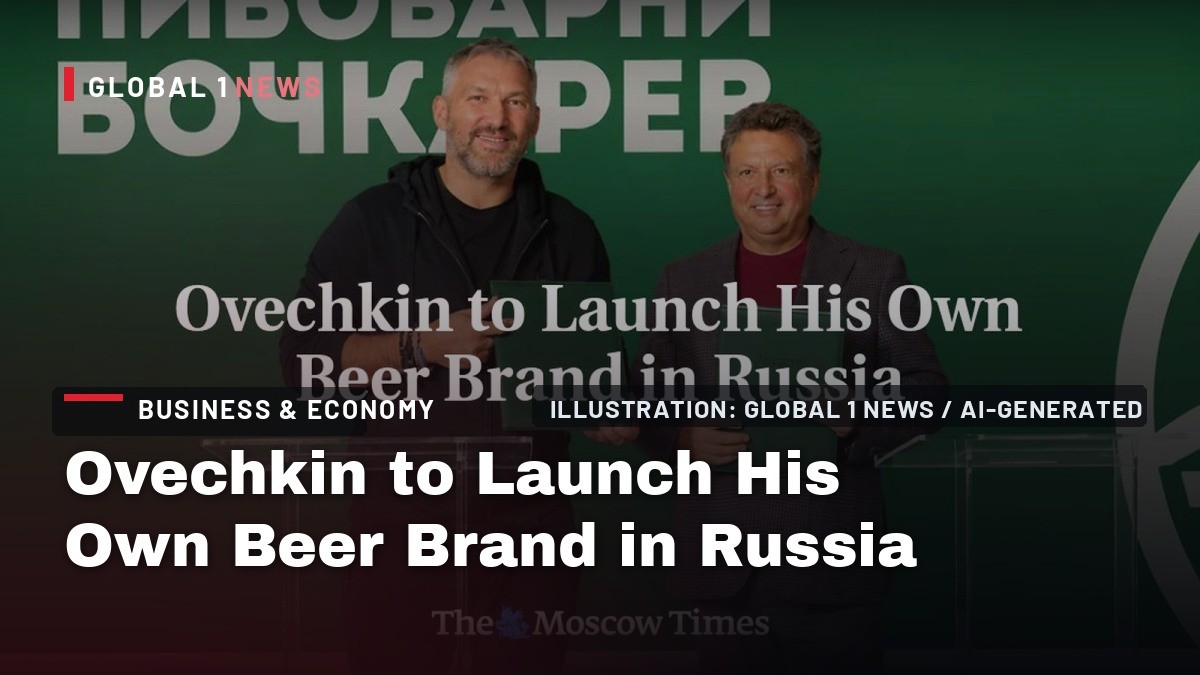
Washington Capitals forward Alexander Ovechkin is set to add a new line to his public persona this autumn: the launch of a personal beer brand in Russia. The OVI range, to be brewed by Bochkarev Breweries, will hit shelves before the close of 2026, according to the Kommersant newspaper. Priced at roughly 100 rubles per can, the line will comprise a classic lager, a lower‑alcohol variant and an alcohol‑free brew, reflecting Ovechkin’s stated preference for pale, clean‑tasting beers. This commercial venture intertwines the star athlete’s high‑profile political alignment with a corporate entity that has thrived on the exodus of Western businesses from the Russian market.
Ovechkin’s Brand and Its Market Position
The OVI brand will be produced by Bochkarev Breweries, a subsidiary of the Arnest group. Bochkarev ranks third in Russia by beer production volume, offering established labels such as Bochkarev, Okhota and Krusovice. By attaching Ovechkin’s name to a product line already positioned among the nation’s leading brewers, the venture gains immediate distribution reach and brand recognition. The price point of about 100 rubles per can places the beer in the mass‑market segment, making it accessible to a broad consumer base.
In comments supplied to Kommersant by the brewer’s press office, Ovechkin said he had long wanted “to create my own beer, one that I would enjoy drinking myself,” emphasizing a personal connection to the product rather than a purely commercial endorsement. This narrative aligns with a broader Kremlin‑friendly image that the athlete has cultivated, presenting him as a patriotic figure who supports domestic industry.
The Arnest Group’s Rise from Western Asset Acquisitions
Arnest, led by businessman Alexei Sagal, has expanded rapidly by acquiring the Russian assets of departing Western firms. Its brewing arm was built around Heineken’s former Russian operations, which Arnest purchased in 2023 for a symbolic one euro. Since then, Arnest has added aluminum packaging plants from Ball Corporation (2022), Oriflame’s Russian assets, Unilever’s Russian business, and most recently Avon’s Russian operations (2026). An agreement to acquire Reckitt’s assets is also pending.
These acquisitions illustrate a systematic transfer of foreign‑owned production capacity into Russian hands, a process accelerated by the full‑scale invasion of Ukraine in 2022. By absorbing former Western brands, Arnest not only secures valuable infrastructure but also inherits market share previously held by multinational corporations, reinforcing its position as a key beneficiary of the “Western corporate exodus.”
Political Connections Behind the Deal
The rapid consolidation of former Western assets under Arnest has not occurred in a vacuum. According to The Bell, Alexei Dyumin—a former bodyguard of President Vladimir Putin who now serves as secretary of the State Council—helped Sagal lobby for the Heineken and Unilever acquisitions. The same report notes ties between Sagal and Denis Manturov, who headed the Ministry of Industry and Trade for many years. These links suggest that Arnest’s expansion has been facilitated, at least in part, by proximity to Kremlin‑aligned officials.
Sagal himself attributes his success to a strategy of approaching Western companies directly, a claim that downplays the role of political patronage. Nonetheless, the involvement of high‑level figures such as Dyumin indicates that state influence may have smoothed the path for these large‑scale takeovers, reinforcing the perception that Arnest operates within a privileged network of Kremlin‑friendly business actors.
Ovechkin’s Political Profile and Western Backlash
Ovechkin’s foray into the Russian consumer market follows a fresh wave of controversy over his political activities. In September 2026, he appeared in a campaign video for United Russia, the ruling party, ahead of the State Duma elections. When questioned about his participation, he affirmed his Russian identity and support for his country. The video provoked criticism in the West: Latvia barred him from entry, the Ukrainian Canadian Congress called for Canadian sanctions, and U.S. Representative Joe Wilson urged the NHL to review Ovechkin’s involvement in the political advertisement.
Since at least 2017, Ovechkin has publicly supported President Vladimir Putin, founding the “Putin Team” movement. After Russia’s 2022 invasion of Ukraine, he expressed a desire for peace and an end to fighting, a stance that, while ostensibly humanitarian, has been interpreted as an attempt to balance personal brand considerations with the expectations of Russian authorities. His continued alignment with the Kremlin has made him a target for sanctions and reputational attacks abroad, intensifying the symbolic weight of his domestic commercial ventures.
Commercial Strategy Amid Sanctions and “Undesirable” Designations
The timing of the OVI launch coincides with heightened pressure on entities linked to the Russian state. The Moscow Times, the source of this reporting, has been designated an “undesirable” organization by Russia’s Prosecutor General’s Office, a label that criminalizes its operations. While the article’s primary focus is Ovechkin’s beer, the broader context underscores how Russian businesses and public figures navigate a landscape marked by sanctions, asset seizures, and media repression.
By partnering with a domestically controlled brewer, Ovechkin sidesteps potential complications that could arise from foreign licensing agreements or imports. The domestic production model aligns with the Kremlin’s “import substitution” narrative, reinforcing the image of a self‑sufficient Russian economy. Moreover, the price point of 100 rubles per can suggests an intention to capture mass‑market demand without relying on premium positioning that might be vulnerable to consumer backlash.
Implications for Kremlin Influence and Consumer Perception
The OVI brand serves as a case study in how high‑profile athletes can be leveraged to bolster state‑aligned commercial enterprises. Ovechkin’s endorsement lends a veneer of patriotic legitimacy to Arnest’s operations, potentially mitigating consumer skepticism about the origins of the acquired Western assets. In a market where nationalistic sentiment has been amplified since 2022, the coupling of a beloved sports figure with a home‑grown beer brand may enhance public acceptance of products that were once foreign‑owned.
At the same time, the venture illustrates the symbiotic relationship between Kremlin‑friendly business conglomerates and celebrity endorsers who share the regime’s political outlook. As Arnest continues to absorb former Western enterprises, its partnership with Ovechkin reinforces a feedback loop: state‑aligned businesses gain market share, while high‑profile supporters receive commercial opportunities that further embed them within the Russian economic sphere. The OVI launch, therefore, is not merely a commercial footnote but a strategic reinforcement of the intertwining of sport, politics, and economic nationalism in contemporary Russia.
This article was produced with AI-assisted research and editorial support. Reporting is based on the source material cited below. Sources: The Moscow Times; themoscowtimes.com; Global1.News (08 October 2026).
By Irina Volkov, Staff Writer
What's Your Reaction?
 Like
0
Like
0
 Dislike
0
Dislike
0
 Love
0
Love
0
 Funny
0
Funny
0
 Wow
0
Wow
0
 Sad
0
Sad
0
 Angry
0
Angry
0

Russia/Eastern Europe Correspondent at Global1.News. Covering Russian politics, energy, security, and the shifting dynamics of the post-Soviet space. Provides clear-eyed analysis on one of the world's most opaque regions.











Comments (0)