
Thai PM Welcomes Myanmar's Min Aung Hlaing Amid Sharp Criticism
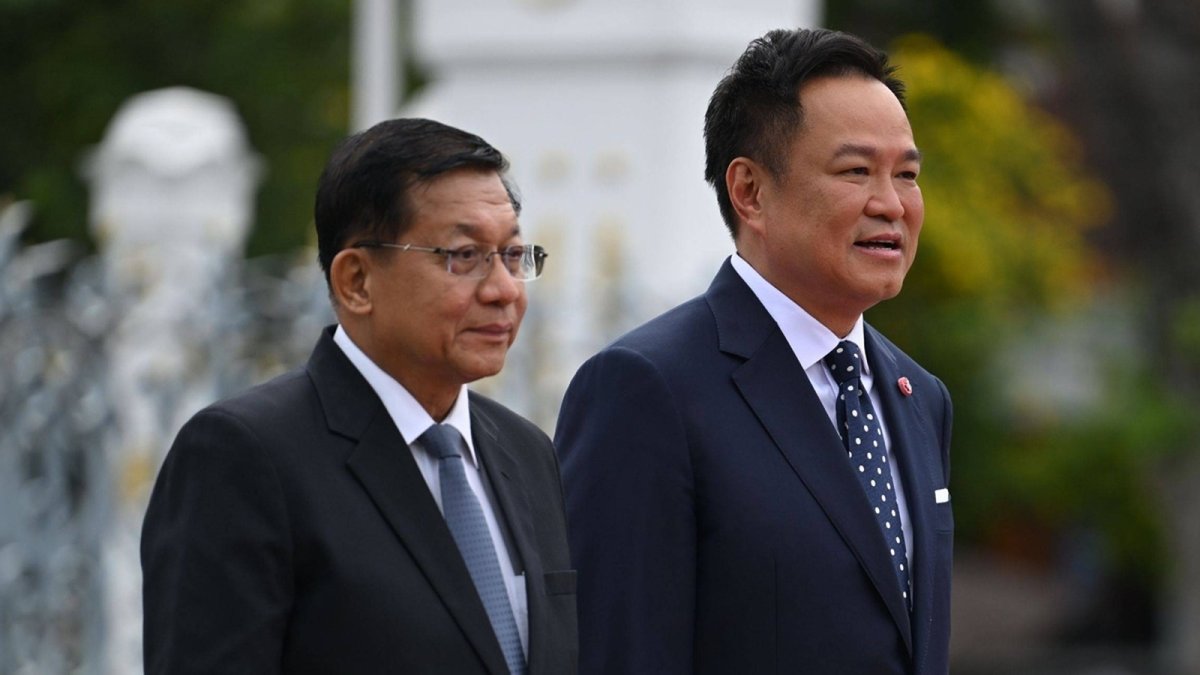
Bangkok, Thailand — Prime Minister Anutin Charnvirakul officially welcomed Myanmar President Min Aung Hlaing to Government House today for two days of bilateral talks, a visit that drew immediate condemnation from Thai civil society groups, democracy advocates and opposition politicians who argue the reception hands legitimacy to a military leadership blamed for widespread violence since the 2021 coup.
Thai PM Welcomes Myanmar's Min Aung Hlaing Amid Sharp Criticism
Bangkok, Thailand — Prime Minister Anutin Charnvirakul officially welcomed Myanmar President Min Aung Hlaing to Government House today for two days of bilateral talks, a visit that drew immediate condemnation from Thai civil society groups, democracy advocates and opposition politicians who argue the reception hands legitimacy to a military leadership blamed for widespread violence since the 2021 coup. The Myanmar leader arrived as an official guest of the Thai government, with the two sides discussing cross-border issues, energy cooperation and trade facilitation even as sixteen civil society organizations issued a joint statement urging Bangkok to stop policies they say benefit Myanmar's military administration.
Official Welcome at Government House
Prime Minister Anutin Charnvirakul welcomed Myanmar President Min Aung Hlaing to the lawn in front of the Thai Khu Fah Building at Government House today at 10:20. Anutin received the visitor before they attended a formal welcoming ceremony and reviewed an honor guard together. The event took place amid Bangkok's busy government district, where Thai officials coordinated security with the Royal Thai Police.
Discussions on Border and Energy Cooperation
The leaders first held a restricted meeting on the second floor of the Thai Khu Fah Building. They exchanged views on cross-border issues, energy cooperation, trade facilitation, and efforts to promote peace along the Thai-Myanmar border. The talks later expanded into a plenary session in the Green Room. According to the Prime Minister's Office, these topics directly affect daily life for communities in Chiang Mai and the Isaan region, where border trade supports local markets and energy projects supply electricity to Thai households.
Thailand's Stance on ASEAN Consensus
Earlier this week, Anutin defended Thailand's approach while speaking at the ASEAN Secretariat in Jakarta. He stated that ASEAN's Five-Point Consensus remains the bloc's principal framework for the Myanmar crisis and reaffirmed support for a policy of calibrated re-engagement. Anutin explained that this approach preserves channels of dialogue, creates space for engagement, responds to realities on the ground, and encourages tangible progress. A peaceful and stable Myanmar serves Thailand's interests as a neighboring country and supports ASEAN unity across Southeast Asia.
Prime Minister Anutin Charnvirakul defended Thailand's calibrated re-engagement policy during his remarks at the ASEAN Secretariat in Jakarta on 4 August, describing the Five-Point Consensus as the bloc's principal framework for addressing the Myanmar crisis. This approach seeks to maintain neighborly communication while upholding ASEAN unity, allowing Thailand to discuss practical matters such as border trade and energy cooperation without fully endorsing the current Myanmar administration. The policy reflects Thailand's geographic position as a frontline state sharing a long land border with Myanmar, where daily flows of goods, workers and resources require ongoing coordination. For Thai readers, this balance illustrates how diplomacy can address immediate needs like cross-border commerce and labor mobility while still aligning with regional calls for an end to hostilities under the consensus reached in April 2021.
The Five-Point Consensus, agreed upon in April 2021, provides a structured path that includes an immediate cessation of violence, delivery of humanitarian assistance and inclusive dialogue among all stakeholders. Thailand's calibrated stance aims to keep these elements central even as it engages on technical issues such as energy projects and trade facilitation along the Thai-Myanmar border. This positioning helps preserve ASEAN cohesion at a time when member states hold differing views on the pace of re-engagement. By framing the policy in Jakarta, Anutin signaled Thailand's commitment to collective mechanisms rather than unilateral actions, which carries implications for regional security and the movement of people across Southeast Asia. Thai border communities benefit from stable relations that support continued economic activity without compromising the consensus framework.
A stable Myanmar remains important for Thailand because prolonged conflict disrupts supply chains, affects energy imports and places pressure on migrant worker communities that number more than two million registered individuals contributing to the Thai economy. The calibrated re-engagement approach allows Thailand to advocate for practical outcomes on issues like river pollution and transnational crime while reinforcing ASEAN's role in promoting dialogue. This perspective encourages Thai readers to view the policy as a pragmatic expression of cultural values that favor harmony and mutual support among neighbors, ensuring that diplomatic engagement serves both national interests and the broader goal of regional peace established through the Five-Point Consensus.
Concerns from Civil Society Groups
Sixteen Thai civil society organizations issued a joint statement opposing the official visit. The coalition, led by Solidarity Collective TH and the Spirit in Education Movement, urged the Thai government to stop policies that benefit Myanmar's military administration. The groups highlighted widespread violence, systematic human rights abuses, and alleged war crimes under Min Aung Hlaing's leadership. They called for improved protections for Myanmar migrant workers in Thailand and for independent humanitarian assistance that reaches civilians directly, rather than through military channels.
Their joint statement highlights how Thailand's engagement with Myanmar's military administration could affect daily realities for millions of people across the border. The demands call for an end to any policies that provide economic or diplomatic benefits to the military-led government, while pushing for stronger safeguards for the more than two million registered Myanmar migrant workers already living and working in Thailand. These workers contribute significantly to Thai agriculture, construction and manufacturing sectors, yet they often face uncertain legal status and limited access to services. By urging improved protections, the groups emphasize that Thailand's border communities have long shared cultural and economic ties with Myanmar, making it essential to prioritize humanitarian needs over formal state-to-state relations that might overlook worker vulnerabilities.
In practical terms, the organizations argue that continued high-level talks risk extending the cycle of violence that has displaced families and disrupted cross-border trade routes vital to northern Thai provinces. They advocate supporting independent humanitarian channels that reach affected populations directly, rather than through official structures, to ensure aid reaches schools and hospitals damaged by ongoing airstrikes. This stance reflects a broader Southeast Asian concern that legitimizing military authority could weaken ASEAN's collective voice on human rights, leaving Thailand exposed to criticism from regional partners who also host large Myanmar communities. For Thai readers, the call to reject reintegration of the military government into ASEAN forums until violence ceases underscores the moral weight of Thailand's position as a founding member of the bloc, where neighborly diplomacy must balance with protecting shared regional stability.
The groups further stress that engagement without clear conditions prolongs suffering for ordinary Myanmar citizens whose livelihoods depend on remittances sent from Thailand. With families separated by conflict and economic hardship, civil society sees Thailand's calibrated approach as carrying implications for domestic labor markets and social cohesion in provinces near the border. Their position invites Thai policymakers to consider how migrant worker policies intersect with ASEAN's Five-Point Consensus, which prioritizes an immediate end to hostilities. This perspective resonates in Thai society, where cultural values of compassion and hospitality encourage support for those fleeing instability, reminding readers that Thailand's reputation in Southeast Asia rests on consistent advocacy for peaceful resolution rather than short-term political calculations.
Statements from Thai-Myanmar Foundation
The Thai-Myanmar Foundation released its own statement today condemning the visit. The foundation noted that Min Aung Hlaing seized power in the 2021 military coup, overthrowing an elected government and imprisoning former State Counsellor Aung San Suu Kyi. It cited United Nations figures showing more than 5,000 people killed since the takeover, along with continued airstrikes on schools and hospitals even after the earthquake earlier this year. The foundation also referenced an arrest warrant from an Argentine court and the International Criminal Court prosecutor's request submitted on 27 November 2024 for alleged crimes against humanity.
The foundation's condemnation rests on the argument that the official welcome risks normalizing a leadership it says has broken democratic processes and deepened a humanitarian crisis since taking power. For Thai audiences familiar with the long history of people-to-people connections along the shared border, the foundation's stance serves as a reminder that diplomatic gestures carry consequences for how Thailand is perceived in ASEAN circles committed to peaceful dispute resolution.
International legal developments add weight to the foundation's concerns, including an Argentine arrest warrant issued under universal jurisdiction and the International Criminal Court prosecutor's November 2024 request for an arrest warrant on charges of crimes against humanity. The foundation maintains that granting legitimacy to the military administration through high-level engagement could erode Thailand's own standing on international legal norms, particularly at a time when ASEAN partners look to Bangkok for steady leadership on regional issues. This argument connects directly to Thailand's role in hosting large numbers of Myanmar nationals, whose safety and rights depend on consistent application of humanitarian principles rather than selective recognition of governments. Readers in Thailand may see parallels with past regional crises where early diplomatic acceptance complicated later efforts to restore stability.
By emphasizing these points, the foundation underscores that Thailand's diplomatic choices influence not only bilateral ties but also the broader credibility of ASEAN mechanisms designed to address post-coup challenges. The reference to the 2021 events and subsequent violence illustrates how legitimacy questions extend beyond Myanmar's internal affairs to affect trade corridors, energy projects and migrant flows that Thai border communities rely upon. In this light, the foundation's position encourages Thai citizens to weigh the long-term value of upholding consistent standards on governance and accountability, ensuring that engagement policies do not inadvertently weaken the collective ASEAN framework that has guided Southeast Asian cooperation for decades.
Opposition Questions on Legitimacy and River Pollution
People's Party deputy leader Rangsiman Rome questioned the decision to host the Myanmar president. He told reporters that talks with Myanmar's military authorities are unlikely to resolve toxic contamination in the Kok River, since parliamentary testimony shows the areas are controlled by the United Wa State Army. Rangsiman argued that Thailand should focus instead on dealing with the Wa armed group linked to scam operations, drug trafficking, and human trafficking. He warned that the visit risks conferring legitimacy on Myanmar's military leadership while undermining ASEAN's Five-Point Consensus on an immediate cessation of violence. For Thai readers, these developments affect border security, migrant worker policies, and regional diplomacy that shape everyday economic ties within ASEAN.
The deputy leader's central point is that the affected areas along the Kok River fall under the control of the United Wa State Army, a group he linked to scam operations, drug trafficking, human trafficking and toxic pollution that directly impact Thai water sources and agricultural lands in northern provinces. Rangsiman Rome's argument highlights how transnational crime networks operating across the border create immediate risks for Thai communities, from contaminated fisheries to public health concerns that cannot be resolved through talks focused solely on political recognition. For Thai readers living near these waterways, the issue underscores the need for policies that prioritize practical border management over symbolic gestures that might legitimize actors tied to such activities.
The deputy leader further warned that the visit risks granting undue legitimacy to Myanmar's military administration, thereby undermining the Five-Point Consensus that explicitly requires an immediate cessation of violence as its starting point. This concern resonates in Thailand's domestic political landscape, where opposition voices stress that national interests in clean water, secure borders and reduced cross-border crime should guide engagement decisions. By linking the Kok River pollution to broader patterns of illicit activity, Rangsiman Rome draws attention to how instability in Myanmar affects everyday Thai livelihoods, including trade in goods and labor mobility that sustain local economies. Southeast Asian observers may view this as a cautionary example of how unresolved regional conflicts spill over into neighboring states, complicating ASEAN efforts to maintain collective security.
Rangsiman Rome's intervention places the Thai government in a position where it must demonstrate that bilateral meetings deliver tangible benefits for citizens rather than abstract diplomatic gains. The emphasis on areas controlled by the United Wa State Army illustrates the complexity of border governance, where multiple armed actors influence outcomes beyond the reach of central authorities in either country. Thai readers concerned about energy imports, migrant worker safety and environmental protection along the frontier can see how these issues intersect with questions of legitimacy, reinforcing the view that Thailand's approach should safeguard domestic priorities while supporting ASEAN's shared commitment to ending violence and restoring conditions for stable cross-border cooperation.
By Ann Srisawat, Staff WriterThis article was produced with AI-assisted research and editorial support. Reporting is based on sources cited in the article.
What's Your Reaction?
 Like
0
Like
0
 Dislike
0
Dislike
0
 Love
0
Love
0
 Funny
0
Funny
0
 Wow
0
Wow
0
 Sad
0
Sad
0
 Angry
0
Angry
0

Southeast Asia Correspondent at Global1.News. Based in Bangkok, covering Thai and Southeast Asian politics, economy, technology, and culture. Deep regional perspective on one of the world's most dynamic regions.













Comments (0)