
SpaceX Caught a Starship Out of the Sky. The Booster Never Made It Back.
SpaceX caught its Starship upper stage out of the sky over Texas on Saturday, the first recovery of an orbital rocket's second stage at a launch pad. The Super Heavy booster aborted its own catch and exploded over the Gulf of Mexico.
A spaceship fell out of orbit on Saturday afternoon, dropped through a cloud deck over the Texas coast, stood itself upright on three rocket engines and settled between two steel arms of the tower that launched it 22 and a half hours earlier. No second stage of an orbital rocket has ever done that. Not once, in the entire history of the craft. And a day earlier, minutes after launch, the other half of the same rocket had blown itself apart over the Gulf of Mexico because something went wrong on the way back.
SpaceX Caught a Starship Out of the Sky. The Booster Never Made It Back.
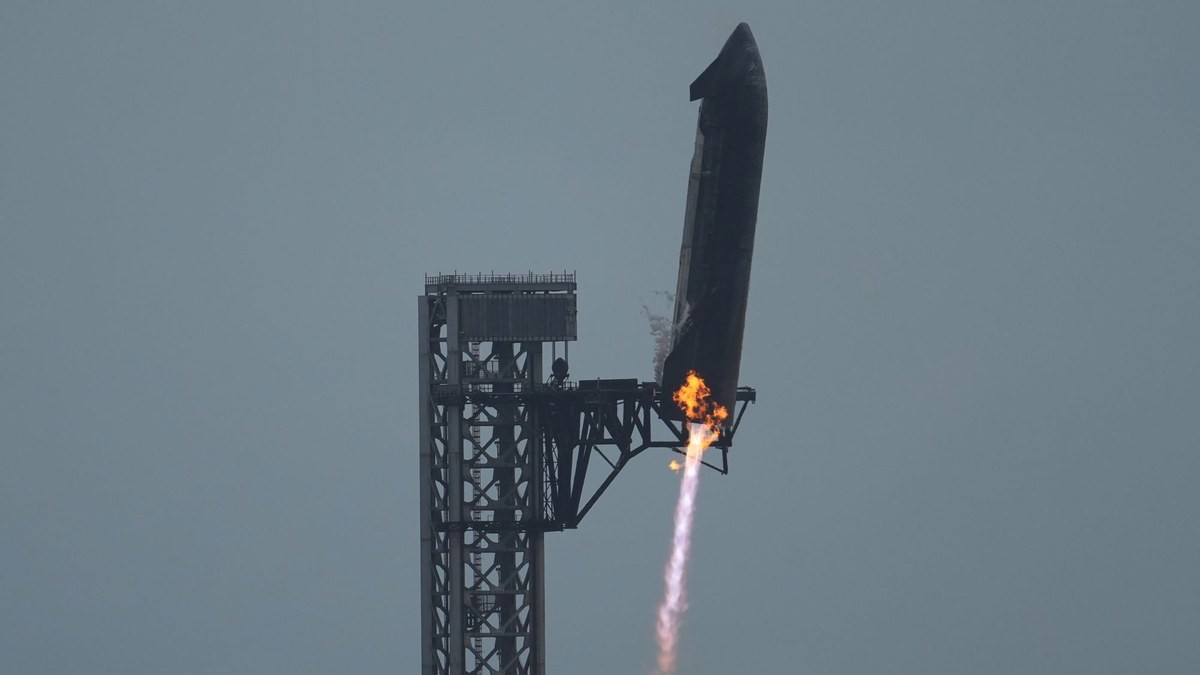
Starbase, Texas — The moment came at about 4:20 p.m. Eastern, and it arrived in almost complete silence from the vehicle itself: a black and silver ship sliding out of the clouds, tilting from horizontal to vertical, and easing into the chopstick arms of the Mechazilla tower as if it were being parked.
The Tower Held
Huge cheers went up from the control room as the ship came to rest. The song playing over the company's video feed was "Baby Come Back" by Player, which is either the best or the worst choice of music ever made for a live broadcast, and SpaceX's commentators were not pretending to be calm about any of it. "That was the Holy Grail of space flight, plummeting through fire to be snatched out of the air by steel," SpaceX spokesman Dan Huot said, in the version of his words carried by AFP. "We caught a Starship and now everything changes." He had already said the shorter version a moment earlier: "That was the missing link."
The reason for the noise is simple enough. Almost every rocket ever flown has thrown its upper stage away. It either burns up on the way down or it becomes another piece of orbital junk, and the millions of dollars of hardware that pushed a payload to orbit ends its life as debris. Landing a first stage and reusing it became routine for SpaceX a decade ago. Landing the part that actually reaches orbit never had been done, by anyone, until Saturday.
Twenty-Two Hours and Fourteen Laps
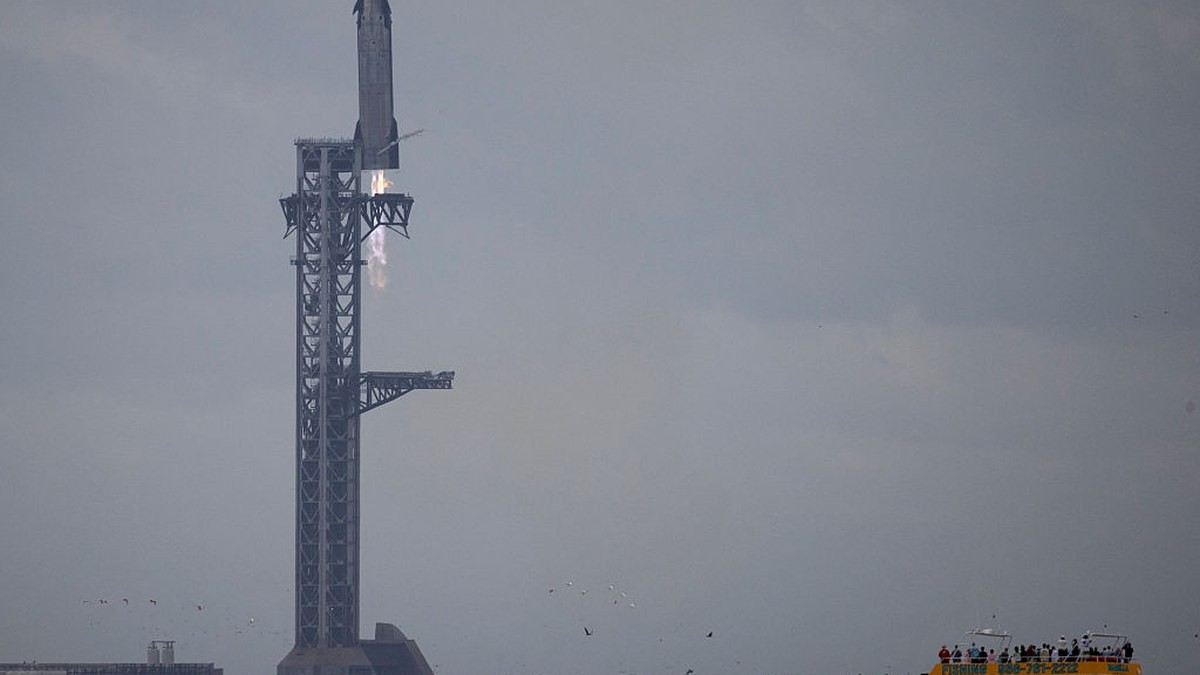
Flight 15 lifted off from Starbase at 5:47 p.m. Eastern on Friday, all 33 Raptor engines on the Super Heavy booster burning under a stack 407 feet tall, and it did so while American airspace was still closed to airliners by a nationwide ground stop. Rockets use different tracking equipment than aircraft. The booster separated about two minutes in and handed the ship, known as Ship 42, to its own engines.
What happened next had only ever happened once. The ship performed its orbital insertion burn, which put a Starship into orbit around the Earth for the second time in the programme's history, after Flight 14 in September. By one hour and 17 minutes into the mission all 26 Starlink V3 satellites had been released from the vehicle's payload bay, and then the ship simply kept going. Flight controllers turned down three separate chances to bring it home early — a splashdown opportunity off Hawaii, another off Chile, and a final check 20 hours and 41 minutes in — and let it fly all 14 laps. "That means this is now going to be the longest Starship mission we've ever flown," Huot said.
The return began with a 10-second burn of a single Raptor engine at about 3:23 p.m. Eastern on Saturday, which dropped the ship out of orbit and pointed it at the atmosphere.
The Booster Aborted, and Then It Exploded
The first stage was supposed to come home too. Super Heavy was meant to fly back to the same tower within minutes of separation and land in the arms, the manoeuvre SpaceX has now pulled off three times. It did not. The booster ended its boostback burn early, and SpaceX's Kate Tice gave the early indications on Saturday's webcast: a low fuel mass alarm. "The team is still investigating the root cause on that," she said.
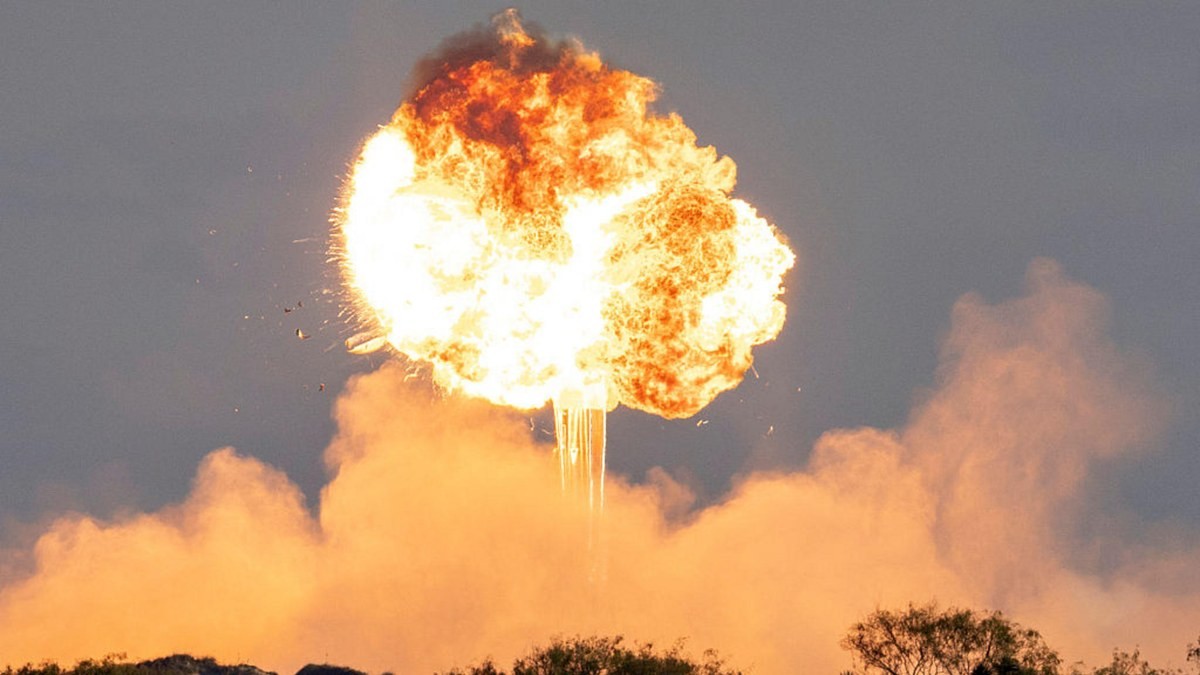
What followed was the guidance system doing its job. The booster detected that it was not in the position it needed to be in to attempt a catch, aborted the landing on its own, and flew out over the water instead. It triggered its flight termination system and exploded just above the surface of the Gulf of Mexico. By Saturday the wreckage was sitting in the water, cordoned off with buoys.
The explanation moved over two days, and it is worth being precise about that. On Friday, Huot attributed the diversion to a guidance, navigation and control issue. On Saturday he explicitly cleared that system, saying it had performed as expected and had correctly called off a catch it could not safely complete.
Two Nubs and a Foot of Margin
The mechanics of the catch are worth a moment, because they explain why this took so long to attempt. The ship did not glide home. It came in belly first, parallel to the ground, then lit engines to flip upright and slow down. Ars Technica, watching from Starbase, described the final approach as slow, gentle and halting.
What the tower actually grabs is almost nothing. Two nubs on either side of the vehicle, each protruding about a foot, were the only purchase the rocket had on the arms. Less than a minute passed between the ship emerging from the cloud deck and being snagged. The margins on a manoeuvre like that are measured in inches and in split seconds, and the whole thing is being attempted with hardware the size of a small building.
Twenty-One Minutes They Cannot Touch It
The risk was not only to the rocket. Coming back from orbit, the ship had to cross land. Its path took it over Baja and northern Mexico, then north of South Padre Island, a popular spring-break destination, before a banking manoeuvre out over the Gulf to approach Starbase from the water. Four flaps on the exterior steered it through a series of small turns, keeping the trajectory over sparsely populated areas.
There is a stretch of that descent where nobody on the ground can help. "Once the rocket is flying over land, there's 21 minutes where the operators can't do anything, and so we're just going to be holding our breath for that time," SpaceX's Lars Blackmore said during Friday's broadcast. The Federal Aviation Administration required SpaceX to show, in its application for this flight, that the probability of a casualty was less than one in a million. Had the tower or any vehicle system looked wrong after reentry, flight controllers had options: tumble the ship deliberately so it broke up in the atmosphere, or send it into the Gulf.
What the Heat Shield Survives
The ship reentered at orbital velocity, above 17,600 miles per hour, and the physics of that are brutal. Air particles hitting the vehicle at that speed tear apart at the molecular level and build a layer of plasma around the exterior that glows orange and reaches more than 2,500 degrees Fahrenheit. What stands between the ship and that is a heat shield made of roughly 18,000 hexagonal ceramic tiles.
Phil Wilson, a SpaceX senior manager for thermal hardware, offered the analogy the company has been using. "You have to think of plasma or the heat load during reentry like a river," he said. If the heat arrived perpendicular, the tiles would melt away; because it flows along the surface, it does not have long enough to destroy the coating. SpaceX checked the shield after launch using long-range ground cameras and cameras mounted on the Starlink satellites the ship had just released, and cleared it for the attempt.
Why This Is Not the Space Shuttle
Reusable spacecraft are not new. NASA's orbiters flew to space and came back to land on a runway for 30 years. But the shuttle was a glider on the way home, with no engines running, and its heat shield was, in Ars Technica's phrase, a delicate flower that needed painstaking refurbishment after every flight. The programme flew 135 missions in three decades and cost far more per pound than promised: NASA once projected as little as $25 per pound to orbit, and the reality came in near $25,000.
SpaceX's ambition is a different order of magnitude. The company wants to fly 135 times a year, and then thousands of times a year, with a vehicle that lands and relaunches the way an aeroplane does. Saturday was the first proof that the hardest half of that idea, catching the part that went to orbit, can actually be done.
The Factory Behind the Catch
A catch is only worth the paper it is written on if there is another ship behind it. SpaceX currently has five Starships in an advanced state of development at Starbase and components for about a dozen more in its factory, according to Ars Technica. The Starfactory can turn out an upper stage once every three weeks. It was sized to build one every three days.
That gap is the whole game. Starship is central to building out the Starlink broadband constellation, particularly with SpaceX planning to retire Falcon 9, the rocket that has carried most of the West's commercial and government payloads for years. A rocket you throw away cannot service a constellation that needs thousands of replacements. A rocket you catch can.
What NASA Is Waiting For
The American human spaceflight programme has a direct stake in this. NASA has awarded SpaceX $2.9 billion in contracts to supply lunar lander variants of Starship for crewed Artemis missions, and the agency is depending on orbital refuelling and repeatable launch to make any of it work.
The plan has already changed shape. Artemis III, originally intended as the programme's first moon landing, is now planned as a two-week demonstration in low Earth orbit, testing docking between the Orion capsule and test versions of both the Starship lander and Blue Origin's Blue Moon. NASA administrator Jared Isaacman greeted Saturday's catch on social media with a simple verdict: "It was almost magic." SpaceX president and chief operating officer Gwynne Shotwell called the vehicle "alien-level technology."
The Next Catch, and the Louisiana Question
Two things now matter more than the applause. The first is why the booster failed, because a rocket that catches its ship but loses its first stage is only halfway to the aeroplane the company keeps promising. The second is where this is all meant to happen next. SpaceX is planning a spaceport in Louisiana's Vermilion Parish, a project it values at $100 billion, with construction expected to begin by the end of next year and a first launch targeted as soon as 2029. It is already contested, with a lawsuit alleging local authorities approved the project behind closed doors and public officials bound by non-disclosure agreements about what was agreed.
Elon Musk marked Saturday the way he marks most things, with a short post congratulating "an incredible team at SpaceX." He is right that the team did something extraordinary. But look at what actually happened this weekend and there is no smoothing it over: the ship came home and the booster did not, on the same flight, and both halves of that sentence are the story. The catching is now proven. The repeating is not. And the difference between those two things is the difference between a spectacular Saturday and a rocket that changes what access to space costs.
By Jessica Ali, Staff Writer
This article was produced with AI-assisted research and editorial support. Sources: Associated Press; BBC News live coverage; CNN live coverage; Ars Technica; Space.com; Aerospace America (American Institute of Aeronautics and Astronautics); The Verge; SpaceX webcast commentary as reported by those outlets. Cover: Global 1 News editorial image. Photographs: Eric Gay/AP; Getty Images via BBC News; Ricardo Arduengo/AFP via Getty Images.
What's Your Reaction?
 Like
0
 Dislike
0
 Love
0
 Funny
0
 Wow
0
 Sad
0
 Angry
0

Editor-in-Chief at Global1.News. Atlanta-based journalist who cuts through the BS and tells it like it is. Lead anchor, host, and the voice you hear when the spin stops and the truth starts.















Comments (0)