
Shipping containers return to Bangkok streets as farmers protest IMF-World Bank meetings
Early Friday morning, the air around Lumpini Park was filled with the steady rhythm of footsteps and the low hum of chants. Their shared mission centers on defending food sovereignty and protecting rural livelihoods from policies they view as imposed by distant financial powers.
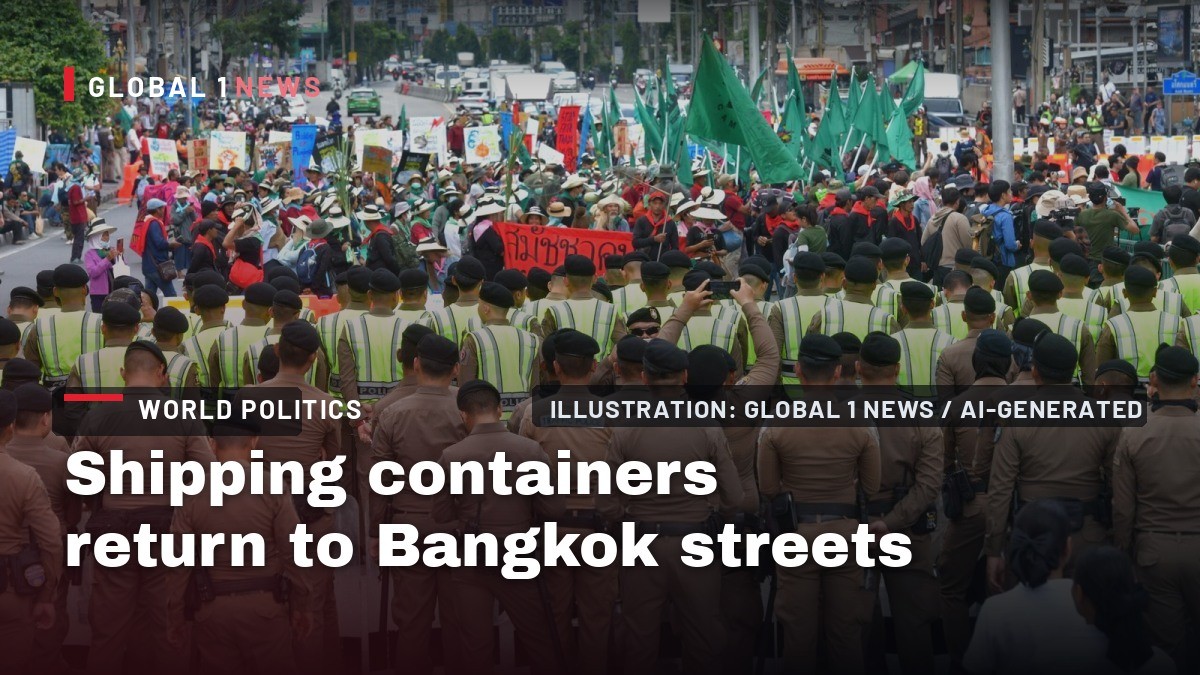
Early Friday morning, the air around Lumpini Park was filled with the steady rhythm of footsteps and the low hum of chants. Members of Thailand’s Assembly of the Poor, part of the global peasant network La Via Campesina, gathered at Gate 1 opposite the police station at 8 a.m., ready to march toward the heart of Bangkok’s financial district. Their destination: the Queen Sirikit National Convention Centre, where the International Monetary Fund and World Bank are holding their annual meetings from 12 to 18 October. The protest, however, met a physical barrier as police deployed shipping containers along Ratchadaphisek Road, turning the city’s thoroughfare into a makeshift barricade.
Roots of the protest: Assembly of the Poor and La Via Campesina
The Assembly of the Poor, a grassroots coalition that has long championed the rights of Thailand’s smallholder farmers, aligns itself with La Via Campesina, an international movement active in more than 60 countries. Their shared mission centers on defending food sovereignty and protecting rural livelihoods from policies they view as imposed by distant financial powers. In Bangkok, the assembly’s presence underscores a deepening concern that global economic decisions made at the IMF‑World Bank gatherings echo in the rice paddies and vegetable fields of Thailand’s countryside.
For many participants, the protest is not merely a political statement but a continuation of a moral tradition rooted in Buddhist principles of compassion and interdependence. The act of marching together, chanting for justice, and confronting state authority reflects a cultural narrative where community solidarity is a cornerstone of Thai identity. This cultural backdrop gives the demonstration a resonance that extends beyond the immediate demands, linking it to a broader vision of a society where economic policies honor the well‑being of all beings.
The logistics of containment: Shipping containers on Ratchadaphisek Road
Metropolitan Police Bureau officers positioned large steel containers on both sides of Ratchadaphisek Road, a major artery that leads directly to the convention centre. The containers serve as a physical deterrent, preventing the marchers from reaching the venue where world finance leaders are convening. This tactic mirrors previous instances in Thai urban protests where authorities have used tangible obstacles to channel or halt crowd movements.
The choice of shipping containers is both practical and symbolic. Their sturdy, industrial nature conveys a message of control, while also disrupting the flow of traffic in a city already accustomed to the ebb and flow of motorbikes, tuk‑tuks, and river ferries. For the protesters, navigating around these barriers becomes part of the performance of dissent, turning the city’s infrastructure into a stage for expressing grievances.
Six demands: The heart of the La Via Campesina agenda
At the core of the coordinated global action are six demands directed at the IMF and World Bank. While the source material does not list each demand in detail, it emphasizes that the protesters argue the institutions undermine democracy and food sovereignty. The demands likely call for reforms that would prioritize the rights of smallholder farmers, ensure transparent decision‑making, and halt policies perceived as neo‑colonial.
These demands echo a long‑standing critique from peasant movements worldwide: that international financial institutions, through loan conditions and policy advice, often push agricultural models that favor large agribusinesses and export‑oriented production. In Thailand, such policies can threaten the delicate balance of rice cultivation, a staple that carries deep cultural and religious significance, especially during Buddhist festivals where rice is offered as a symbol of sustenance and generosity.
Global context: Coordinated action across continents
The Bangkok protest forms part of a synchronized effort by La Via Campesina members in more than 60 countries. This worldwide coordination highlights the transnational nature of concerns over the IMF and World Bank’s influence on agriculture and rural livelihoods. From Latin America’s Andean highlands to the plains of Sub‑Saharan Africa, farmers and activists are raising their voices in unison, underscoring a shared sense of vulnerability to global financial decisions.
Such a coordinated movement also reflects the growing capacity of digital communication to mobilize disparate groups around common causes. While the source material does not detail the mechanisms of coordination, the simultaneous demonstrations suggest a networked strategy that leverages social media, community radio, and local organizing to align protest dates with the annual meetings.
Economic stakes: What the IMF‑World Bank meetings mean for Thailand
The annual meetings bring together central bankers, finance and development ministers, private sector executives, civil society representatives, and academics to discuss the global economic outlook, financial stability, and poverty reduction. For Thailand, a nation that balances a vibrant export‑driven economy with a substantial agricultural sector, the outcomes of these discussions can have direct implications.
Decisions on loan programs, structural adjustment policies, or climate‑resilient agriculture initiatives can shape the resources available to Thai farmers. Moreover, the presence of high‑level officials in Bangkok underscores the city’s role as a hub for regional diplomacy, positioning Thailand at the crossroads of Southeast Asian economic policy and global financial governance.
Local reactions: Community perspectives on the protest
Beyond the organized march, residents along the protest route observed the containers and the gathering crowds with a mixture of curiosity and concern. For many Bangkokians, daily life is punctuated by traffic jams, street markets, and the occasional political rally. The sight of shipping containers blocking a major road is a stark reminder of how national and international issues can intrude upon everyday urban rhythms.
In nearby neighborhoods, small business owners expressed empathy for the farmers’ plight, noting that food security is a shared concern. Some vendors, accustomed to serving commuters and tourists, reflected on how rising food prices and supply chain disruptions—issues often discussed at the IMF‑World Bank meetings—affect their livelihoods. These local voices add a human dimension to the abstract debates taking place within the convention centre walls.
Looking ahead: The potential impact of the protest
While the immediate effect of the containers is to keep the marchers from reaching the convention centre, the broader significance lies in the visibility the protest brings to Thailand’s agricultural concerns on a global stage. By aligning their demonstration with the IMF‑World Bank meetings, the Assembly of the Poor leverages the media attention surrounding the event to amplify their message.
In the weeks following the meetings, the outcomes—whether in the form of policy statements, loan agreements, or public commitments—will be scrutinized by activists and scholars alike. The protest’s legacy may be measured not only by any concessions obtained but also by the strengthening of a transnational solidarity network that continues to challenge the narratives of development imposed by distant financial institutions. For Thailand’s rural communities, the march represents a hopeful assertion that their voices, rooted in Buddhist compassion and communal stewardship, can shape the future of the nation’s food systems and democratic life.
This article was produced with AI-assisted research and editorial support. Reporting is based on the source material cited below. Sources: Khaosod English; khaosodenglish.com; Global1.News (16 October 2026).
By Ann Srisawat, Staff Writer
What's Your Reaction?
 Like
0
Like
0
 Dislike
0
Dislike
0
 Love
0
Love
0
 Funny
0
Funny
0
 Wow
0
Wow
0
 Sad
0
Sad
0
 Angry
0
Angry
0

Southeast Asia Correspondent at Global1.News. Based in Bangkok, covering Thai and Southeast Asian politics, economy, technology, and culture. Deep regional perspective on one of the world's most dynamic regions.











Comments (0)