
The Unbundling of Order: Shin-wha Lee on Fragmented Global Governance and South Korea's Connective Power
The Erosion of Post-War Institutional Alignment For most of the post-war era, power, legitimacy, and cooperation reinforced one another through American security leadership, democratic partnerships, and universal institutions. Professor Shin-wha Lee of Korea University identifies the breakdown of this alignment as the central structural transformation of contemporary international relations. She terms this process the unbundling of order, a condition of disalignment in which security, economic g
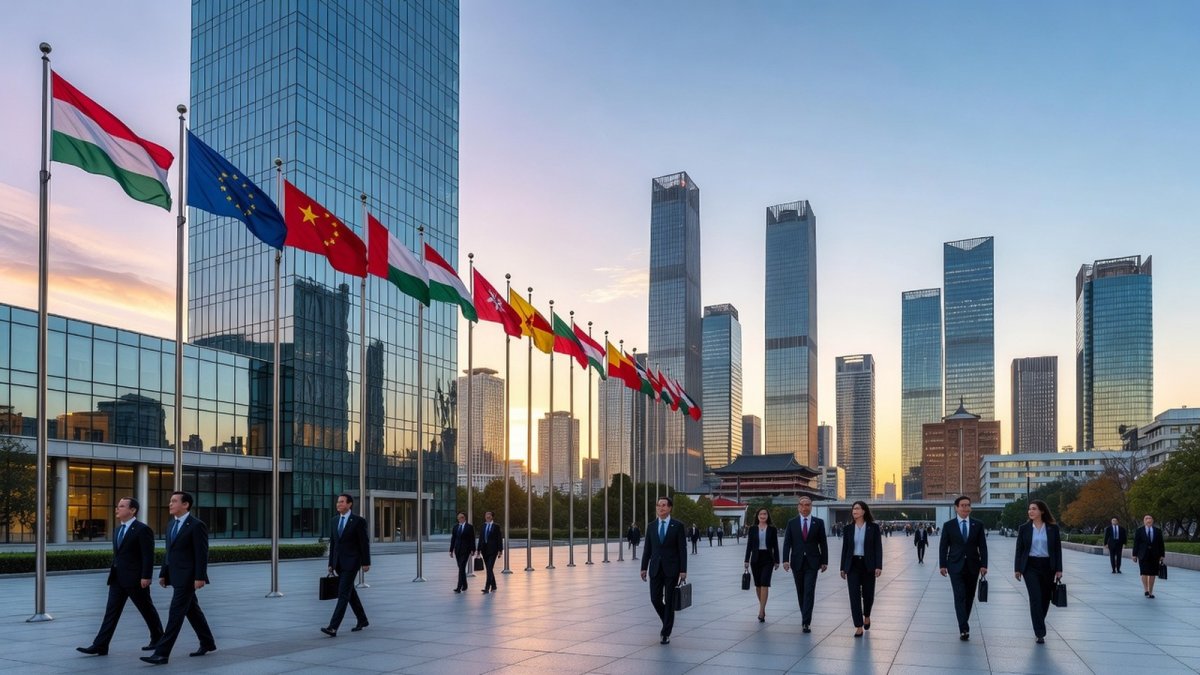
The Erosion of Post-War Institutional Alignment
For most of the post-war era, power, legitimacy, and cooperation reinforced one another through American security leadership, democratic partnerships, and universal institutions. Professor Shin-wha Lee of Korea University identifies the breakdown of this alignment as the central structural transformation of contemporary international relations. She terms this process the unbundling of order, a condition of disalignment in which security, economic governance, political legitimacy, and practical cooperation no longer occur within the same institutions or among the same groups of states.
This diagnosis moves beyond familiar debates about whether the liberal international order is collapsing or which great power might succeed the United States. Instead, Professor Lee asks whether the essential functions of international order can be reconnected under conditions of increasing geopolitical fragmentation. Her analysis emerges from the April 20, 2026 conference Democratic Multilateralism at the Edge, jointly organized by the Seoul Forum for International Affairs and Korea University’s Institute for Interdisciplinary Unification Studies.
The Three Pillars and Their Separation
Professor Lee outlines three pillars that once operated in concert. American leadership underwrote security, open markets, and freedom of navigation. Democratic partnerships generated political trust among like-minded states. Universal institutions such as the United Nations, the World Trade Organization, and the nuclear nonproliferation regime supplied common rules and legal legitimacy. Although these pillars were never perfect, they generally reinforced one another.
Russia’s invasion of Ukraine exposed the inability of the United Nations to prevent or halt great power aggression. The protracted United States-Iran confrontation demonstrated that military superiority alone cannot guarantee regional stability or the credibility of nonproliferation commitments. Competition over semiconductors, artificial intelligence, critical minerals, and maritime supply chains has blurred the boundary between economics and security. As a result, the institutions that once integrated power, legitimacy, and cooperation now operate separately, producing disalignment rather than mutual reinforcement.
From the vantage point of South Korea, the post-war alignment delivered tangible developmental gains that shaped the country’s modern trajectory. Export-led growth unfolded under the protective umbrella of the United States security alliance, while accession to the General Agreement on Tariffs and Trade and later the World Trade Organization in 1995 opened markets essential for industrialization. United Nations membership in 1991, achieved alongside both Koreas, conferred formal international recognition and reinforced the legal standing of the Republic of Korea. The present unbundling threatens precisely this pathway by decoupling the security guarantees, trade rules, and institutional legitimacy that once converged to support sustained economic ascent and diplomatic recognition.
The Minilateralism Paradox and Institutional Trade-offs
The unbundling of order has accelerated the turn toward minilateral coalitions. Smaller groups of like-minded partners can coordinate rapidly, protect sensitive technologies, strengthen supply chain resilience, and respond to shared threats. Yet these arrangements lack broad legitimacy. Universal institutions retain legal authority and political inclusion but frequently prove incapable of collective action. Professor Lee emphasizes that neither form suffices on its own.
This paradox places particular pressure on middle powers that must navigate both exclusive functional coalitions and inclusive multilateral forums. South Korea’s participation in the IP4 grouping alongside Japan, Australia, and New Zealand, and its engagement with NATO’s Indo-Pacific partners following the 2026 NATO Summit in Ankara, illustrates the practical turn toward minilateral mechanisms. At the same time, Seoul continues to rely on the United Nations and the World Trade Organization for normative legitimacy and dispute settlement.
South Korea’s engagement with these tensions draws upon a long-established middle-power diplomatic tradition. Hosting the 2010 G20 Seoul Summit, the 2012 Nuclear Security Summit, and the 2019 ROK-ASEAN Commemorative Summit demonstrated the country’s capacity to convene diverse actors and mediate between developed and developing states. Contemporary minilateral experiments such as the IP4 and engagement with NATO’s Indo-Pacific partners after the 2026 Ankara Summit therefore coexist with continued investment in the United Nations and World Trade Organization, reflecting Seoul’s consistent preference for bridging rather than choosing between exclusive coalitions and inclusive institutions.
Democratic Multilateralism as Strategic Synthesis
Professor Lee argues that democratic multilateralism offers the necessary synthesis of legitimacy and operational capacity. Democratic governments may disagree on specific policies, yet transparent institutions and political accountability render sustained strategic cooperation more credible. Intelligence sharing, advanced technology cooperation, defense industrial integration, financial coordination, and resilient supply chains all depend on confidence that partners will safeguard sensitive information and uphold long-term commitments across changes of government.
Democracy therefore retains strategic importance not merely as a normative preference but as a functional foundation for institutional trust. This insight carries direct implications for South Korea, whose security depends on the United States alliance, whose prosperity rests on an open global economy, and whose technological competitiveness requires reliable networks for knowledge protection and investment coordination.
The inter-Korean dimension further illustrates the functional stakes of this synthesis. Institutional trust and democratic accountability shape the credibility of any coordinated approach to North Korea policy, particularly on denuclearization. Seoul’s capacity to align with democratic partners on these issues hinges on durable domestic political legitimacy that can sustain consistent positions across electoral cycles and maintain the confidence of external interlocutors.
South Korea’s Exposure and the Imperative of Connective Power
Few countries stand at the intersection of nuclear deterrence, China-United States competition, technological rivalry, supply chain resilience, and democratic cooperation as directly as South Korea. Professor Lee contends that Seoul must move beyond simple diversification of partnerships toward an organizing logic that connects its alliances, functional coalitions, markets, and institutions. Deterrence will remain anchored primarily in the United States alliance. Technological resilience requires secure networks. Economic security depends on diversified markets and production chains. Wider institutions continue to supply common rules and international acceptance.
The task is to render these distinct frameworks mutually reinforcing. Professor Lee introduces the concept of connective power: the capacity of a middle power to align security commitments, economic partnerships, technological networks, and multilateral institutions around compatible purposes. This form of influence rests on institutional access, a reputation for reliability, effective brokerage, and contributions to regional and global public goods. South Korea’s Ministry of Foreign Affairs and research institutions such as the Asan Institute for Policy Studies and the Korea Development Institute have long examined these brokerage functions in Korean foreign policy.
South Korea possesses concrete assets that can operationalize connective power. Its centrality in semiconductor and battery supply chains provides leverage in technological governance discussions. The scheduled hosting of the 2027 APEC summit offers a platform for convening regional actors. Defense industrial cooperation with partners such as Poland demonstrates the ability to extend security linkages beyond the traditional alliance framework. Research institutions including the Asan Institute for Policy Studies, the Korea Development Institute, and the Korea Institute for International Economic Policy continue to generate analysis that informs middle-power strategy across these domains.
Layered Orders and the Role of Indispensable Middle Powers
Professor Lee concludes that the post-war order cannot be restored because the architecture that sustained it has already changed. Yet the alternative is not necessarily a world of closed and competing blocs. The more plausible trajectory involves several layered and overlapping orders in which states pursue national interests through different arrangements while cooperating where regional stability and global public goods require collective action.
Under these conditions, the most indispensable states will not dominate every arena but will make cooperation across arenas possible. For South Korea, bridging these systems constitutes a national imperative. Its security, prosperity, technological competitiveness, and diplomatic autonomy under the pragmatic diplomacy of the Lee Jae-myung administration depend on the ability to operate effectively across multiple institutional systems. Professor Shin-wha Lee’s framework thus supplies both a diagnosis of structural transformation and a practical agenda for middle-power agency in an era of disalignment.
Shin-wha Lee’s analysis intersects with ongoing Korean academic debates on the “global pivotal state” concept and the evolution of middle-power diplomacy. By foregrounding connective power as a response to institutional disalignment, the framework provides analytical resources for the Lee Jae-myung administration’s pragmatic diplomacy, emphasizing brokerage across layered orders rather than alignment within any single bloc. This contribution situates South Korea’s agency within a broader scholarly conversation that links structural change to actionable diplomatic strategy.
By Prof. David Park, Staff WriterThis article was produced with AI-assisted research and editorial support. Reporting is based on sources cited in the article.
What's Your Reaction?
 Like
0
Like
0
 Dislike
0
Dislike
0
 Love
0
Love
0
 Funny
0
Funny
0
 Wow
0
Wow
0
 Sad
0
Sad
0
 Angry
0
Angry
0

East Asia/Technology Correspondent at Global1.News. Seoul-based voice covering Korean politics, technology, business, and culture. Analyzes how technology and geopolitics intersect across East Asia.















Comments (0)