
Russia Launches First 5G Networks After Years of Delays
Russia’s long‑awaited commercial 5G rollout finally commenced this week, with all four of the nation’s leading mobile operators activating the new service in Moscow, St.
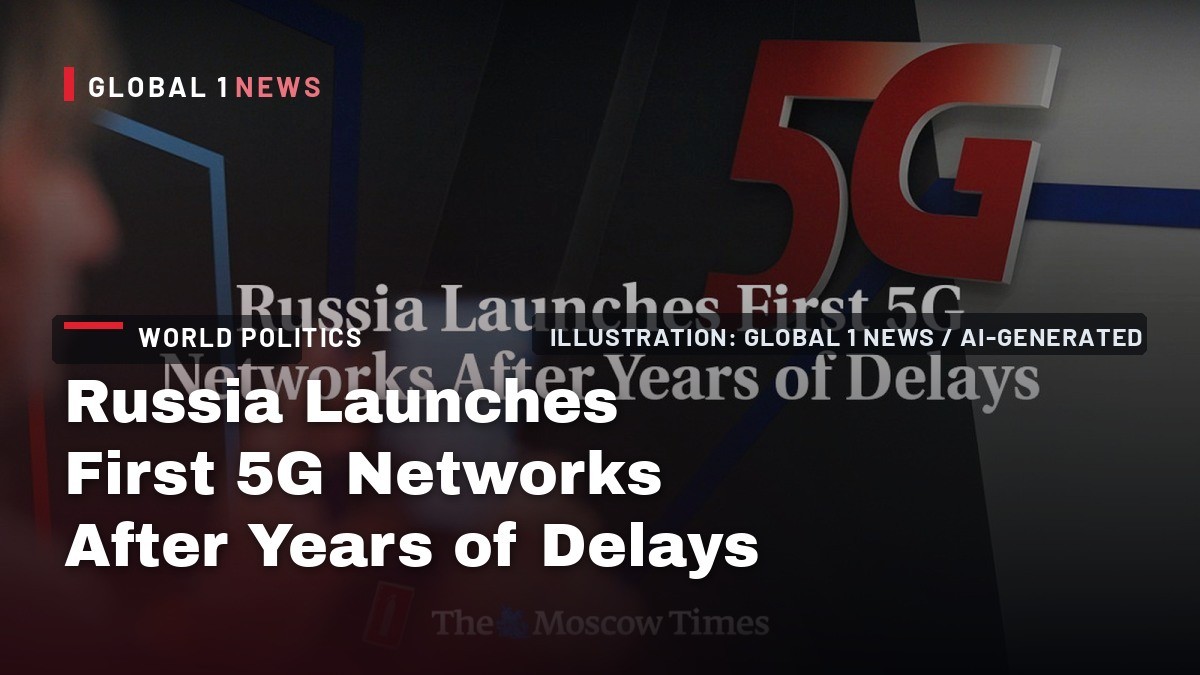
Russia’s long‑awaited commercial 5G rollout finally commenced this week, with all four of the nation’s leading mobile operators activating the new service in Moscow, St. Petersburg and Yekaterinburg. The launch, announced by the Ministry of Digital Development, Communications and Mass Media, marks a decisive step in a project that has been stalled for years by regulatory disputes, security‑service control of key spectrum, and the exodus of Western equipment suppliers following the 2022 invasion of Ukraine.
Political directive behind the rollout
According to the Digital Development Ministry, the rollout was ordered directly by President Vladimir Putin. The Kremlin’s decision to push forward with 5G now, despite lingering technical and legal obstacles, reflects a broader strategy to showcase domestic technological resilience in the face of Western sanctions. By linking the launch to “regular mobile internet disruptions” that authorities claim are necessary to counter Ukrainian drone attacks, officials are framing the new network as part of a national security narrative.
In the official statement, the ministry emphasized that the rollout will serve “10 million people,” a figure that underscores the political weight attached to delivering high‑speed connectivity to the country’s most populous regions. This aligns with a pattern of Kremlin‑driven projects that aim to demonstrate progress while reinforcing the narrative of external threats.
Technical constraints and spectrum allocation
The most conspicuous technical hurdle has been the control of the 3.4‑3.8 GHz band, the internationally recognised 5G spectrum. Russian military and security services have retained exclusive rights to this range, leaving commercial operators without access to the frequencies that underpin most global 5G deployments. As a result, operators have been forced to use the 4.63‑4.99 GHz band, a higher‑frequency window that limits device compatibility.
One immediate consequence is that Apple iPhones, which are tuned to the lower‑frequency bands, cannot currently connect to Russian 5G networks. The ministry noted that Android devices will gain access “in the near future,” while iPhone compatibility “depends on a decision by the Apple corporation.” This disparity highlights how spectrum policy is being used as a lever of control, influencing both market dynamics and consumer experience.
Impact of Western equipment exits
The departure of Nokia and Ericsson after the full‑scale invasion of Ukraine removed two of the primary suppliers of 5G infrastructure. Their exit forced Russian operators to seek alternative sources, likely turning to domestic manufacturers or other non‑Western vendors. The article does not specify the exact replacements, but the loss of established equipment providers has undoubtedly slowed the deployment timeline and increased costs.
These supply‑chain disruptions illustrate a broader pattern: sanctions have compelled Russian telecoms to re‑tool their networks with home‑grown or third‑party technology, a process that typically entails longer lead times and reduced performance compared to the original Western‑sourced plans.
Geographic scope of the launch
The initial activation covered three major metropolitan areas—Moscow, St. Petersburg and Yekaterinburg—where the four operators have established 5G service. Coverage in other major cities varies by operator, indicating a staggered approach that reflects both technical readiness and the uneven distribution of the newly allocated spectrum.
The ministry announced an ambition to extend 5G to “50 more cities by the end of this year.” While the exact list of target cities is not provided, the goal suggests a rapid scaling effort that will likely prioritize regional hubs and economically significant locations. This expansion plan will be a key indicator of how effectively Russian operators can overcome the spectrum and equipment challenges in the coming months.
Domestic mobile traffic growth
Officials highlighted that domestic mobile internet traffic has “more than tripled in six years.” Although the article does not break down the drivers of this surge, the figure points to an accelerating demand for mobile data, a trend that makes the introduction of 5G both timely and economically attractive for operators.
The ministry also noted that 4G networks already cover 90 % of Russia’s inhabited territory. This extensive 4G footprint provides a solid foundation for the 5G rollout, allowing operators to overlay the new service in densely populated areas while leveraging existing infrastructure for broader reach.
Security rationale and public perception
Authorities have linked the rollout to “regular mobile internet disruptions” that are framed as necessary countermeasures against Ukrainian drone attacks. By presenting 5G as a tool to enhance national security, the government seeks to legitimize the project and rally public support. This narrative also serves to justify the continued control of critical spectrum by security agencies.
Public perception of the rollout may be shaped by the promise of faster internet for millions, but it will also be tempered by the limitations imposed on device compatibility. The disparity between Android and iPhone users could generate consumer frustration, especially among those who rely on Apple devices for business or personal use.
Implications for the Kremlin’s power structure
The 5G launch underscores the Kremlin’s ability to marshal state resources to achieve strategic technological goals, even when faced with external pressure and internal bureaucratic resistance. By directing operators to use a frequency band under security‑service control, the state reinforces its grip over a critical communications layer, ensuring that any future expansion remains under its purview.
Moreover, the rollout serves as a showcase of resilience in the face of sanctions, a narrative the Kremlin has repeatedly employed to bolster domestic legitimacy. As the network expands to additional cities, the success—or any setbacks—will be closely monitored by both the security apparatus and the broader political elite, influencing future decisions on spectrum allocation, foreign technology dependence, and the balance between civilian and security‑service interests in Russia’s digital landscape.
This article was produced with AI-assisted research and editorial support. Reporting is based on the source material cited below. Sources: The Moscow Times; themoscowtimes.com; Global1.News (11 September 2026).
By Irina Volkov, Staff Writer
What's Your Reaction?
 Like
0
Like
0
 Dislike
0
Dislike
0
 Love
0
Love
0
 Funny
0
Funny
0
 Wow
0
Wow
0
 Sad
0
Sad
0
 Angry
0
Angry
0
Russia/Eastern Europe Correspondent at Global1.News. Covering Russian politics, energy, security, and the shifting dynamics of the post-Soviet space. Provides clear-eyed analysis on one of the world's most opaque regions.












Comments (0)