
Rubio to host meeting of Indo-Pacific Quad, wrap up G20 gathering
U.S. Secretary of State Marco Rubio will host the foreign ministers of Australia, India and Japan on Saturday, marking the third Quad ministers’ meeting of the year.
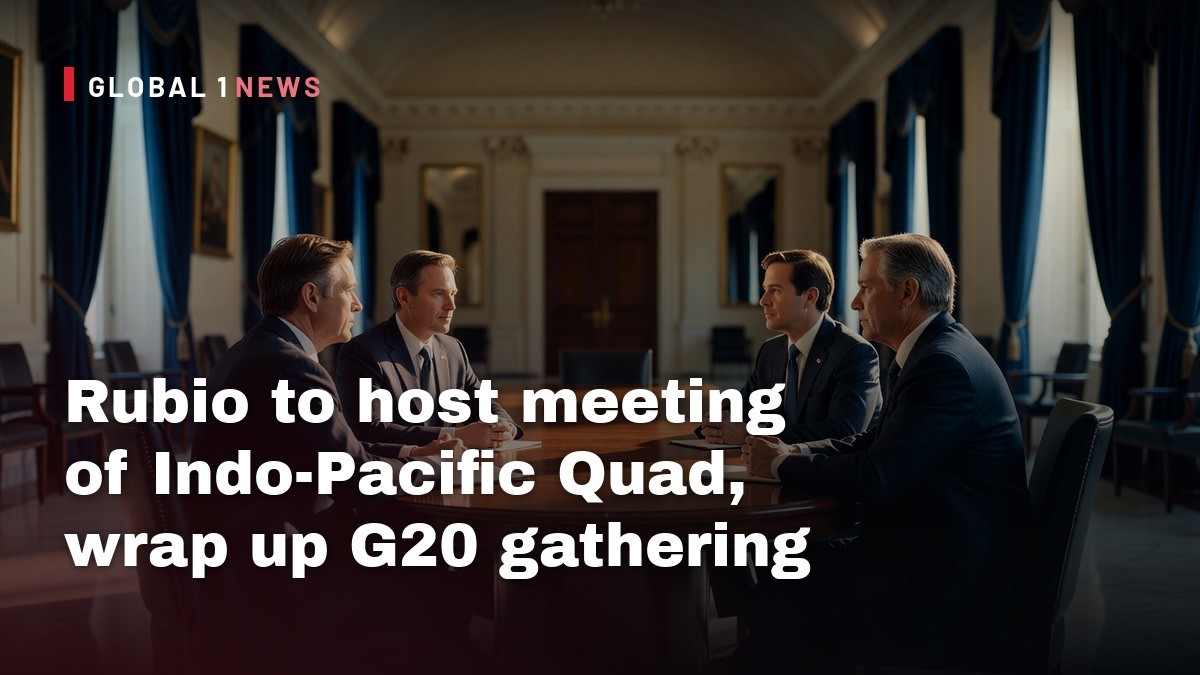
U.S. Secretary of State Marco Rubio will host the foreign ministers of Australia, India and Japan on Saturday, marking the third Quad ministers’ meeting of the year. The gathering in Washington follows a two‑day G20 foreign‑ministerial session in Atlanta and sets the stage for a Quad leaders’ summit in Manila during the ASEAN conference on 15‑18 November. While the Quad’s origins lie in the Biden administration’s 2021 launch of a coordinated Indo‑Pacific strategy, the upcoming Manila summit will be the first to include President Donald Trump, whose approach to the group has been shaped by a series of trade frictions and diplomatic tensions.
Rubio’s Dual Agenda: Quad Coordination and G20 Wrap‑Up
Rubio’s schedule reflects a dual focus on deepening the Quad’s strategic alignment while attempting to steady the broader G20 dialogue. After the Quad ministers’ session, he will conclude the G20 meetings in Atlanta, where he has invited the Indo‑Pacific ministers to attend a college football game featuring his son, Anthony, a running back for the University of Florida. The State Department’s itinerary frames the football outing as a diplomatic bridge, underscoring Rubio’s belief that informal settings can ease the “complex economic and geopolitical challenges” highlighted in his recent remarks at the Georgia Aquarium.
In his remarks, Rubio emphasized that “the future of our nations depend on our willingness to understand that while our interests may not always align, we should always seek to work together to advance them when and where they do align.” This language signals an attempt to reconcile divergent positions within the G20, especially after Friday’s meeting revealed deep rifts over the wars in Ukraine and the Middle East, and a refusal by some European members to pose for a family photo with Russian Foreign Minister Sergei Lavrov.
From Biden’s Quad to Trump’s Manila Summit
The Quad, formally known as the strategic dialogue among the United States, Japan, India and Australia, did not convene at the leaders’ level until President Joe Biden took office in 2021. Under Biden, the group focused on maritime security, supply‑chain resilience and democratic values in the Indo‑Pacific. President Trump, who was slated to attend a Quad summit in India in late 2025, cancelled that visit amid tariff disputes with New Delhi, leaving a gap in his direct engagement with the forum.
Rubio’s upcoming Manila summit therefore represents Trump’s first Quad leaders’ summit, a symbolic moment that could recalibrate the group’s agenda. The summit will take place alongside the ASEAN conference, a venue that traditionally draws regional leaders and offers a platform for broader diplomatic outreach. Observers will watch whether the Manila gathering shifts the Quad’s focus toward trade and technology cooperation, or whether it reverts to a security‑centric posture under Trump’s administration.
Implications for Israel’s Tech and Innovation Landscape
Although Israel is not a Quad member, the country’s high‑tech sector has long been intertwined with the economies of the United States, Japan, India and Australia. Israeli startups in cybersecurity, artificial intelligence and agritech regularly secure funding from venture capital firms and corporate investors in these markets. The Quad’s emphasis on supply‑chain resilience and digital infrastructure could open new avenues for Israeli firms to participate in joint projects, particularly in areas like secure communications and resilient logistics.
The Ministry of Economy and the Israel Innovation Authority have, in recent years, pursued partnerships with Quad nations to promote bilateral R&D collaborations. A Quad summit that foregrounds technology standards and standards‑setting could provide Israeli policymakers with a diplomatic lever to align national innovation strategies with the broader Indo‑Pacific ecosystem, potentially enhancing export opportunities for Israeli hardware and software solutions.
Trade Frictions and Tariff Disputes: A Continuing Challenge
Rubio’s remarks at the Georgia Aquarium highlighted the need for cooperation despite “interests that may not always align.” The recent cancellation of Trump’s 2025 India visit over tariff disputes underscores the fragility of trade relations within the Quad. While the United States and India have been negotiating market‑access improvements, lingering disagreements over agricultural imports and digital taxes have occasionally stalled progress.
For Israel, which relies heavily on export markets in the United States and increasingly in Asia, the Quad’s ability to resolve internal trade tensions could indirectly affect Israeli exporters. A smoother US‑India trade relationship would likely benefit Israeli firms that use Indian manufacturing hubs or source components from Indian suppliers, reinforcing the interconnected nature of modern supply chains.
Security Dynamics: From the Ukraine Conflict to the Middle East
The G20 meeting in Atlanta exposed stark divisions over the wars in Ukraine and the Middle East, with European members refusing a joint photograph with Russian Foreign Minister Sergei Lavrov. These fissures illustrate the broader geopolitical fault lines that the Quad must navigate. While the Quad’s primary focus has been the Indo‑Pacific, its members share concerns about great‑power competition, cyber threats and the stability of maritime routes that also impact Israel’s security calculations.
Israel’s own security apparatus closely monitors developments in the Middle East, and any escalation involving major powers could have spill‑over effects on regional stability. The Quad’s coordination on maritime security, particularly in the South China Sea, may set precedents for multilateral security frameworks that Israel could reference when engaging with its own regional partners, such as Egypt, Jordan and the Gulf states.
Rubio’s Diplomatic Outreach: Soft Power and Personal Touches
Inviting the Quad ministers to a college football game is a classic example of American soft power, blending personal hospitality with diplomatic intent. By showcasing his son’s athletic involvement, Rubio personalizes the diplomatic encounter, potentially fostering a more relaxed atmosphere for informal dialogue. Such gestures can be pivotal in building trust among senior officials, especially when formal negotiations are strained by trade or security disagreements.
The inclusion of cultural experiences, from an aquarium reception to a football match, reflects a broader U.S. diplomatic playbook that seeks to humanize high‑level engagements. For Israeli diplomats observing these tactics, the approach offers a template for integrating cultural diplomacy into bilateral meetings with Quad members, perhaps by highlighting Israel’s own tech showcases or cultural festivals.
Looking Ahead: What the Manila Summit Could Mean for Regional Cooperation
As the Quad leaders prepare to convene in Manila, the agenda will likely balance security concerns with economic collaboration. The backdrop of the ASEAN conference provides an opportunity to align Quad initiatives with broader regional priorities, such as digital connectivity, climate resilience and supply‑chain diversification. Successful outcomes could translate into concrete projects, joint research programs and coordinated standards that benefit all participating economies.
For Israel, the Manila summit represents a chance to position itself as a partner of choice in technology and innovation. By monitoring the Quad’s commitments and aligning its own innovation policies accordingly, Israel can leverage the Quad’s momentum to deepen market access, attract investment and contribute to regional solutions that address shared challenges, from cyber security to sustainable agriculture. The coming weeks will reveal whether the Quad’s renewed focus under President Trump can translate into actionable cooperation that resonates beyond the Indo‑Pacific and reaches into the broader Middle Eastern and global innovation ecosystems.
This article was produced with AI-assisted research and editorial support. Reporting is based on the source material cited below. Sources: Al-Monitor; al-monitor.com; Global1.News (31 October 2026).
By Hannah Berg, Staff Writer
What's Your Reaction?
 Like
0
 Dislike
0
 Love
0
 Funny
0
 Wow
0
 Sad
0
 Angry
0

Israel Correspondent at Global1.News. Based in Tel Aviv, covering Israeli politics, security, technology, and society. Provides balanced, deeply-sourced reporting on one of the most closely-watched regions in the world.













Comments (0)