
Prabowo’s Rainbow Coalition Has Achieved Stability at the Cost of Efficacy
Two years into his presidency, President Prabowo Subianto has fashioned a “rainbow coalition” that, while projecting a veneer of political stability, increasingly strains the machinery of governance.
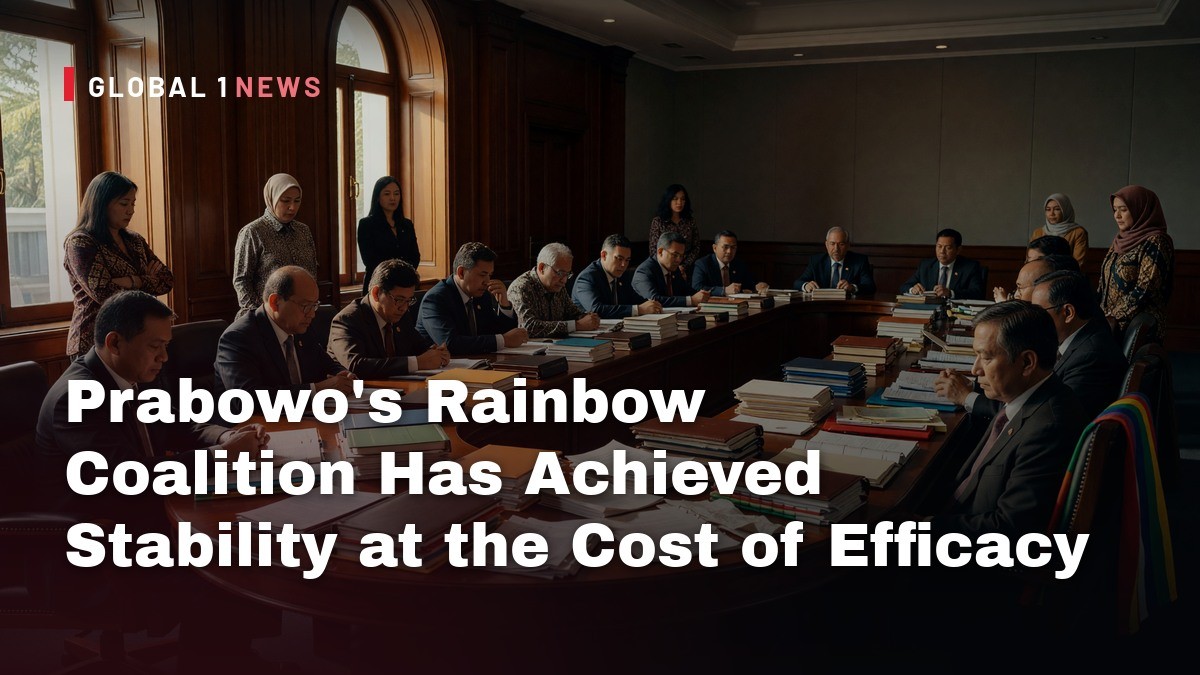
Two years into his presidency, President Prabowo Subianto has fashioned a “rainbow coalition” that, while projecting a veneer of political stability, increasingly strains the machinery of governance. In a speech to the Nahdlatul Ulama (NU) 35th Congress in August 2026, Prabowo underscored the necessity of stability to preserve his expansive coalition, a theme that resonates with the historical pattern of post‑Reformasi Indonesian cabinets. The present administration, however, must grapple with overlapping authority, over‑centralization, and a sluggish policy pipeline that threaten to erode the very stability it seeks to protect.
Historical Roots of Indonesia’s Rainbow Coalition
The practice of assembling broad‑based coalitions dates back to the earliest years of Indonesia’s democratic transition. After the 1999 adoption of a proportional‑representation (PR) system, the electoral threshold introduced in 2004 made it virtually impossible for any single party to field a presidential candidate without coalition support. Consequently, presidents from Abdurrahman Wahid (1999‑2001) through Megawati Sukarnoputri (2001‑2004) built cabinets that incorporated almost every parliamentary party, the Indonesian military (TNI), and major civil‑society groups such as NU.
This structural necessity persisted under later leaders. Presidents Susilo Bambang Yudhoyono and Joko “Jokowi” Widodo relied on charismatic appeal to secure a plurality of votes, yet their initial minority coalitions proved insufficient for legislative success, prompting them to broaden their bases by adding business leaders, religious organizations, and security officials to the cabinet. The pattern demonstrates that Indonesia’s political architecture rewards breadth over depth, a dynamic that Prabowo has inherited and amplified.
The Scale of Prabowo’s Cabinet
Prabowo’s current cabinet comprises 49 ministers and 57 vice‑ministers, the largest composition since the Reformasi era. This size reflects an intentional strategy to accommodate the diverse interests of coalition partners, from major parties to mass organizations like NU. While the sheer number of posts enables the president to placate a wide array of stakeholders, it also creates a complex web of overlapping mandates.
The proliferation of vice‑ministerial portfolios, in particular, has blurred lines of authority. Ministries led by politically connected figures often wield influence disproportionate to their formal remit, while less prominent ministries struggle for relevance. This hierarchy, rooted more in personal access to the president than in policy domain, hampers coordinated decision‑making, especially during crises such as the 2025 Sumatra floods, the 2026 Flores earthquake, and the ongoing forest‑fire emergencies in Sumatra and Kalimantan.
Policy Implementation Under Strain
Frequent cabinet reshuffles—eight as of October 15, 2026—underscore the administration’s need to constantly recalibrate the coalition’s internal balance. Each reshuffle, while intended to appease dissatisfied partners, disrupts continuity in policy formulation and execution. Ministries experience turnover that erodes institutional memory, delaying the rollout of reforms and diluting the impact of budget‑efficiency measures that have concentrated fiscal discretion in the president’s hands.
The concentration of budgetary authority further intensifies competition among coalition partners. With fewer state resources available for distribution, parties and mass organizations vie for limited patronage, heightening friction. This dynamic is evident in the lead‑up to the 2029 general election, where coalition members are expected to intensify lobbying for fiscal allocations to sustain their constituencies.
Electoral Law Reforms and Future Coalition Calculus
Indonesia’s electoral architecture is poised for another transformation. In January 2025, the Constitutional Court eliminated the presidential threshold, removing the requirement that a candidate secure either 20 percent of parliamentary seats or 25 percent of legislative votes. While this reform ostensibly broadens the field of presidential aspirants, coalition partners are now proposing new criteria to limit the number of nominees, a debate that will shape the amendment of the Election Law.
The outcome of this deliberation will directly affect Prabowo’s strategic calculus. A reinstated or re‑imagined threshold could compel the president to deepen his coalition’s breadth, while a more permissive framework might encourage a consolidation of core partners. Either scenario will test the durability of the current “rainbow” arrangement as the 2029 election approaches.
Comparative Lessons from Prior Administrations
Both Yudhoyono and Jokowi encountered the paradox of coalition politics: the very breadth that secured legislative majorities also sowed seeds of intra‑coalition rivalry. Jokowi’s experience with the Indonesian Democratic Party of Struggle (PDIP) illustrates how even a dominant party can become a source of friction when budgetary constraints limit patronage distribution. Yudhoyono’s early‑term struggles similarly reveal that a large coalition does not guarantee policy efficacy without clear mechanisms for coordination.
Prabowo’s administration, by expanding the cabinet further, amplifies these historical challenges. The necessity of constant tinkering to satisfy divergent interests risks turning governance into a series of negotiated compromises rather than decisive action. The precedent suggests that without institutional reforms to streamline decision‑making, the coalition’s size may become a liability rather than an asset.
Implications for Regional Geopolitics
Indonesia’s internal political stability carries weight beyond its borders, influencing the strategic calculus of neighboring powers and regional institutions. A government hampered by internal friction may struggle to project consistent foreign‑policy positions, affecting ASEAN consensus on issues such as maritime security and economic integration. Moreover, the concentration of authority in the presidency, coupled with a fragmented cabinet, could limit Indonesia’s capacity to respond swiftly to regional crises, thereby altering the balance of influence in Northeast Asia.
For Korean policymakers and think tanks—such as the Ministry of Foreign Affairs (MOFA), the Korea Institute for International Economic Policy (KIEP), and the Asan Institute for Policy Studies—monitoring Indonesia’s coalition dynamics is essential. A less decisive Indonesian government may open diplomatic space for South Korea to deepen bilateral cooperation, particularly in disaster‑response coordination and infrastructure investment, while also necessitating caution in multilateral negotiations where Indonesia’s voice remains pivotal.
Forward‑Looking Assessment
Prabowo’s “rainbow coalition” has succeeded in delivering a superficial veneer of stability, yet the underlying structural tensions threaten to undermine policy efficacy as the 2029 election nears. The expansive cabinet, while a pragmatic tool for coalition management, has blurred authority lines, slowed decision‑making, and intensified competition for dwindling fiscal resources. Historical parallels indicate that without reforms to streamline governance—such as clarifying ministerial mandates, reducing the frequency of reshuffles, and establishing transparent budget‑allocation mechanisms—the coalition’s size may become a strategic liability.
Looking ahead, the outcome of the pending Election Law amendment will be a decisive factor. Should coalition partners succeed in reinstating a functional presidential threshold, Prabowo may be compelled to further broaden his base, deepening the very challenges he now faces. Conversely, a more permissive framework could enable a consolidation of core allies, potentially allowing a leaner, more coherent cabinet. For scholars of Korean‑Indonesian relations, the evolution of Indonesia’s coalition politics will remain a barometer of the nation’s capacity to navigate domestic pluralism while maintaining a decisive role in regional geopolitics.
This article was produced with AI-assisted research and editorial support. Reporting is based on the source material cited below. Sources: The Diplomat; thediplomat.com; Global1.News (04 November 2026).
By Prof. David Park, Staff Writer
What's Your Reaction?
 Like
0
 Dislike
0
 Love
0
 Funny
0
 Wow
0
 Sad
0
 Angry
0

East Asia/Technology Correspondent at Global1.News. Seoul-based voice covering Korean politics, technology, business, and culture. Analyzes how technology and geopolitics intersect across East Asia.














Comments (0)