
Patriot Shortage Leaves NATO's Air Shield Thin After Iran War
The cascading fallout from the 2026 Iran war has reached the heart of NATO's eastern flank, with U.S. and alliance officials now conceding that American Patriot missile interceptor stockpiles in Europe have been critically depleted.
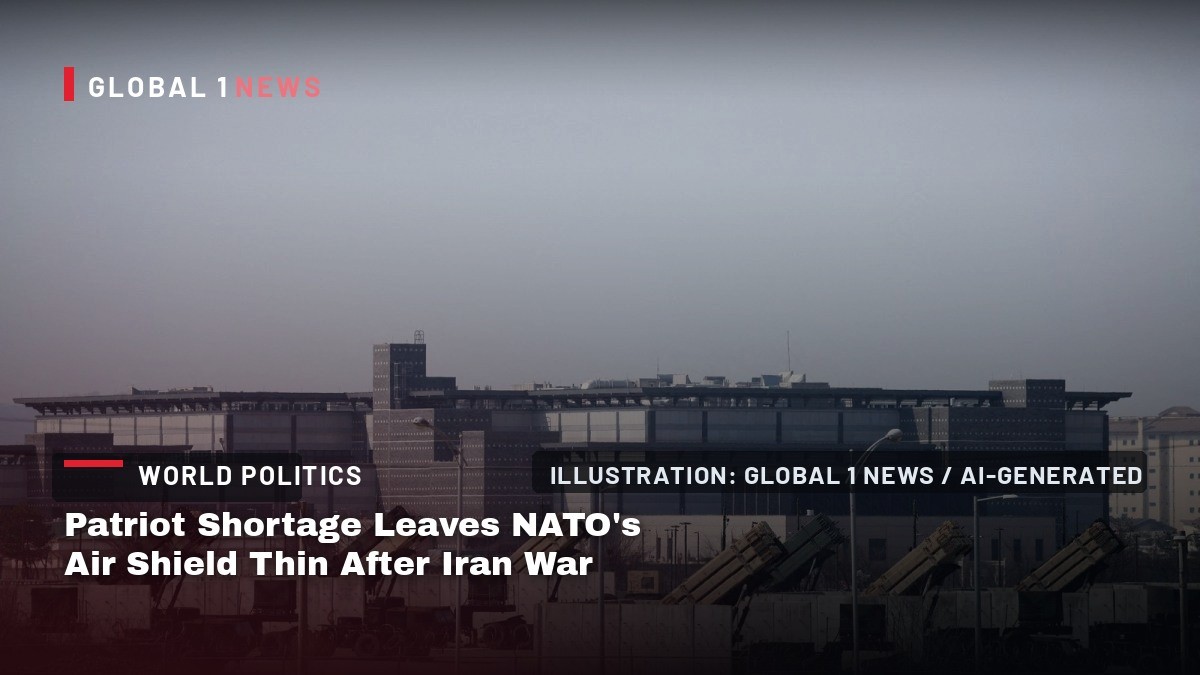
The cascading fallout from the 2026 Iran war has reached the heart of NATO's eastern flank, with U.S. and alliance officials now conceding that American Patriot missile interceptor stockpiles in Europe have been critically depleted. The shortage, driven by the massive expenditure of munitions in the Middle East, leaves the alliance with a dangerously thin shield against potential Russian ballistic missile strikes, even as Moscow's own war in Ukraine strains its capacity for a two-front air campaign.
Patriot Shortage Leaves NATO's Air Shield Thin After Iran War
Washington, United States - Aug 27, 2026 - The U.S. military is grappling with a severe shortage of advanced missile interceptors in Europe after the war with Iran depleted key stockpiles, raising concerns about NATO's ability to counter a potential Russian attack, U.S. and alliance officials said. The disclosure, made by officials speaking on condition of anonymity to discuss sensitive military matters, paints a stark picture of an alliance reliant on a single, overstretched missile defense system at a moment of maximum geopolitical tension.
The Patriot Gap: A Vulnerable Shield Over Europe
The most concerning shortfall involves Patriot missile interceptors, the only system in the U.S. arsenal capable of reliably shooting down Russia's high-speed ballistic missiles. A U.S. defense official stated that in Europe, the American military "definitely" does not have enough Patriots to stop any possible sustained ballistic missile attack. The capability to defend against a single ballistic missile strike or a stray Russian missile that goes off course would be "very limited," the official added.
A senior NATO official confirmed the low inventories of Patriots among American and alliance forces in Europe. The warning is stark: in the event of a Russian ballistic missile assault on a military headquarters or power plant, NATO could be in a similar position to Patriot-starved Ukraine and be forced "to take punch after punch in the mouth," the U.S. defense official said. This admission underscores a fundamental shift in the European security calculus, where the assumption of U.S. air defense dominance has been quietly replaced by a grim acceptance of potential vulnerability.
The Iran War's Toll: 65% of U.S. Patriots Expended
The root cause of this shortage lies in the Middle East, not Europe. The Iran war, which began on February 28, 2026, and reaches its six-month mark on Friday, has been a voracious consumer of American munitions. U.S. and Gulf allies have fired off significant numbers of interceptors, including Patriots, to thwart Iran's drones and missiles, with some of those attacks killing and wounding American troops. The conflict has used up 65% of U.S. Patriots, amounting to roughly 1,500 of the nation's 2,330 interceptors, according to the Center for Strategic and International Studies (CSIS).
Mark Cancian, a retired Marine colonel and senior adviser at CSIS, noted that the U.S. provided about 600 interceptors to Ukraine during the Biden administration. However, the Iran war was the tipping point. Ed Arnold, senior associate fellow at the Royal United Services Institute (RUSI) in London, explained that the supply to Ukraine was "planned for and reasonably measured," whereas stocks in the Middle East have been "unexpectedly and quickly drained, exposing supply chain constraints." The result is a strategic vacuum in Europe, where the U.S. military has been forced to shift assets southward to support the war effort, leaving the eastern flank exposed.
ATACMS Shortages and the Broader Munitions Crisis
The Patriot shortage is not an isolated incident. The U.S. military in Europe is also grappling with critical shortages of the Army Tactical Missile System (ATACMS), a medium-range ballistic missile designed to strike behind enemy lines. However, the overall munitions picture in Europe is less dire than on air defenses alone, because some European militaries possess their own offensive missiles, such as the Taurus and Storm Shadow, both long-range air-launched bunker-busting missiles.
This distinction is crucial. While offensive capabilities can be supplemented by European allies, defensive capabilities are uniquely dependent on the Patriot system. The Pentagon declined to discuss weapons stockpile levels for security reasons. U.S. Army Col. Martin O'Donnell, a senior NATO military spokesperson, pushed back against the dire assessment, saying it is "simply not the case" that the number of Patriot missiles in Europe is beyond critical. NATO, he insisted, is able to "block punches" and has enough air defense munitions available to defend itself as well as to donate to Ukraine. The contradiction between the anonymous officials' warnings and the public reassurance highlights the sensitivity of the issue.
Alternatives and Limitations: SAMP/T and Naval Defenses
The dearth of Patriot interceptors leaves few alternatives for shooting down Russia's more advanced ballistic missiles, which can be combined with swarms of inexpensive drones to overwhelm defenses. Ballistic missiles are a particular challenge because they dive steeply toward targets at more than five times the speed of sound, leaving little time to stop them. The Patriot system tracks the missile, predicts its path, and launches within minutes, all while carrying out complex calculations to ensure the interceptor finds its target. One Patriot battery can only cover a limited area-a small military base, for example, but not a whole city.
One alternative is France and Italy's SAMP/T NG air defense system. France has promised to speed up delivery of the upgraded system to Ukraine, which the manufacturer says is better able to counter ballistics. However, the new iteration has not yet been battle-tested, and the current version of the SAMP/T has a smaller range than the Patriot. While U.S. and European militaries have warships that can serve as mobile air defense, they may be too far from a target to protect it and could risk getting sunk. These limitations underscore the uncomfortable reality that there is no immediate, plug-and-play substitute for the Patriot.
Production Bottlenecks and the Race to Rearm
The supply chain constraints exposed by the Iran war are now the central focus of NATO's rearmament efforts. About 600 missiles, including those destined for Europe, should be made this year, with a production goal of 2,000 Patriot missiles a year set for 2030, Cancian said. NATO says Europe's first Patriot missile production facility is expected to open in Germany in September, with deliveries possibly beginning early next year. The first deliveries should go to countries that have already placed orders, including Germany, the Netherlands, Romania, and Spain, the U.S. defense official said.
But for now, that means some countries, such as Germany, have bought expensive Patriot systems but are in the "ridiculous" position of not having any ammunition to fire from them, Arnold said. Germany's defense ministry declined to comment on stockpiles. This production bottleneck is a strategic vulnerability that Russia is likely monitoring closely. The Guardian reported in July that European capitals are growing concerned that the U.S. defense industrial base can no longer deliver the weapons pledged to NATO allies after stockpiles were depleted by the Ukraine and Iran conflicts. The opening of the German facility is a step forward, but it will take years to close the gap.
Russian Constraints: The Uncomfortable Safety Net
Despite the dire warnings, there is a mitigating factor: Moscow likely cannot carry out a sustained air assault on a NATO target while it launches almost nightly attacks on Ukraine, Arnold said. Ukraine's recent strikes into Russia also have exposed weaknesses in Russia's air defenses, which could prompt Putin to think twice about provoking a retaliatory attack. "The uncomfortable truth is possibly the best air defense that we have is Russian constraints," Arnold said.
This analysis is supported by the geopolitical context. CIA Director John Ratcliffe went to Moscow this week to warn Russia not to attack, The Wall Street Journal reported, a rare and secretive trip that Trump downplayed as "sort of semi-routine." European and NATO officials say Russia could be in a position to attack countries in the alliance by 2030, and Patriot stockpiles are projected to rebound by then. The window of vulnerability is real but finite. The question is whether NATO can manage the risk without provoking a miscalculation, and whether the U.S. defense industrial base can deliver on its promises before the window closes.
This article was produced with AI-assisted research and editorial support. Sources: Daily Sabah/Associated Press, Reuters, CSIS, The Guardian.
By Malik Hassan, Staff Writer
What's Your Reaction?
 Like
0
Like
0
 Dislike
0
Dislike
0
 Love
0
Love
0
 Funny
0
Funny
0
 Wow
0
Wow
0
 Sad
0
Sad
0
 Angry
0
Angry
0

Middle East Correspondent at Global1.News. Based in Beirut, covering politics, conflict, energy, and society across the Middle East. Brings context and depth to a region often reduced to headlines.














Comments (0)