
Pantanal Burned Area Quadruples in 2026 as Brazil's Wetland Faces New Fire Crisis
Brazil's Pantanal burned area quadrupled in 2026, reaching 90,719 hectares by mid-August versus 21,935 in 2025, as drought and a forecast super El Nino threaten the world's largest wetland. Prosecutors expand satellite, drone and citizen monitoring.
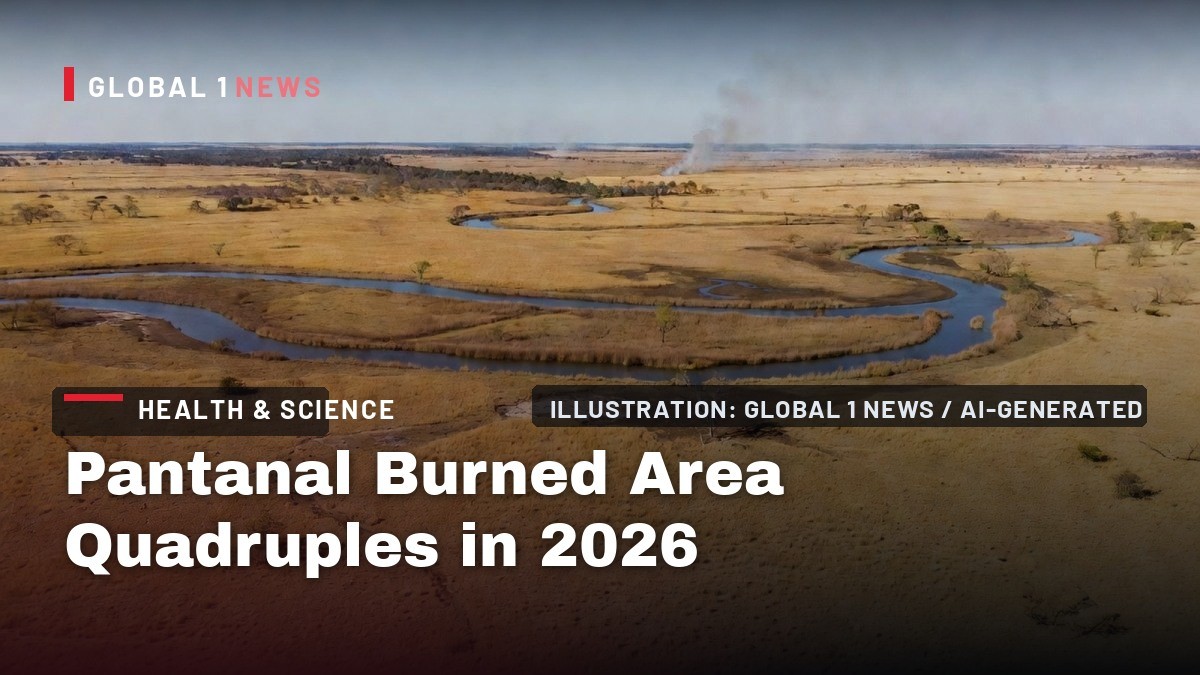
The numbers arrived this week from the Public Prosecutor's Office of Mato Grosso do Sul (MPMS), and they carry the weight of a warning that can no longer be ignored. The area burned in the Brazilian Pantanal between January and mid-August of this year has more than quadrupled compared to the same period in 2025, jumping from 21,935.60 hectares to 90,719.60 hectares. This is not a statistical anomaly; it is a signal that the world's largest tropical wetland is entering a danger zone, and the institutions tasked with protecting it are scrambling to expand their defenses before the worst of the fire season arrives.
Campo Grande, Brazil — The data, released by the MPMS on 25 August, confirms what local brigadiers and ranchers in the southern Pantanal have been whispering for weeks: the dry season is biting harder and earlier than last year. The agency's "Pantanal em Alerta" (Pantanal on Alert) program, which monitors the biome through satellites, drones and a public alert system, has been expanded in response. But as the numbers show, technology is racing against a climate that is becoming increasingly hostile.
The Hard Numbers: A Fourfold Increase in Burned Area
The comparison is stark. Between 10 January and 16 August 2025, the MPMS recorded 21,935.60 hectares of burned area in the Mato Grosso do Sul portion of the Pantanal. In the corresponding window of 2026, from 7 January to 18 August, that figure exploded to 90,719.60 hectares — more than four times the area consumed in the same period just one year earlier. The data, compiled through satellite imagery and geospatial analysis, covers the entire southern Pantanal, the Brazilian portion of the biome that lies within Mato Grosso do Sul state.
To put this in perspective: 90,719 hectares is roughly the size of a large Brazilian municipality. It is an area larger than the city of São Paulo's urban perimeter. And critically, this is not the peak of the fire season. Historically, the worst burning in the Pantanal occurs between September and November, when the dry season reaches its maximum intensity. The fact that the burned area has already quadrupled before that window opens is what has prosecutors and environmental agencies on high alert.
Why the Pantanal Burns: Drought, Humidity and the Specter of El Niño
The conditions fueling this year's fires are a familiar cocktail, but one that is being mixed with increasing potency. The MPMS points to a prolonged drought (estiagem prolongada), low air humidity and high temperatures as the primary climate factors allowing fires to spread rapidly across the floodplain grasslands and forested areas. The region has seen below-average rainfall for months, leaving vegetation dry and combustible.
Adding to the concern is the forecast of a possible "super" El Niño in 2026. This is the same climate pattern that intensified the catastrophic 2024 season, when nearly 4.5 million hectares of the Pantanal burned — roughly 30% of the biome and nearly 22 times the area lost between 2000 and 2018. Meteorologists are watching the Pacific Ocean temperatures closely, with effects expected to intensify from September onward. If a strong El Niño materializes, it could prolong the drought and push temperatures even higher, creating conditions for fires that are nearly impossible to contain.
Last year offered a glimmer of hope. In 2025, the Pantanal and the Amazon saw a dramatic recovery, with burned area dropping to record lows, according to MapBiomas data reported in July 2026. That recovery was attributed to a combination of favorable rains and aggressive enforcement. But this year's numbers suggest that the reprieve was temporary, and the underlying vulnerabilities of the biome remain deeply entrenched.
Pantanal em Alerta: Satellites, Drones and a Citizen Alert System
In response to the advancing fires, the MPMS has intensified its "Pantanal em Alerta" program, which has become the state's primary technological shield against the flames. The program operates on a simple but powerful premise: detect fires early, respond fast, and hold those responsible accountable. It uses satellite imagery, geospatial analysis and data integration to identify heat foci in near-real-time, allowing firefighting agencies to respond before a small blaze becomes an inferno.
The system is not just for officials. A digital alert platform, developed by the MPMS in partnership with the Military Fire Brigade of Mato Grosso do Sul (CBMMS), allows any citizen to register and indicate an area of interest. If a fire focus is detected nearby, the user receives an immediate alert by email or cell phone message. This crowdsourced monitoring network turns local ranchers, tourism operators and residents into the eyes and ears of the enforcement agencies, dramatically increasing the chances of containing fires in their early stages.
The program also relies on a fleet of long-range drones equipped with thermal cameras, an investment of R$12 million announced in May 2026. These drones, integrated with INPE and NASA satellite data, provide high-resolution imagery that can pinpoint ignition sources even in remote areas. Real-time monitoring stations have been installed in key municipalities, including Corumbá, the gateway city to the southern Pantanal, which has historically been one of the most fire-affected regions.
Accountability: Zero Tolerance and the Search for Causes
Technology alone cannot stop a fire. That is why the MPMS has paired its monitoring systems with a "zero tolerance" strategy against criminal fires, defined in May 2026 in coordination with environmental agencies. The strategy establishes immediate investigation flows for any detected ignition, with a focus on holding rural landowners accountable. The message is clear: a fire on your property is your responsibility, whether it was set intentionally or spread from negligence.
The integrated work involves a broad coalition of institutions: the MPMS, Imasul (the state environment institute), the Environmental Military Police (PMA), the Fire Brigade, Ibama (the federal environment agency), Criminal Forensics and Sejusp (the state justice and public security secretariat). This multi-agency approach aims not only to fight fires but to identify their causes, produce technical evidence and hold offenders accountable in both civil and criminal spheres.
Priority properties are mapped using geotechnology and historical data. The MPMS analyzes ignition focus history, fire recurrence, proximity to Conservation Units and environmentally sensitive areas, as well as records of recurrence since 2020. This territorial intelligence allows inspection teams to focus their efforts on the properties most likely to be sources of illegal burning. The results are already visible: satellite images and technical analyses have supported targeted inspections, resulting in citations and fines for illegal burning, and deeper investigations into the origins of fires.
What Is at Stake: Jaguars, Communities and the Ranching Economy
The Pantanal is not just a collection of statistics. It is the world's largest tropical wetland, spanning Brazil, Bolivia and Paraguay, with about 65% of the Brazilian biome lying in Mato Grosso do Sul. It is home to jaguars, giant otters, hyacinth macaws and hundreds of other species that exist nowhere else on Earth. The fires that consume the landscape also destroy the habitats of these animals, many of which are already threatened by habitat loss and climate change.
But the stakes are not only ecological. The Pantanal supports a vibrant ranching economy, with cattle grazing on the vast floodplain grasslands that have been managed sustainably for generations. Towns like Corumbá, Aquidauana and Miranda depend on the health of the biome for their livelihoods, both through ranching and through the growing ecotourism industry that draws visitors from around the world to see the region's wildlife. When the fires burn, they destroy pasture, kill livestock, and choke the skies with smoke that drives tourists away.
The human cost is often overlooked. Local communities, including traditional populations and indigenous groups, rely on the Pantanal's resources for their survival. The fires threaten their homes, their food sources and their way of life. For the people of Mato Grosso do Sul, the fight against the flames is not an abstract environmental cause; it is a battle for their homes and their future.
The Road Ahead: September and the Fire Peak
As August draws to a close, the MPMS and its partners are bracing for what comes next. The fire season's peak is still ahead, typically hitting in September and October when the dry season reaches its maximum intensity. If the current trend continues, and if the forecasted "super" El Niño materializes, the burned area could exceed even the catastrophic levels of 2024.
The expansion of "Pantanal em Alerta" is a step in the right direction, but it is a defensive measure. The underlying causes of the fires — illegal clearing, negligent land management and a changing climate — require a longer-term strategy that addresses the root of the problem. The MPMS has made clear that it will continue to pursue accountability, but the scale of the challenge demands a coordinated response from all levels of government, from the municipal to the federal.
For now, the people of the Pantanal watch the skies and the satellite data with a mixture of hope and apprehension. The technology is better than ever, the enforcement is more aggressive, and the public is more engaged. But the fires are also more intense, the droughts more severe, and the climate more unpredictable. The next few months will determine whether the lessons of 2024 have been learned, or whether the Pantanal is destined to burn again.
This article was produced with AI-assisted research and editorial support. Sources: MPMS (Public Prosecutor's Office of Mato Grosso do Sul), Capital do Pantanal, Correio de Corumba.
By Elena Vasquez, Staff Writer
What's Your Reaction?
 Like
0
Like
0
 Dislike
0
Dislike
0
 Love
0
Love
0
 Funny
0
Funny
0
 Wow
0
Wow
0
 Sad
0
Sad
0
 Angry
0
Angry
0

Latin America Correspondent at Global1.News. Based in Mexico City, covering politics, economics, energy, and culture across the region. Brings an on-the-ground perspective to stories spanning from the Rio Grande to Patagonia.













Comments (0)