
Palestinian Football Returns After Three-Year Hiatus With 'Thousand Martyrs Cup'
On Friday, after nearly three years of silence imposed by war, the whistle blew again for Palestinian club football. In the occupied West Bank, in the Gaza Strip, and in the refugee camps of Lebanon, matches kicked off simultaneously under a competition bearing a name that carries the weight of loss...
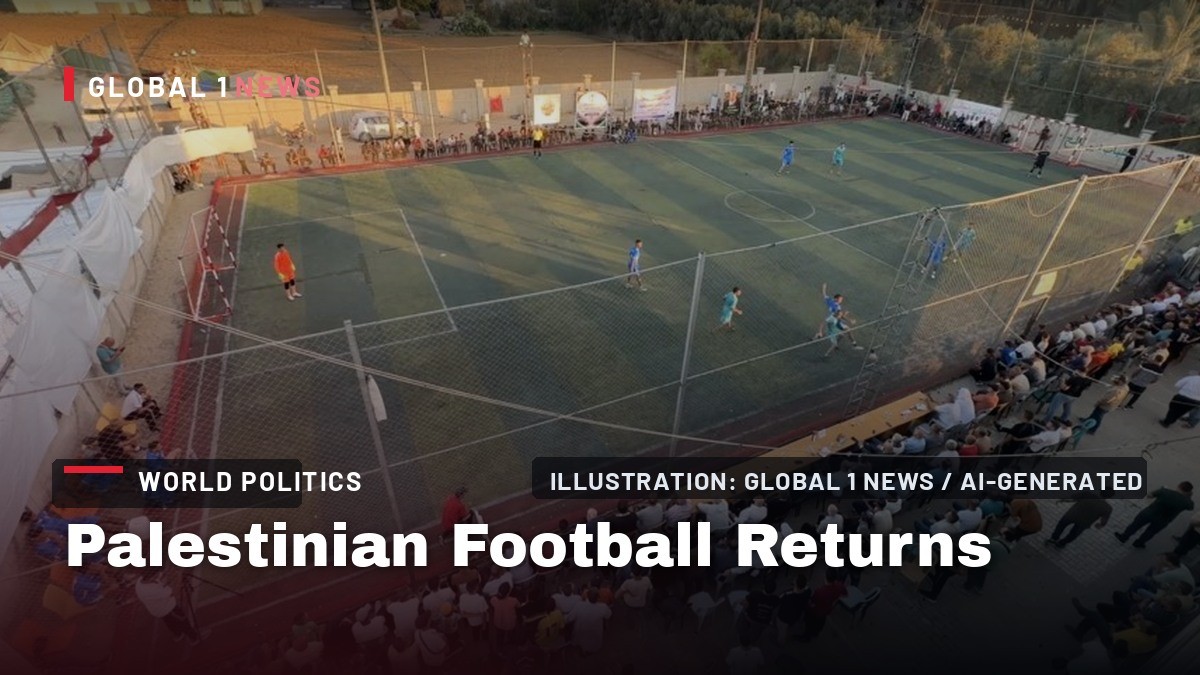
On Friday, after nearly three years of silence imposed by war, the whistle blew again for Palestinian club football. In the occupied West Bank, in the Gaza Strip, and in the refugee camps of Lebanon, matches kicked off simultaneously under a competition bearing a name that carries the weight of loss: the Thousand Martyrs Cup. Organized by the Palestinian Football Association (PFA), the tournament marks the first coordinated return of domestic sporting life since Israel’s genocidal war on Gaza began in October 2023. It is not merely a sporting event; it is an act of collective resilience, a declaration that Palestinian athletes, clubs and communities refuse to be erased.
A Friday of First Whistles Across Three Fronts
The opening matches on Friday were held in three distinct arenas of Palestinian life, each with its own scars. At the Faisal Al-Husseini International Stadium in the town of Al-Ram, north of Jerusalem, Jabal Al-Mukaber faced Shabab Al-Khalil in the occupied West Bank. In the central Gaza Strip, Khadamat Rafah played Shabab Rafah at the Ittihad Deir Al-Balah Club’s stadium, a venue that has itself witnessed the destruction wrought by Israeli bombardment. In Lebanon, Al-Ansar met Al-Nahda at the Abu Jihad Al-Wazir Stadium in the Ain Al-Hilweh refugee camp in the south, a site that has long been a cradle of Palestinian identity and sport in exile.
The matches were the visible tip of a much larger undertaking. As many as 244 clubs from the West Bank, Gaza and the Palestinian diaspora are participating in the competition, according to the Palestinian Football Association. The group-stage draw was held simultaneously across the association’s various branches on September 1, a logistical feat that underscores the PFA’s determination to restore a sense of normalcy and structure to a sporting calendar shattered by war. For the players who took to the pitch on Friday, many of whom had not played a competitive match in years, the occasion was both emotional and historic.
A Cup Named for the Fallen
The name of the tournament is not ceremonial; it is a memorial etched into the very fabric of the competition. The Palestinian Football Association named the cup in memory of the athletes killed by Israel during its war on the Gaza Strip. According to data cited by the PFA, more than 1,000 Palestinian athletes—including players, coaches and referees—have been killed since the war began in October 2023. Mustafa Siyam, secretary-general of the Palestinian Sports Media Association, told Anadolu Agency that the war deliberately targeted Palestinian athletes and sporting infrastructure. He described the tournament as a tribute to “the martyrs of the sports movement, honoring their loyalty and their sacrifice.”
The figure of 1,014 athletes killed, as reported by the PFA, is not a statistic to be absorbed passively. Each number represents a life cut short, a career ended on a street or in a stadium, a family left to mourn. These were young men and women who trained in difficult conditions, who dreamed of representing their people on a larger stage, and who were killed in a war that has shown no mercy to civilians, including those who sought solace in sport. The Thousand Martyrs Cup ensures that their names, their dedication and their sacrifice are not forgotten. It is a promise that Palestinian football will carry their memory forward, even as the ground beneath it remains unstable.
Gaza’s Return to the Pitch Amid the Rubble
The resumption of matches in Gaza carries a significance that cannot be overstated. The enclave has suffered extensive human and material losses since Israel launched its war in October 2023. Stadiums that once hosted league matches now lie in ruins, their pitches cratered by airstrikes, their stands reduced to twisted metal and concrete dust. Sports infrastructure across Gaza has been systematically destroyed, and clubs have lost players, coaches and staff to the violence. For the people of Gaza, football was not merely entertainment; it was a lifeline, a space where children could feel like children and where communities could gather in shared joy. That space was taken away, and with it, a measure of their humanity.
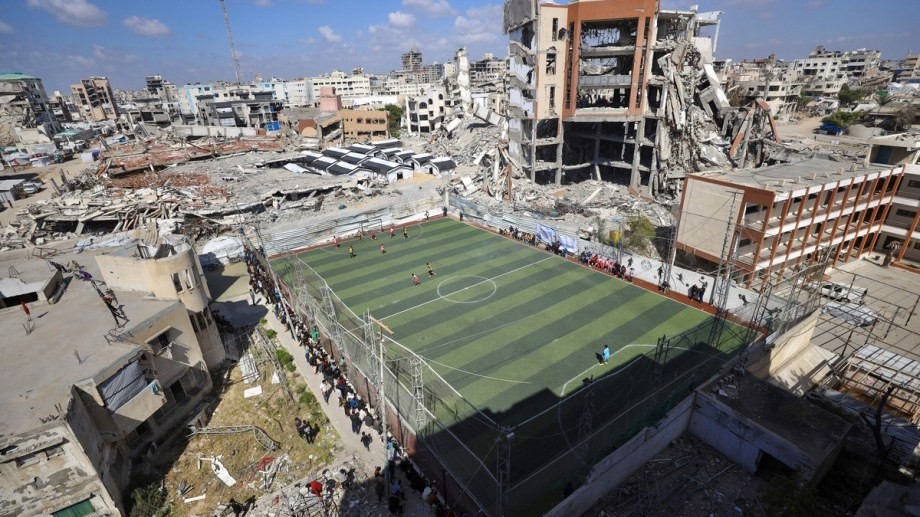
(Source: Khames Alrefi / Anadolu Agency via Middle East Monitor)
Friday’s match between Khadamat Rafah and Shabab Rafah at the Ittihad Deir Al-Balah Club’s stadium was therefore more than a game. It was a reclamation of a right—the right to play, to compete, to experience the simple thrill of a ball crossing a goal line. The players who stepped onto that pitch did so knowing that many of their peers are no longer alive to join them. Their presence was a quiet act of defiance against a war that has sought to erase not just buildings, but the very idea of a Palestinian future. Mustafa Siyam captured this sentiment when he told Anadolu that the tournament’s launch represents “a message that sporting life is returning, even if only in a limited way.” In Gaza, that message is heard loudly, even amid the ongoing destruction and the ever-present threat of further violence.
The West Bank and Lebanon: Playing Under Occupation and in Exile
In the occupied West Bank, the return of domestic tournaments comes after a three-season suspension caused by the continuing Israeli escalation. The occupation has severely restricted the ability of clubs and players to train, travel and hold matches on a regular basis. Checkpoints, military raids and the constant threat of violence have made the simple act of moving from one town to another a logistical and often dangerous challenge. For clubs like Jabal Al-Mukaber and Shabab Al-Khalil, Friday’s match was a hard-won opportunity to compete again, but it was also a reminder of the fragile conditions under which Palestinian sport must operate. The Israeli military’s presence in the West Bank, along with the expansion of illegal settlements, continues to suffocate Palestinian life, including its sporting institutions.
In Lebanon, the competition is being organized through the PFA’s diaspora branch and includes Palestinian clubs operating primarily in refugee camps. The Ain Al-Hilweh camp, where Al-Ansar faced Al-Nahda on Friday, is one of the largest and most historically significant Palestinian refugee camps in the country. For generations, these camps have preserved Palestinian identity, culture and, crucially, sport. The clubs that emerged from them are not just athletic organizations; they are repositories of memory and resistance. By including these diaspora clubs in the Thousand Martyrs Cup, the PFA is affirming that Palestinian football is not confined to the geography of historic Palestine. It extends to every camp, every exile, every community that carries the Palestinian flag in its heart. The participation of these clubs is a reminder that the Palestinian sporting family is vast, resilient and unbroken.
Appeals to FIFA and the Fight for Sporting Justice
The resumption of domestic competition comes alongside renewed calls from the PFA for international accountability. At a press conference in Ramallah in August, PFA president Jibril Rajoub announced the league’s restart on September 4 and appealed directly to FIFA and other international federations to stand by Palestinian sports. He called on the global football community to protect the right of players, clubs and children to enjoy sport in “freedom and dignity.” These are not abstract words; they are a plea to an international system that has largely remained silent while Palestinian athletes have been killed and Palestinian stadiums have been destroyed.
The PFA has repeatedly urged FIFA to sanction Israeli clubs operating in West Bank settlements, which are illegal under international law, and to suspend Israel’s FIFA membership. These efforts have so far met with little concrete action, leaving Palestinian football to navigate a deeply unequal playing field. Israeli clubs continue to benefit from international recognition and competition, while Palestinian clubs struggle for the most basic rights of movement and safety. The Thousand Martyrs Cup is, in part, a response to this injustice. It is a demonstration that Palestinian football will not wait for permission to exist. It will organize, it will compete, and it will honor its dead, regardless of whether the world’s football governing bodies choose to act.
What the Resumption Signals for the Future
The PFA has stated that the Thousand Martyrs Cup will pave the way for the gradual resumption of domestic competitions, with a classified league expected to follow next season. This transitional tournament is therefore not an end in itself but a beginning—a fragile, tentative step toward rebuilding a sporting ecosystem that has been systematically dismantled. For the 244 clubs participating, the tournament offers a chance to regroup, to assess their squads, and to begin the long process of recovery. For the players, it is an opportunity to reclaim their identities as athletes, not just as survivors.
But the road ahead remains fraught with obstacles. The war in Gaza is not over, and the threat of further escalation looms over every fixture. The West Bank remains under occupation, with movement restrictions that could disrupt the schedule at any moment. The refugee camps in Lebanon are subject to their own political and security pressures. Yet the very fact that these matches took place on Friday is a testament to the unyielding spirit of Palestinian sport. It signals that even in the face of genocide, displacement and destruction, the Palestinian people will continue to play, to compete and to honor those they have lost.
A Moment of Meaning Beyond the Scoreline
For Palestinian players and communities, the Thousand Martyrs Cup is more than a series of football matches. It is a moment of collective catharsis, a chance to grieve together and to celebrate survival together. When the players of Khadamat Rafah and Shabab Rafah walked onto the pitch in Deir Al-Balah, they carried with them the memory of teammates who will never play again. When the crowds gathered in Al-Ram and Ain Al-Hilweh, they did so knowing that their presence was a political act, a refusal to be silenced. The tournament’s name is a constant reminder of the cost of this war, but its very existence is a reminder that Palestinian life, and Palestinian joy, cannot be extinguished.
Football has always been a mirror of society, and in Palestine, it reflects both the deepest wounds and the most resilient hopes. The return of club football on Friday is a milestone, but it is also a call to the international community: to recognize the humanity of Palestinian athletes, to hold accountable those who have killed them, and to support the right of every child in Gaza, the West Bank and the camps to play in peace. Until that day comes, Palestinian football will continue to play on, in whatever spaces remain, under whatever skies allow it. The whistle blew on Friday, and it will blow again. That is the promise of the Thousand Martyrs Cup.
By Fatima Al-Rashid, Staff Writer
This article was produced with AI-assisted research and editorial support. Sources: Middle East Monitor, Anadolu Agency, Al Jazeera.
What's Your Reaction?
 Like
0
Like
0
 Dislike
0
Dislike
0
 Love
0
Love
0
 Funny
0
Funny
0
 Wow
0
Wow
0
 Sad
0
Sad
0
 Angry
0
Angry
0
Gulf/MENA Correspondent at Global1.News. Based in Doha, covering Gulf politics, energy markets, diplomacy, and development across the Middle East and North Africa. Tracks the economic transformation of the Gulf states.











Comments (0)