
Hong Kong Primary Three pupils’ maths competency hits all-time low
Hong Kong’s latest Territory-wide System Assessment (TSA) has revealed a striking divergence in primary education outcomes: the mathematics passing rate for Primary Three pupils has slipped to an all‑time low, while basic English competency has reached a record high.
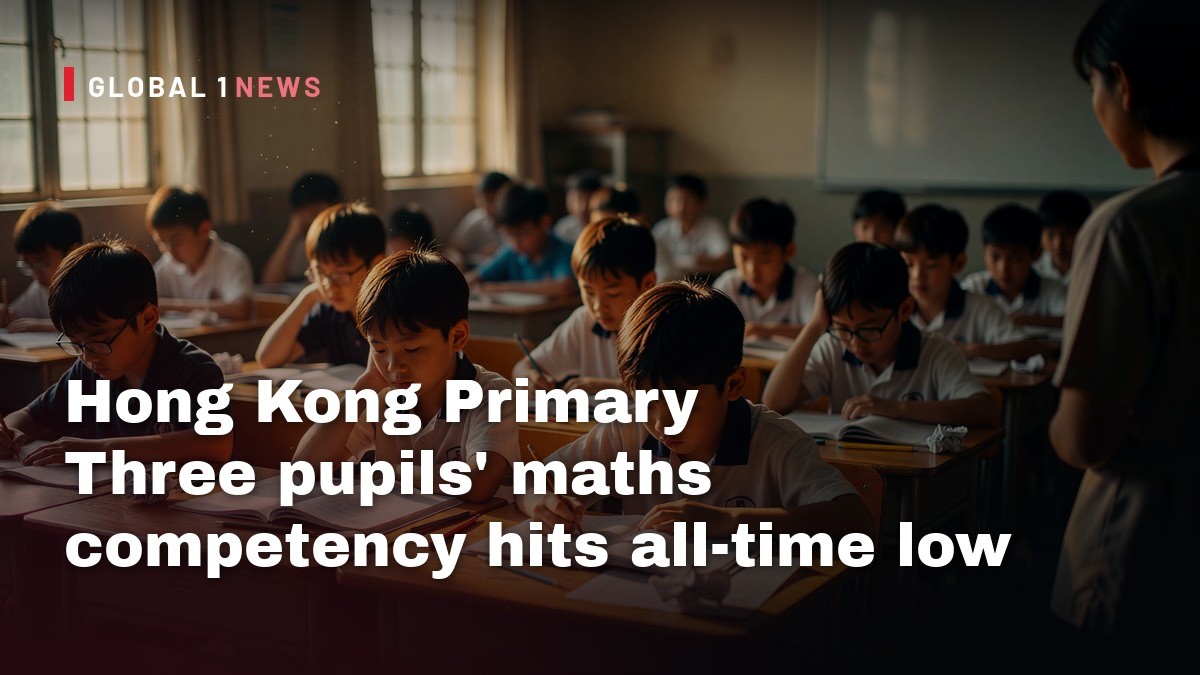
Hong Kong’s latest Territory-wide System Assessment (TSA) has revealed a striking divergence in primary education outcomes: the mathematics passing rate for Primary Three pupils has slipped to an all‑time low, while basic English competency has reached a record high. This twin trend, emerging in the 2026 assessment, offers a window into broader socio‑political dynamics shaping the city’s educational landscape, the strategic priorities of the Hong Kong Special Administrative Region (HKSAR) government, and the evolving interface between mainland policy directives and local schooling practices.
Historical Trajectory of Primary Mathematics Performance
Since the TSA began in 2004, Hong Kong’s mathematics competency among Primary Three students has generally been strong, reflecting the city’s reputation for rigorous academic standards. The most recent data, however, marks a turning point. The passing rate fell to 84.7 percent in 2026, a decline of 0.7 percentage points from the previous year and the lowest level recorded since the assessment’s inception. This downward movement follows a longer‑term trend: the peak passing rate of 89.9 percent observed in 2016 has been eroded steadily over the ensuing decade.
The gradual decline suggests more than a single‑year anomaly. It points to systemic pressures that have accumulated since the mid‑2010s, a period during which Hong Kong’s education system has been subject to intensified political oversight, curriculum revisions, and shifting resource allocations. While the raw figures are modest—a sub‑one‑percent drop from the previous year—the symbolic weight of a record low cannot be dismissed, especially in a context where academic achievement has long been a cornerstone of Hong Kong’s international identity.
English Competency Gains and Their Significance
In contrast, the same assessment recorded a record high English passing rate of 86.3 percent, surpassing previous benchmarks. This improvement underscores a sustained emphasis on English language proficiency, a legacy of Hong Kong’s colonial past and a strategic asset in its role as a global financial hub. The rise in English performance, juxtaposed with the dip in mathematics, raises questions about the allocation of instructional time, teacher expertise, and policy focus within primary schools.
From a geopolitical perspective, the elevation of English competence aligns with Hong Kong’s continued integration into global markets and its function as a conduit for international capital. The HKSAR government’s support for bilingual education serves both domestic stability and external credibility, reinforcing the city’s positioning as a bridge between mainland China and the world. The record high therefore reflects not merely pedagogical success but also a deliberate reinforcement of the linguistic tools that facilitate cross‑border economic activity.
Policy Context: Curriculum Reforms and Political Oversight
Since the implementation of the National Security Law in 2020, Hong Kong’s education system has undergone a series of reforms aimed at strengthening national identity and aligning curricula with mainland priorities. These reforms have introduced new civic education components, increased scrutiny of teaching materials, and emphasized “patriotic” content. While the TSA data do not directly measure the impact of such reforms, the timing of the mathematics decline coincides with a period of heightened policy intervention.
One plausible inference is that the curricular emphasis on national education may have inadvertently crowded out instructional time for core subjects such as mathematics. Teachers, navigating a more complex political environment, may allocate greater effort to ensure compliance with new content standards, potentially at the expense of traditional subject mastery. The steady decline since 2016, predating the 2020 security legislation, suggests that earlier policy shifts—such as the 2016 curriculum overhaul that introduced more interdisciplinary approaches—could also have contributed to a gradual rebalancing of instructional priorities.
Socio‑Economic Factors Influencing Student Performance
Hong Kong’s socio‑economic landscape has been under strain in recent years, with rising living costs and a housing market that places considerable pressure on families. Such macro‑economic stressors can affect student outcomes, particularly in subjects that require sustained practice and parental support, such as mathematics. The modest decline in passing rates may reflect broader household challenges that limit access to supplementary tutoring—a sector that has traditionally bolstered academic performance in the city.
Conversely, English proficiency may have benefited from a more extensive ecosystem of community resources, including public libraries, media exposure, and the prevalence of English in commercial signage. These ambient factors can reinforce classroom learning, offering students informal reinforcement that is less dependent on private tutoring. The record high in English thus may be partially insulated from the socio‑economic headwinds that have weighed on mathematics achievement.
Implications for Hong Kong’s Talent Pipeline
Mathematics competence is a key predictor of future participation in science, technology, engineering, and mathematics (STEM) fields. A sustained decline at the primary level could translate into a narrower pipeline of locally trained talent for Hong Kong’s burgeoning tech and innovation sectors. The city’s strategic plan to diversify its economy beyond finance—emphasizing high‑tech industries, fintech, and smart city initiatives—relies heavily on a workforce proficient in quantitative skills.
If the downward trend persists, Hong Kong may become increasingly dependent on talent imported from mainland China or other regions, potentially reshaping the city’s labor market dynamics. This reliance could have geopolitical ramifications, as the inflow of mainland professionals may accelerate cultural integration and shift the balance of local versus external expertise within key industries.
Comparative Perspective: Mainland China’s Educational Priorities
Mainland China has, for decades, placed a premium on mathematics education, viewing it as essential to national modernization and global competitiveness. The divergence between Hong Kong’s declining mathematics performance and the mainland’s sustained emphasis on quantitative mastery highlights a growing policy asymmetry. While Hong Kong’s education system retains a degree of autonomy under “one country, two systems,” the trend may prompt central authorities to reassess the degree of alignment required.
In the broader context of China’s Belt & Road Initiative and its push for technological self‑reliance, the cultivation of strong math skills is seen as a strategic imperative. Hong Kong’s lagging performance could be interpreted by Beijing as a signal that the city’s educational outcomes need to be more closely calibrated with national objectives, potentially prompting further policy interventions aimed at reinforcing mathematics instruction.
Strategic Outlook and Policy Recommendations
The 2026 TSA results serve as an early warning sign for policymakers in Hong Kong. To arrest the decline in mathematics competency, a multi‑pronged approach is advisable. First, a review of curriculum time allocation should ensure that mathematics retains sufficient instructional hours amidst the expanding civic and national education components. Second, targeted professional development for mathematics teachers could address any gaps in pedagogical expertise that have emerged under the pressures of new policy mandates.
Third, the government might consider expanding publicly funded tutoring or after‑school support programs, particularly for students from lower‑income households who are disproportionately affected by the city’s high cost of living. Finally, fostering partnerships with mainland educational institutions could facilitate the exchange of best practices in mathematics education, aligning Hong Kong’s outcomes with the broader national talent development strategy.
In sum, the juxtaposition of a record low in primary mathematics and a record high in English within the same assessment underscores the complex interplay of educational policy, socio‑economic pressures, and geopolitical imperatives that shape Hong Kong’s schooling system. How the HKSAR authorities respond will not only determine the future academic trajectory of its youngest learners but also influence the city’s capacity to sustain its role as a global hub in an era of intensifying China‑centric strategic competition.
This article was produced with AI-assisted research and editorial support. Reporting is based on the source material cited below. Sources: South China Morning Post; scmp.com; Global1.News (05 November 2026).
By Prof. Marcus Chen, Staff Writer
What's Your Reaction?
 Like
0
 Dislike
0
 Love
0
 Funny
0
 Wow
0
 Sad
0
 Angry
0

World Politics Analyst at Global1.News. Based in Beijing, covering US-China relations, global trade, and geopolitical strategy. Brings deep analytical perspective to the power dynamics shaping international affairs.















Comments (0)