
Pacquiao joins Marcos Cabinet as anti-poverty czar
Manny Pacquiao returned to government service Tuesday as secretary and lead convenor of the National Anti-Poverty Commission, taking his oath before President Ferdinand Marcos Jr. at Malacañang and replacing Lope Santos III to coordinate anti-poverty efforts nationwide.
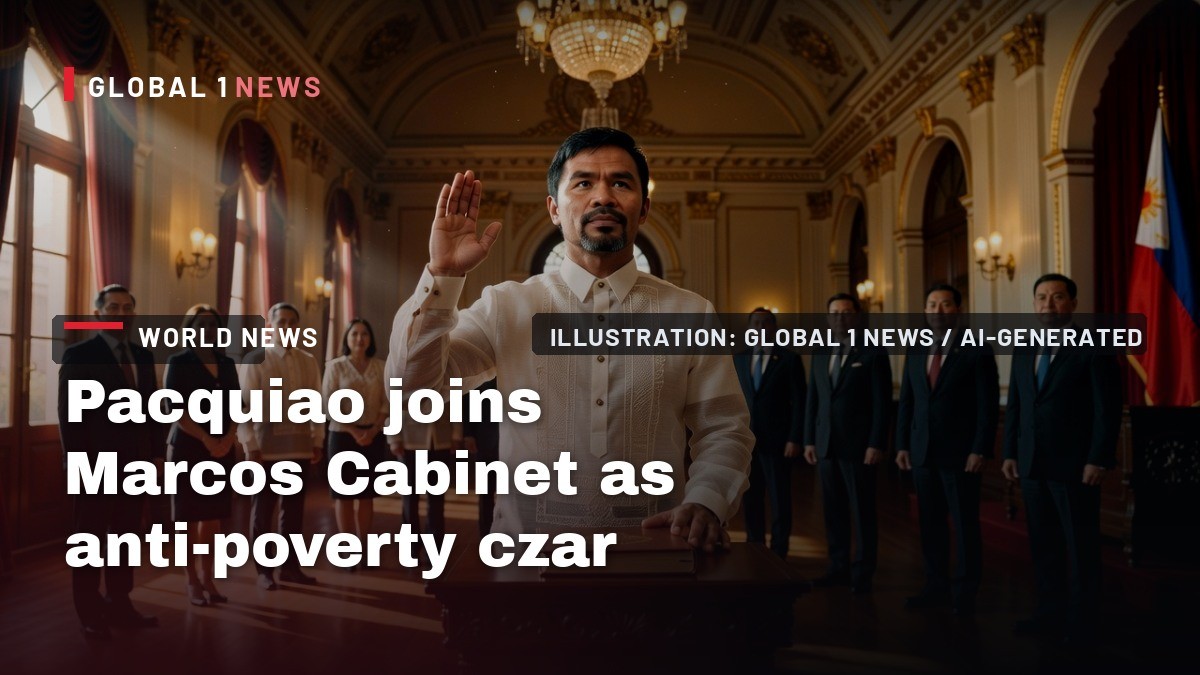
MANILA — Boxing legend and former senator Manny Pacquiao is back in government service, taking on the role of the nation’s lead anti-poverty czar under the Marcos administration. The eight-division world champion took his oath as secretary and lead convenor of the National Anti-Poverty Commission (NAPC) before President Ferdinand Marcos Jr. at Malacañang on Tuesday, September 8, marking his return to public office four years after his Senate term ended.
A Champion’s Return to the Halls of Power
The oath-taking ceremony on Tuesday formalized Pacquiao’s entry into the Cabinet, a significant homecoming for the Sarangani native who first rose to prominence not in politics, but in the boxing ring. His appointment places him at the helm of the NAPC, the government body tasked with coordinating poverty reduction programs across national agencies, local government units, and the private sector.
Pacquiao’s return comes at a critical time for the country, as Filipino families continue to grapple with the high cost of food and daily necessities. For many in his home province and across the nation, the “Pambansang Kamao” has always been a symbol of rising from nothing—a story that resonates deeply in communities where poverty remains a daily struggle. His new role is seen by many as a chance to translate that personal narrative into tangible government action for the poorest of the poor.
The former senator replaces Lope Santos III, who had served as NAPC lead convenor since 2023. The transition in leadership follows a recent administrative shake-up, with President Marcos transferring supervision of the NAPC from the Department of Social Welfare and Development (DSWD) back to the Office of the President just weeks ago. This move signals a more direct hand from Malacañang in steering the country’s anti-poverty agenda.
Understanding the NAPC and Its Mandate
To understand the weight of Pacquiao’s new job, one must look at the machinery he now leads. The NAPC was created under Republic Act No. 8425, also known as the Social Reform and Poverty Alleviation Act, a landmark legislation from the 1990s designed to systematize the government’s approach to fighting poverty. Unlike agencies that directly hand out aid, the NAPC’s primary function is coordination—ensuring that the various anti-poverty initiatives of different departments do not overlap and that resources reach the intended beneficiaries efficiently.
The commission is chaired by the President himself, with the lead convenor serving as the head of its secretariat. Holding the rank of a Cabinet secretary, the lead convenor acts as the central figure linking the Office of the President to the ground-level realities of poor communities. This structure is designed to cut through bureaucratic red tape, allowing for a more unified strategy in addressing systemic issues like food security, livelihood generation, and access to basic services.
For ordinary Filipinos, the NAPC is the body that is supposed to ensure that a farmer in a remote barangay in Mindanao and a vendor in a crowded Manila street market both benefit from national growth. It is the clearinghouse for programs that touch the lives of informal settlers, fisherfolk, and minimum wage earners—the very sectors that Pacquiao has often championed during his time in public service.
Reaching the Grassroots: From Barangay Halls to Sari-Sari Stores
The true test for Pacquiao will be how effectively the NAPC can translate national policy into local action. The commission’s work often hinges on its ability to partner with local government units and barangay captains, who are the first responders to poverty in their communities. It is at the barangay level where the daily realities of hunger and lack of opportunity are most visible, and where the success of any anti-poverty program is ultimately measured.
In many provinces, the NAPC’s role involves mediating between national agencies and local leaders to ensure that programs like livelihood training or feeding initiatives are not just paper directives. The goal is to foster a sense of bayanihan, the communal spirit of helping one another, within the framework of government action. For a country where many families rely on the sari-sari store in their neighborhood for daily survival, the coordination of micro-financing and small business support is crucial.
Pacquiao’s familiarity with the grassroots is undeniable. Coming from a background of extreme poverty in General Santos City, he has often spoken about selling bread and helping his mother in the market as a child. This lived experience could provide him with a unique perspective in leading an agency that often struggles to connect with the very people it is meant to serve. The challenge, however, lies in scaling that personal empathy into a nationwide, systematic approach that can withstand political changes.
Pacquiao’s Political Journey: From Senate to Malacañang’s Table
Pacquiao’s path back to government has been anything but linear. He served six years in the Senate, with his term ending in June 2022. During his time as a legislator, he was known for his advocacy on housing and education, though his attendance and legislative output were often subjects of public debate.
In 2022, he made a bold bid for the highest office in the land, running for president. He finished third in that race, behind the eventual winner, President Marcos Jr., and then-Vice President Leni Robredo. The defeat did not keep him out of the political arena for long. He later sought a return to the Senate in the 2025 midterm elections, running under the administration-backed Alyansa para sa Bagong Pilipinas ticket. Despite the backing of the ruling coalition, Pacquiao failed to secure a seat, a surprising setback for a politician of his stature.
This appointment, therefore, represents a significant political rehabilitation and a sign of the President’s trust. By bringing Pacquiao into the Cabinet, President Marcos is not just filling a position; he is consolidating his political coalition and tapping into the immense popularity that Pacquiao still enjoys among the masses. For Pacquiao, it is a chance to remain relevant in governance and to serve in a capacity that aligns with his personal brand as a champion of the underprivileged.
What This Means for Filipino Families and the Fight Against Hunger
The appointment comes at a time when many Filipino households are still feeling the pinch of rising commodity prices. For the average family, the question is not about political strategy but about results. Will this new leadership mean more food on the table? Will there be more job opportunities for the unemployed? Will the government’s ayuda, or financial aid, reach those who need it most without delay?
Pacquiao’s role as lead convenor places him in a position to influence these outcomes. His office will be responsible for pushing agencies to prioritize poverty alleviation in their budgets and programs. He will be expected to work closely with the DSWD, the Department of Labor and Employment, and the Department of Agriculture to ensure a cohesive approach. The recent transfer of the NAPC’s supervision to the Office of the President gives him a stronger mandate to call on other departments to act, a power that could be crucial in cutting through bureaucratic inertia.
There is also a symbolic aspect to his appointment. For many overseas Filipino workers (OFWs) who left their families to seek a better life abroad, and for the families they left behind, Pacquiao represents the dream that one can escape poverty through hard work. His presence in the Cabinet could serve as an inspiration, but it also raises expectations. The public will be watching closely to see if the man who once fought for glory in the ring can now fight effectively for the welfare of millions of Filipinos living below the poverty line.
Challenges Ahead and the Path Forward
Pacquiao steps into this role with a mixed record as a legislator and a failed bid for the Senate just last year. Critics may question his readiness to handle the complex, data-driven work of poverty alleviation, which requires more than just charisma and good intentions. The NAPC has often been criticized for being a largely ceremonial body with limited power to compel other agencies to act. Pacquiao will need to navigate these institutional limitations to make a meaningful impact.
Furthermore, the political dynamics are delicate. He is now serving an administration whose leader he once ran against. While he has shown loyalty by joining the administration’s Senate slate in 2025, the transition from political rival to Cabinet member will require a delicate balancing act. His success will depend on his ability to work behind the scenes, building consensus among governors, mayors, and barangay captains, rather than seeking the spotlight that he is so accustomed to.
As the nation moves toward the holiday season, a time when the gap between the rich and the poor becomes starkly visible, Pacquiao’s work will be under a microscope. The coming months will reveal whether his appointment is a mere political accommodation or a genuine commitment to tackling one of the country’s most persistent problems. For now, the Filipino people can only hope that the energy and determination that defined his boxing career will now be channeled into the grueling, less glamorous fight against poverty.
This article was produced with AI-assisted research and editorial support. Sources: Philstar.comBy Bella Reyes, Staff WriterWhat's Your Reaction?
 Like
0
Like
0
 Dislike
0
Dislike
0
 Love
0
Love
0
 Funny
0
Funny
0
 Wow
0
Wow
0
 Sad
0
Sad
0
 Angry
0
Angry
0

Philippines/Southeast Asia Correspondent at Global1.News. Manila-based journalist covering Philippine politics, environment, maritime security, and social issues. Passionate about marine conservation and the communities protecting the Philippines' natural heritage.














Comments (0)