
P1.9 Trillion Flood Spending Fails: Lacson Demands Answers
Sen. Panfilo Lacson questions P1.939 trillion in flood control spending since 2011 as monsoon floods hit Metro Manila. DPWH Secretary Vince Dizon cites need for updated master plan. P107.4 billion proposed for 2027 flood budget. Families in Pasig, Malabon, Valenzuela face recurring flooding.
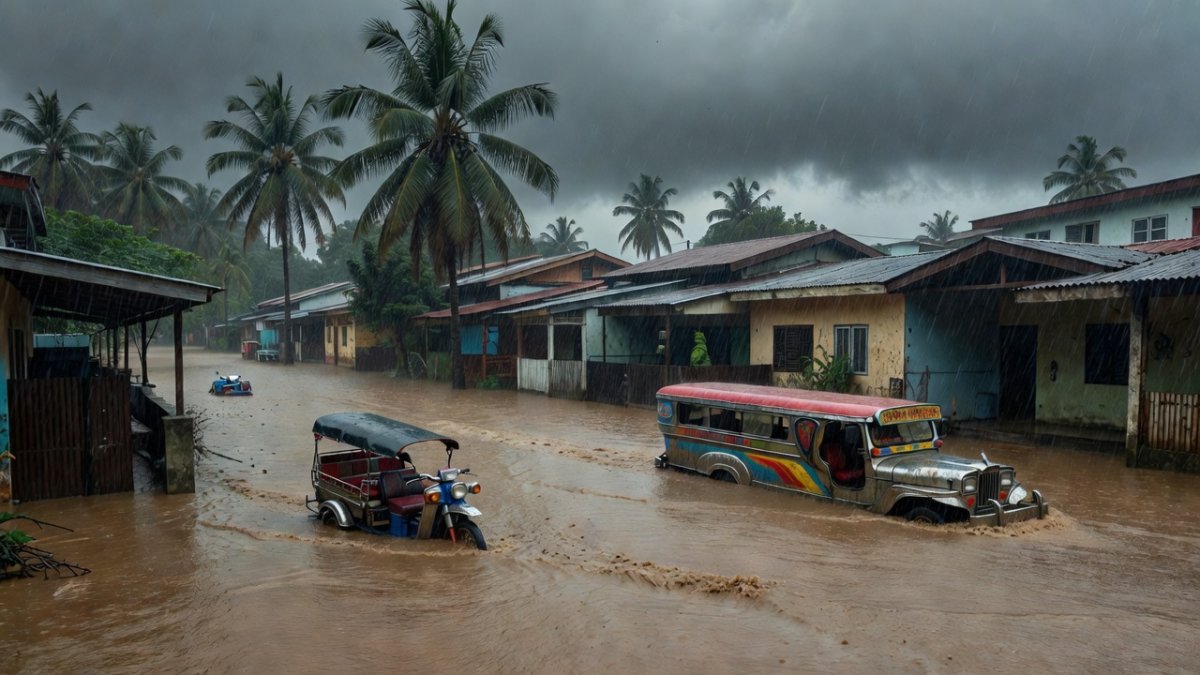
The rain came down hard on Monday night, and by Tuesday morning, many of our kapitbahay in Metro Manila woke up not to the sound of alarm clocks, but to the sight of murky floodwater creeping into their homes. In Barangay Dela Paz, Pasig, the water reached 36 inches — waist-deep for most adults, making roads impassable for motorcycles and sedans. In Malabon, 13 areas reported flooding. In Valenzuela, water lingered along D. Bonifacio Avenue. It is a scene we know all too well, a recurring nightmare that plays out every rainy season.
But this time, a senator is asking a question that many of us have been asking for years: with nearly P2 trillion supposedly spent on flood control, why are we still wading through the same floodwaters?
Sen. Panfilo Lacson raised this very issue in a statement yesterday, questioning the effectiveness of the government's flood control program. According to the senator, the Department of Public Works and Highways (DPWH) has spent a staggering P1.939 trillion on flood control management over the past 15 years, spanning three administrations — and yet, the country remains as vulnerable as ever to devastating floods. "P1.939 trillion funded the DPWH flood control management program under three presidents from 2011-2025, and the result is uncontrolled flood," Lacson said.
It is a bitter pill to swallow for the families in flooded barangays who have to carry their children on their shoulders just to get to dry ground, and for the sari-sari store owners who watch their goods get ruined by the rising water year after year.
The P1.9 Trillion Question
Lacson's frustration is rooted in a simple but painful observation: the money has been spent, but the problem persists. He noted that the multitrillion-peso spending equates to roughly P350 million per day — a mind-boggling figure for ordinary Filipinos who save every piso just to make ends meet. The senator's message is clear: we cannot keep throwing money at a problem without a clear, integrated direction.
"Are we following a flood management program? If not, we are just wasting money because we have no direction," Lacson said. He plans to raise this issue during the upcoming Development Budget Coordination Committee briefing, where he intends to scrutinize the P107.4 billion earmarked for flood control in the proposed 2027 national budget. "A good question to ask is, how will it be spent? Are there overall programs for this? If so, where are they?"
This is not just a question of government accounting. For the tricycle driver in Quezon City who loses a day's income because the streets are impassable, or the OFW who sends money home to build a house that gets flooded every year, this is about whether the government truly understands the daily struggles of the people. The senator's questions echo the sentiments of many Filipinos who feel that despite the billions spent, the government's flood control efforts have been piecemeal and reactive, rather than proactive and comprehensive.
What the Numbers Show
The historical spending data cited by Lacson paints a picture of ballooning budgets without corresponding results. Under the administration of the late president Benigno Aquino III, DPWH flood management allocations stood at P11.323 billion in 2011. By 2017, under President Rodrigo Duterte, the budget had grown to P81.223 billion. The following year, 2018, it breached the P100-billion threshold at P139.001 billion.
Annual funding consistently hovered above P116 billion through 2022 before surging dramatically in recent years. In 2023, the allocation jumped to P287.018 billion, followed by P346.771 billion in 2024, and peaking at P372.814 billion in 2025 under the administration of President Ferdinand Marcos Jr. The trajectory shows a government that is willing to spend — but the question remains whether it is spending wisely.
For the average Filipino, these numbers are abstract. What is not abstract is the sight of the San Juan River standing at 11.94 meters as of 5:10 a.m. Tuesday, a dangerous level that threatens nearby communities. What is not abstract is the Metro Manila Development Authority offering free towing services for vehicles submerged in floodwaters — a service that, while helpful, should not be necessary if the flood control systems were working properly.
Interior Secretary Jonvic Remulla has ordered local chief executives to conduct pre-disaster risk assessments and carry out preemptive or mandatory evacuations of residents in vulnerable communities. This comes after the Mines and Geosciences Bureau reported that more than 17,000 barangays are susceptible to floods and rain-induced landslides. Seventeen thousand barangays — that is a staggering number of communities, each one filled with families, children, and elderly residents who face the brunt of every typhoon and monsoon.
A Master Plan After Years of Waiting
Echoing Lacson's concerns, DPWH Secretary Vince Dizon admitted that a master plan is crucial. "We really need a master plan because we cannot just wait, we have to do something," Dizon said at a press briefing yesterday. He revealed that the government expects to complete an updated flood control master plan this year, containing measures and projects to address the country's flooding woes.
The original plan was approved during the administration of the late president Benigno Aquino III in 2012 — 14 years ago. In those 14 years, billions have been spent, but the plan has apparently not been updated to reflect changing circumstances, climate patterns, or the rapid urbanization that has transformed our cities. This is a classic case of government bureaucracy moving too slowly while the waters rise ever faster.
San Juan City Mayor Francis Zamora, who leads the Metro Manila Council, said the DPWH has already begun the initial phase of a unified drainage master plan that would link flood-control systems across city boundaries. "Only a master plan will ensure the interconnection of drainage systems," Zamora said in an interview with "Storycon" on One News. He added that future national and local flood control projects should be aligned with this plan.
This is a crucial point. In Metro Manila, flooding does not respect city boundaries. Water flows from one city to another, and if each LGU only looks after its own drainage systems, the problem simply gets pushed elsewhere. The bayanihan spirit that Filipinos are known for needs to be applied to our flood control efforts — we need to work together, not in silos.
Families in the Floodwaters
Behind the statistics and the budget figures are real people. In Pasig, the floodwaters at the Katipiran Yap Compound in Barangay Dela Paz reached 91.44 centimeters, or 36 inches, around 4:30 a.m. — making the area impassable to motorcycles and sedans. Imagine the parents who had to carry their children on their shoulders to get them to school, or the workers who could not get to their jobs because their vehicles could not pass.
In Malabon, 13 areas reported flooding as of 5 a.m., with water levels ranging from one to eight inches. The deepest flooding was recorded in Barangay Panghulo at eight inches, while five- to six-inch flooding was reported in Barangays Catmon, Concepcion, Hulong Duhat, San Agustin and Tañong. In Valenzuela, flooding had largely subsided by early Tuesday, but one to two inches of surface water remained along D. Bonifacio Avenue in Barangay Canumay East.
These are not just numbers on a report. These are the homes of our kapitbahay, the streets where our children play, the routes that our jeepney drivers and tricycle drivers depend on for their livelihood. Every flood season, these communities are disrupted, their daily lives upended, their hard-earned possessions damaged or destroyed. The emotional toll is just as significant as the financial one — the constant anxiety of watching the sky darken, the fear of not knowing how high the water will rise this time.
What the 2027 Budget Means
Lacson's warning about the P107.4 billion earmarked for flood control in the proposed 2027 national budget is a call for accountability. Without a clear, integrated master plan, he warned, this money risks being wasted. This is a significant amount of money — money that could build schools, hospitals, and other infrastructure that our communities desperately need.
The DPWH is also planning to build water retention basins in Quezon City and other parts of Metro Manila to help mitigate flooding. Dizon said they are looking at Sitio Kaingin Bukid in Barangay Apolonio Samson in Quezon City, Bustillos in Sampaloc, and Rajah Sulayman as possible sites for these basins. Water retention basins are a proven method of flood control — they capture excess rainwater and release it slowly, preventing the sudden surges that overwhelm drainage systems.
But these projects take time to plan, fund, and construct. In the meantime, our communities continue to suffer. The question that Lacson is asking — and that many Filipinos are asking — is whether the government has a clear vision for how this money will be spent. Will it be spent on scattered, uncoordinated projects that provide temporary relief but do not solve the underlying problem? Or will it be spent on a comprehensive, integrated approach that addresses the root causes of flooding?
The Road Ahead for Flood-Resilient Communities
As the rain continues to fall and the floodwaters rise, the need for action becomes more urgent. The government cannot afford to wait another 14 years to update its master plan. The climate is changing, the rains are becoming more intense, and our cities are becoming more congested. The old ways of doing things are no longer sufficient.
Lacson's call for accountability is a reminder that the government must be transparent about how it spends public funds. The P1.939 trillion spent over the past 15 years is not just a number — it is the hard-earned money of Filipino taxpayers, including the OFWs who sacrifice being away from their families to provide for their loved ones back home. They deserve to know that their money is being spent wisely.
For the families in flooded barangays, the road ahead is uncertain. But there is hope in the fact that the issue is being raised, that questions are being asked, and that the government is acknowledging the need for a master plan. The bayanihan spirit that has always defined our people — the willingness to help one another in times of crisis — must now be matched by a government that is equally committed to finding long-term solutions.
The P107.4 billion in the proposed 2027 budget is an opportunity. It is a chance for the government to show that it has learned from the mistakes of the past, that it is willing to listen to the concerns of the people, and that it is committed to building a future where our children do not have to wade through floodwaters just to get to school. The question is whether our leaders will seize this opportunity or let it slip away like the water that flows through our streets every rainy season.
This article was produced with AI-assisted research and editorial support. Sources: Philstar.com
By Bella Reyes, Staff Writer
What's Your Reaction?
 Like
0
Like
0
 Dislike
0
Dislike
0
 Love
0
Love
0
 Funny
0
Funny
0
 Wow
0
Wow
0
 Sad
0
Sad
0
 Angry
0
Angry
0

Philippines/Southeast Asia Correspondent at Global1.News. Manila-based journalist covering Philippine politics, environment, maritime security, and social issues. Passionate about marine conservation and the communities protecting the Philippines' natural heritage.













Comments (0)