
Over P5 Billion Needed to Rebuild Storm-Hit Classrooms
DepEd needs P5.072B to rebuild 476 schools destroyed by typhoons Luis, Maymay, Neneng and the southwest monsoon. Over 1,100 classrooms serve as evacuation centers for nearly 10,000 families. The storms killed 32 people and affected 8 million nationwide.
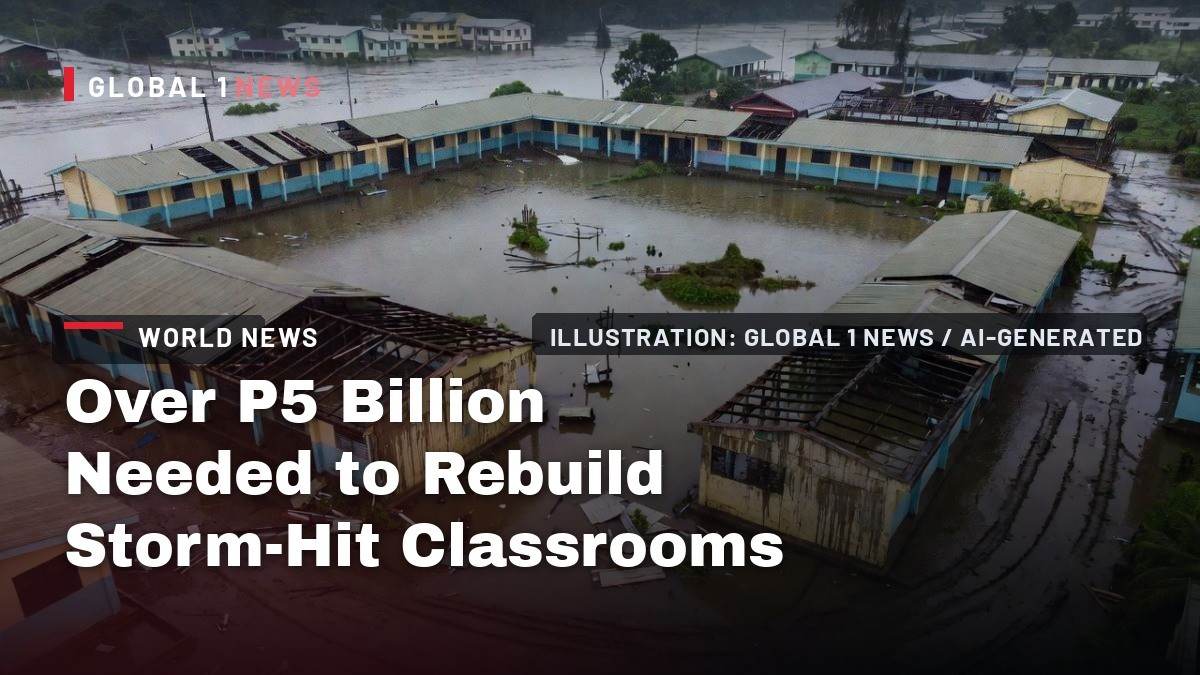
The Department of Education (DepEd) has revealed that at least P5.072 billion is urgently needed to reconstruct 476 schools destroyed by the relentless southwest monsoon (habagat) and the successive tropical cyclones Luis, Maymay, and Neneng that battered the country in late August. The staggering figure, detailed in a situation report released on Saturday, underscores the immense toll this year’s storm season has taken on the nation’s educational infrastructure, leaving thousands of Filipino students and teachers facing an uncertain return to normalcy.
Breaking Down the Reconstruction Bill
Beyond the full reconstruction costs, the DepEd Disaster Risk Reduction and Management Service (DRRMS) reported that an additional P1.013 billion is required for the major repair of 624 schools. The financial burden does not stop there, as the agency also identified a need for P277.34 million to address minor repairs across 1,444 schools, and a further P46.983 million dedicated solely to cleanup and clearing operations for another 1,627 school sites.
Together, these figures put the total repair bill at more than P6.4 billion, a sum that will test the government’s fiscal resilience as it balances disaster response with ongoing educational reforms. For DepEd, the challenge is not only finding the money but sequencing the work: clearing debris first, then making schools safe enough to reopen, and finally rebuilding those that were destroyed outright. Officials said the agency is tracking the damage school by school, using its field offices to validate reports before funds are released.
Evacuation Centers Strain School Resources Across Luzon
The damage to school buildings is compounded by the fact that many are still serving as temporary shelters for families displaced by the flooding and high winds. According to the DepEd, a total of 1,145 classrooms across 307 schools are currently being used as evacuation centers, providing refuge for at least 9,798 families. This dual role of schools—as centers of learning and as sanctuaries during calamities—is a familiar reality in the Philippines, but it places an immense strain on resources and delays the rehabilitation process.
The distribution of these evacuation centers highlights the geographic spread of the disaster. Central Luzon bears the heaviest load with 172 evacuation centers, followed by Calabarzon with 57, and the Ilocos Region with 37. Even Metro Manila, despite its urban infrastructure, has 15 schools serving as evacuation hubs. Eastern Visayas has 11, Mimaropa has eight, and the Cordillera Administrative Region has seven. For many barangays, the local public school is the only sturdy structure capable of housing large numbers of people, a fact that DepEd acknowledges even as it complicates the path to reopening.
“The Disaster Risk Reduction and Management Service maintains close coordination with field offices to track emerging impacts, validate class suspension data through the ‘Walang Pasok’ monitor and support timely clearing and repair of affected schools,” the DepEd stated in its report. This coordination is critical, as the agency must balance the immediate humanitarian needs of evacuees with the long-term goal of resuming classes. For the thousands of families sheltering in these schools, the situation is a daily struggle. Parents want their children back in classrooms, but the buildings they depend on for safety are also the places keeping them out of them. The longer evacuation continues, the harder it becomes for students to keep up with their lessons, and the longer repair work is delayed.
National Death Toll and Widespread Displacement
The human cost of this disaster extends far beyond damaged infrastructure. The Office of Civil Defense (OCD) has reported that the combined effects of cyclones Luis, Maymay, and Neneng, exacerbated by the enhanced habagat, have resulted in at least 32 confirmed deaths and have affected more than 8 million individuals across the archipelago. These numbers represent families who have lost loved ones, livelihoods, and homes, and they underscore the severity of a storm system that struck in rapid succession, leaving little time for recovery between events.
The sequence of typhoons in late August overwhelmed local disaster response mechanisms. The Philippine Atmospheric, Geophysical and Astronomical Services Administration (PAGASA) hoisted red rainfall warnings over Metro Manila and other parts of Luzon, triggering widespread flooding that turned streets into rivers and forced the suspension of work and classes. For many communities, the flooding was among the worst they had experienced in years.
In addition to the immediate dangers of flooding and strong winds, the Philippine Institute of Volcanology and Seismology (Phivolcs) has issued warnings of possible lahar flows from the slopes of Mount Pinatubo and Taal Volcano. The intense rainfall from the storms has saturated volcanic debris, creating the risk of destructive mudflows that could threaten low-lying communities. This geological hazard adds another layer of complexity to the recovery effort, as local government units (LGUs) must now prepare for potential secondary disasters even as they grapple with the current crisis.
Infrastructure Losses and the Economic Burden
The damage to schools is part of a broader pattern of destruction that has hit the nation’s infrastructure hard. Earlier damage reports have placed total infrastructure losses at P5.95 billion across the entire storm system. This includes roads, bridges, flood control structures, and public buildings, all of which are essential for the movement of goods, services, and relief supplies. The destruction of these assets hampers economic activity and slows down the delivery of aid to the most affected areas.
Public works crews face a race against time to clear roads and repair critical bridges. Many rural areas, particularly in the mountainous regions of the Cordillera and the agricultural heartlands of Central Luzon, remain isolated due to landslides and washed-out roads. This isolation prevents farmers from bringing their produce to market, further squeezing an economy already reeling from the storm’s impact. The cost of reconstruction will inevitably divert funds from other development projects, a painful trade-off that the national government must navigate in the coming months.
The economic ripple effects are felt at the grassroots level. Across flooded farming areas, damaged fields and disrupted harvests mean lost income for countless families, many of whom now struggle to afford basic necessities, including school supplies for their children. This intersection of agricultural loss and educational disruption creates a cycle of poverty that is difficult to break, highlighting the need for a comprehensive and compassionate recovery plan.
DepEd’s ‘Walang Pasok’ Monitor and Operational Readiness
In response to the ongoing crisis, the DepEd has emphasized the importance of its ‘Walang Pasok’ monitor, a system designed to provide timely and accurate announcements regarding class suspensions. This tool has become an essential resource for parents, students, and teachers, allowing them to plan their days around the unpredictable weather. The system, which is coordinated with local government units and the national weather agency, ensures that decisions to suspend classes are based on real-time data and safety assessments.
The DepEd has advised all field offices and school disaster risk reduction and management teams to sustain their monitoring and operational readiness. "Weather conditions remain capable of triggering localized flooding, landslides and further disruptions," the agency warned. This advisory is not merely precautionary; the southwest monsoon is still active, and forecasters have not ruled out the possibility of additional weather disturbances forming in the coming weeks. In the hardest-hit regions, the start of the school year, which typically falls in late August or early September, faces significant disruption as communities recover.
For public school teachers, the situation is particularly challenging. Many have volunteered their time to help manage evacuation centers, distribute relief goods, and assist in clearing operations. This spirit of bayanihan is commendable, but it also means that teachers are exhausted and have had little time to prepare their lesson plans for the new school year. The DepEd has acknowledged this strain and is working to provide support and resources to help educators cope with the added responsibilities. The resilience of the Filipino teacher, who often goes above and beyond the call of duty, is a testament to the nation’s character, but it should not be taken for granted.
Path to Recovery and the Call for Bayanihan
The road to recovery will be long and arduous. The DepEd’s request for over P5 billion in reconstruction funds is a clear signal that the government cannot shoulder this burden alone. There is a growing call for the private sector, non-governmental organizations, and international partners to step in and assist with the rebuilding effort. The spirit of bayanihan, the Filipino tradition of communal unity and cooperation, will be essential in the weeks and months ahead.
Local government units, from provincial governors to barangay captains, are on the front lines of this recovery. They are tasked with the unglamorous but vital work of clearing debris, assessing damage, and ensuring that relief goods reach the most vulnerable. The coordination between the national government and these local leaders will determine the speed and effectiveness of the rebuilding process. For the millions of Filipino students waiting to return to their classrooms, the promise of a rebuilt school is a beacon of hope amidst the devastation.
As the nation grapples with the aftermath of these storms, the focus must remain on the human impact. Every peso allocated for reconstruction represents a child’s chance to learn in a safe environment, a teacher’s ability to inspire, and a community’s path to normalcy. The classrooms that are being repaired are not just structures of concrete and steel; they are the foundations of the nation’s future. The task ahead is daunting, but the resilience of the Filipino people, honed by countless storms, offers a glimmer of hope that the country will rise again, stronger and more united than before.
This article was produced with AI-assisted research and editorial support. Sources: Philippine Star (Philstar.com), August 30, 2026.
By Bella Reyes, Staff Writer
What's Your Reaction?
 Like
0
Like
0
 Dislike
0
Dislike
0
 Love
0
Love
0
 Funny
0
Funny
0
 Wow
0
Wow
0
 Sad
0
Sad
0
 Angry
0
Angry
0

Philippines/Southeast Asia Correspondent at Global1.News. Manila-based journalist covering Philippine politics, environment, maritime security, and social issues. Passionate about marine conservation and the communities protecting the Philippines' natural heritage.













Comments (0)