
Over 29,000 double-envelope ballots counted in Israeli election, around 6% of total
Israel’s parliamentary election on 27 October 2026 has entered a critical phase as the Central Elections Committee moves to count the double‑envelope ballots that represent roughly six percent of the total vote.
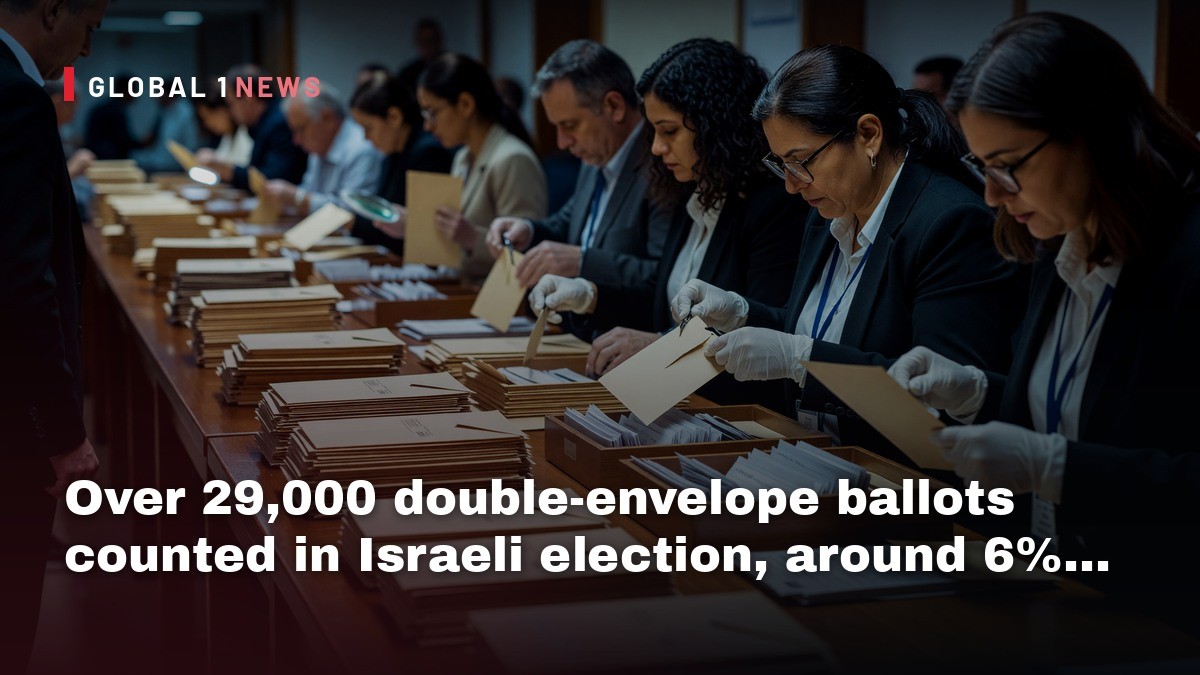
Israel’s parliamentary election on 27 October 2026 has entered a critical phase as the Central Elections Committee moves to count the double‑envelope ballots that represent roughly six percent of the total vote. While the regular ballot count has already projected a fragmented Knesset, the remaining envelopes—used by soldiers, diplomats, police officers and displaced residents—could still shift the balance of power between the two main political blocs. The human dimension of these ballots, and the legal safeguards surrounding them, underscores the broader stakes for democratic representation in a region where political exclusion often translates into human rights violations.
The significance of double‑envelope voting
Double‑envelope voting was introduced to accommodate Israelis who cannot reach their registered polling stations, ensuring that citizens serving abroad or in conflict‑affected areas can still exercise their franchise. Each voter places an outer envelope bearing identifying details, which election officials verify to prevent duplicate voting. Inside, an anonymous ballot is sealed, preserving the secrecy of the vote. This system, used for nearly half a million ballots, reflects an attempt to balance security concerns with the fundamental right to vote.
In the current count, 29,253 of these envelopes have been processed, representing about six percent of the total vote pool. The Central Elections Committee expects the remaining envelopes to be tallied by the afternoon, meaning that the final composition of the Knesset could still be altered as the day progresses. For the individuals whose votes are contained in these envelopes—soldiers stationed at checkpoints, diplomats navigating foreign ministries, police officers maintaining order, and residents displaced by conflict—their participation carries profound personal and collective meaning.
Projected seat distribution and the fragility of the outcome
Channel 12’s early projections, based on the regular ballot count, show Prime Minister Benjamin Netanyahu’s bloc on 53 seats, while the opposition bloc led by Yashar party leader Gadi Eisenkot stands at 48 seats. Neither bloc reaches the 61 seats required for a majority in the 120‑member Knesset, leaving the balance of power delicately poised. The Arab parties, comprising the Joint List and the United Arab List (Ra’am), are projected to secure a combined 19 seats—a record level of representation.
The pending double‑envelope ballots could tip the scales for any of these groups. Even a modest shift of a few seats could determine which coalition partners are courted, influencing policy directions on issues ranging from settlement expansion to the treatment of Palestinian detainees. The uncertainty underscores how each vote, especially those cast from the margins of society, holds the potential to shape national trajectories.
Voter turnout and its historical context
The election committee reports a voter turnout of 77.7 percent, the highest recorded since 1999. This surge reflects a heightened public engagement amid ongoing regional tensions and internal political polarization. High participation rates can be interpreted as a collective assertion of democratic agency, especially for communities that have historically faced disenfranchisement.
For displaced residents and Palestinians living under occupation, the elevated turnout in Israel carries a complex symbolism. While they are not eligible to vote in Israeli elections, the outcomes directly affect the policies that govern their daily lives. The inclusion of double‑envelope ballots for displaced Israelis also highlights the broader issue of displacement within Israel’s own borders, a condition that mirrors the experiences of many Palestinians.
Legal safeguards and international law considerations
The verification of identification on the outer envelope is intended to prevent duplicate voting, a safeguard that aligns with international standards for free and fair elections. However, the process also raises questions about privacy and the potential for discrimination, especially if identification requirements disproportionately affect certain groups, such as Arab citizens or Palestinians with contested residency status.
International human‑rights law emphasizes the right to participate in public affairs without undue barriers. The double‑envelope system, by facilitating voting for those away from their home constituencies, can be seen as a positive step toward inclusivity. Yet, the reliance on identification documents must be scrutinized to ensure it does not become a tool for exclusion, particularly in a context where many Palestinians lack recognized Israeli IDs.
The human stories behind the ballots
Among the double‑envelope voters are soldiers stationed at checkpoints in the West Bank, tasked with enforcing a security regime that often subjects Palestinians to movement restrictions, house demolitions and arrests. Their votes, cast from the front lines, reflect personal stakes in policies that directly impact the lives of the very people they oversee.
Diplomats, meanwhile, navigate foreign ministries while representing a state whose policies are scrutinized on the world stage. Their ballots may convey perspectives shaped by international negotiations, peace initiatives, and the pressure of global public opinion on Israel’s treatment of Palestinians.
Police officers, who enforce domestic law, and displaced residents, who have been uprooted by settlement expansion or military operations, also contribute to the double‑envelope count. Their participation underscores the pervasive reach of the conflict into everyday life, where voting becomes both a civic duty and a personal statement of resilience.
Potential coalition scenarios and their implications for human rights
If the double‑envelope count nudges Netanyahu’s bloc closer to a majority, the likelihood of a right‑leaning coalition that supports settlement expansion and stricter security measures increases. Such a government could intensify policies that exacerbate the humanitarian situation in the occupied territories, including home demolitions, restrictions on movement, and the use of administrative detention.
Conversely, a modest gain for the opposition bloc could strengthen calls for a negotiated two‑state solution and potentially open space for reforms aimed at improving the legal status of Palestinians in Israel and the occupied territories. The Arab parties, already poised to hold a historic 19 seats, could become pivotal swing votes, leveraging their position to demand greater protection of civil liberties and an end to discriminatory practices.
The final composition of the Knesset will therefore have direct ramifications for the human‑rights landscape, influencing legislation on settlement policy, military conduct, and the treatment of Arab citizens and Palestinians under occupation.
Looking ahead: the importance of transparent counting
The Central Elections Committee’s commitment to concluding the double‑envelope count by the afternoon reflects an effort to maintain transparency and public confidence in the electoral process. Timely and open reporting of the results is essential to uphold the legitimacy of the Knesset, especially in a polarized environment where accusations of fraud can inflame tensions.
For observers, both domestic and international, monitoring the counting process offers a window into how democratic mechanisms function under the strain of ongoing conflict. Ensuring that the counting is free from interference, that identification checks are applied fairly, and that the anonymity of the ballot is preserved, will be crucial benchmarks for assessing the election’s compliance with international standards.
As Israel moves toward finalizing its election results, the world watches not only the numbers but the human stories they represent. The double‑envelope ballots, though a small fraction of the total vote, embody the aspirations and anxieties of those who live at the intersection of security duties and civilian life. Their eventual impact on the composition of the Knesset will reverberate through policies that shape the daily realities of Palestinians and Israelis alike, underscoring the inextricable link between democratic processes and human rights in the Middle East.
This article was produced with AI-assisted research and editorial support. Reporting is based on the source material cited below. Sources: Middle East Monitor; middleeastmonitor.com; Global1.News (29 October 2026).
By Fatima Al-Rashid, Staff Writer
What's Your Reaction?
 Like
0
 Dislike
0
 Love
0
 Funny
0
 Wow
0
 Sad
0
 Angry
0
Gulf/MENA Correspondent at Global1.News. Based in Doha, covering Gulf politics, energy markets, diplomacy, and development across the Middle East and North Africa. Tracks the economic transformation of the Gulf states.










Comments (0)