
Russia Asks if Netherlands Is Joining Ukraine War After Dutch Company's Missiles Used in Bridge Attack
On 18 November 2026 the Russian diplomatic mission in The Hague issued a stark query to the Dutch government after a Dutch‑based startup, Destinus, announced that its missiles had been employed in the recent Ukrainian strike on the Crimean Bridge.
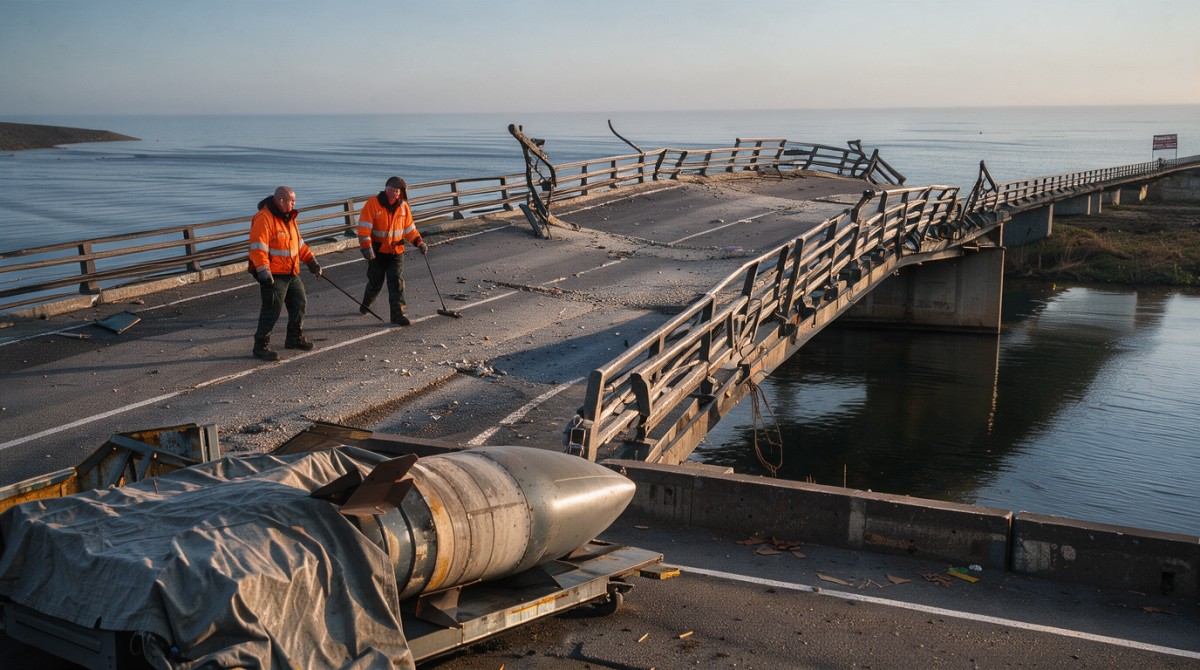
On 18 November 2026 the Russian diplomatic mission in The Hague issued a stark query to the Dutch government after a Dutch‑based startup, Destinus, announced that its missiles had been employed in the recent Ukrainian strike on the Crimean Bridge. The incident, which saw Ukrainian drones and missiles demolish the central road span linking Russia with the annexed peninsula, has reignited Moscow’s long‑standing narrative of Western complicity in the war and prompted a fresh diplomatic volley aimed at the Netherlands.
Background to the Crimean Bridge attack
Ukrainian forces launched a coordinated assault on the Crimean Bridge on Tuesday, employing a combination of drones and missiles to strike the central road segment. The strike inflicted both a material and symbolic setback for President Vladimir Putin, occurring just days before his scheduled meetings with the leaders of China and the United States. The attack is described in the source as “one of Kyiv’s most significant long‑range strikes of the war,” underscoring its strategic weight.
According to the report, the only foreign‑made weapons identified in the strike were the missiles supplied by Destinus, a startup headquartered in the Netherlands. This claim, made by the company itself, marks a rare instance of a Western manufacturer being directly linked to a high‑profile Ukrainian offensive against Russian infrastructure.
Destinus’s admission and its implications
Destinus publicly stated that its missiles were the sole non‑Russian armaments used in the bridge attack. The company’s declaration, posted on the same day as the strike, provided Moscow with a concrete point of contention. By acknowledging the presence of Dutch‑origin weapons on Ukrainian battlefields, Destinus inadvertently supplied the Kremlin with a rhetorical tool to allege direct Dutch involvement in the conflict.
The Russian embassy in The Hague seized upon this admission, posting a statement on X that asked whether “The Hague openly joining the conflict?” The embassy’s message framed the Dutch role as a “confession” that had been “well noted,” suggesting that the Netherlands had moved beyond passive support to active participation.
Russia’s diplomatic strategy toward the Netherlands
The embassy’s public query is part of a broader Russian diplomatic pattern of leveraging specific incidents to pressure Western governments. By casting the Netherlands as a potential belligerent, Moscow seeks to isolate the Dutch government diplomatically and to sow doubt among its European allies about the extent of their involvement in the Ukraine war.
In the same statement, the embassy highlighted the timing of the bridge attack relative to Putin’s upcoming high‑level meetings, implicitly warning that further Western‑supplied strikes could jeopardise diplomatic engagements with China and the United States. This timing underscores the Kremlin’s use of tactical events to shape broader geopolitical narratives.
Legal and political context for Russian media
The source material also contains a brief note on the status of The Moscow Times within Russia. The Prosecutor General’s Office has designated the outlet as an “undesirable” organization, criminalising its operations and exposing its staff to prosecution. This follows a prior labeling of the publication as a “foreign agent.” The designation reflects the Kremlin’s intensified crackdown on independent journalism, which it frames as a defense against “discrediting” the decisions of Russian leadership.
While this information pertains to the media environment rather than the bridge incident, it illustrates the broader context in which Russian diplomatic statements are crafted: an environment where dissenting voices are systematically silenced, and state narratives are tightly controlled.
Potential Dutch governmental response
The Dutch government has not issued a public reply within the source material, leaving its official stance on the embassy’s accusation ambiguous. Historically, the Netherlands has maintained a policy of supporting Ukraine through humanitarian aid and sanctions against Russia, while avoiding direct military involvement. The embassy’s question may therefore be intended to force a diplomatic clarification or to test the limits of Dutch political tolerance for such accusations.
Given the Netherlands’ role as a host to a startup whose technology was used in a high‑profile strike, the Dutch authorities may face pressure from both domestic constituencies demanding accountability and from Moscow demanding a more explicit condemnation of Ukraine’s use of Dutch‑origin weapons.
Strategic significance for the Kremlin
By foregrounding the involvement of a Dutch firm, the Kremlin aims to broaden the narrative of Western aggression beyond the United States and NATO, implicating a wider array of European actors. This strategy seeks to erode the moral high ground claimed by Western governments and to justify Russia’s own defensive posture.
The timing of the embassy’s statement—issued shortly after the bridge attack and before Putin’s meetings with Chinese and American leaders—suggests an attempt to leverage the incident as a bargaining chip in upcoming diplomatic negotiations. By highlighting Dutch participation, Moscow may be seeking to extract concessions or to pressure the Netherlands into a more cautious stance toward Ukraine.
Broader geopolitical ramifications
The incident underscores how commercial technology firms can become entangled in geopolitical conflicts. Destinus’s involvement, whether intentional or incidental, illustrates the blurred lines between private enterprise and state security concerns in modern warfare. As Western firms increasingly supply dual‑use technologies, the risk of their products being employed in high‑profile attacks grows, providing adversaries with propaganda material.
For the international community, the episode may prompt a reassessment of export controls and corporate responsibility. While the source does not detail any legal actions against Destinus, the public scrutiny it now faces could influence future policy decisions in the Netherlands and across the European Union regarding the licensing of missile technology to foreign customers.
In the short term, the Russian embassy’s question is likely to fuel diplomatic friction between Moscow and The Hague. In the longer term, the episode may serve as a precedent for how states leverage commercial supply chains to shape wartime narratives, adding another layer of complexity to the already intricate interplay of technology, commerce, and geopolitics in the Ukraine conflict.
This article was produced with AI-assisted research and editorial support. Reporting is based on the source material cited below. Sources: The Moscow Times; themoscowtimes.com; Global1.News (18 November 2026).
By Irina Volkov, Staff Writer
What's Your Reaction?
 Like
0
 Dislike
0
 Love
0
 Funny
0
 Wow
0
 Sad
0
 Angry
0
Russia/Eastern Europe Correspondent at Global1.News. Covering Russian politics, energy, security, and the shifting dynamics of the post-Soviet space. Provides clear-eyed analysis on one of the world's most opaque regions.











Comments (0)