
Lee and Macron Pledge Deeper Security Ties After Paris Summit
South Korean President Lee Jae-myung and French President Emmanuel Macron pledged on September 8 to deepen defense cooperation and coordinate on securing free passage through the Hormuz Strait, capping a two-day state visit to France that also produced new agreements on artificial intelligence, nuclear energy, and trade. The summit at the Elysee Palace, preceded by a wreath-laying at the Tomb of the Unknown Soldier beneath the Arc de Triomphe, came five months after Macron's April state visit to
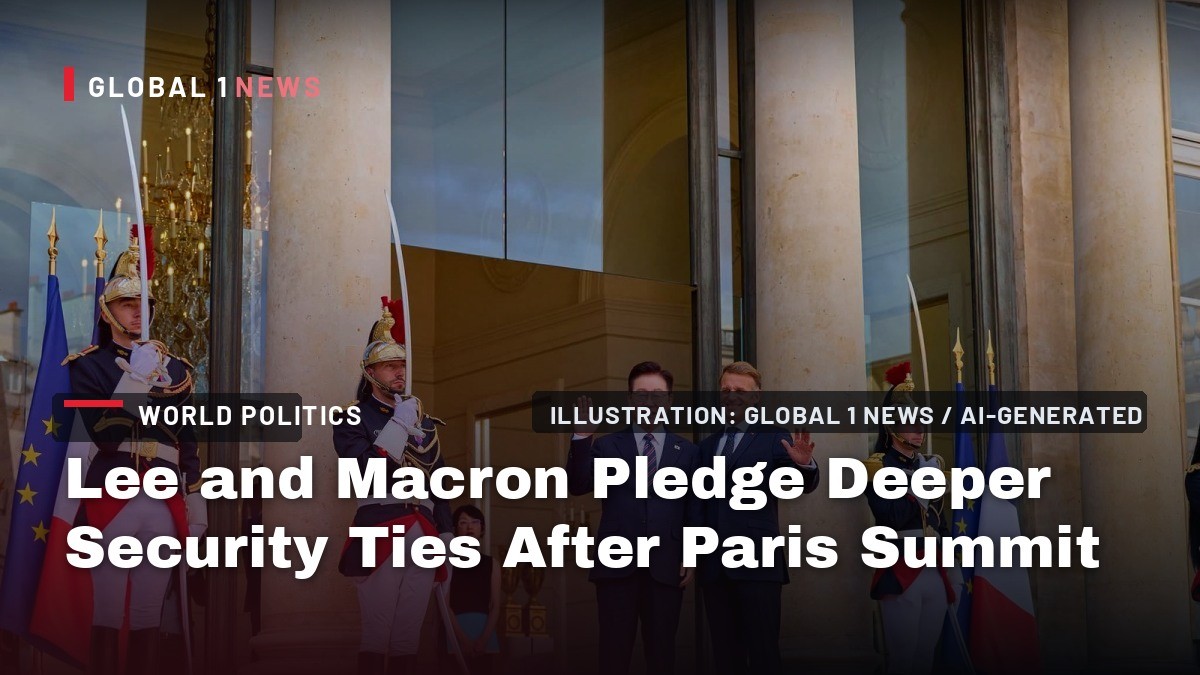
South Korean President Lee Jae-myung and French President Emmanuel Macron pledged on September 8 to deepen defense cooperation and coordinate on securing free passage through the Hormuz Strait, capping a two-day state visit to France that also produced new agreements on artificial intelligence, nuclear energy, and trade. The summit at the Elysee Palace, preceded by a wreath-laying at the Tomb of the Unknown Soldier beneath the Arc de Triomphe, came five months after Macron's April state visit to Seoul.
Lee, Macron Deepen Defense Ties in Paris Summit
Paris, France - September 9, 2026 - The expanded summit, following a one-on-one lunch between the two leaders, yielded commitments spanning military logistics, classified information sharing, and maritime security, alongside a private-sector investment agreement between Samsung Electronics and French AI startup Mistral. Lee is scheduled to meet French National Assembly President Yael Braun-Pivet on September 9 and OECD Secretary-General Mathias Cormann before concluding his four-day state visit.
Defense Cooperation: Logistics, Secrets, and the Hormuz Strait
Speaking at a joint press conference after the summit, Lee said the two governments "agreed to achieve a genuine leap forward in defense and security cooperation in order to jointly respond to the uncertainties of the international order," adding that they would move quickly toward signing a reciprocal military logistics support agreement. Such an arrangement would allow each side's forces to draw on the other's logistical infrastructure, a significant step for a European power and an Asian ally of the United States that have no mutual defense treaty of their own.
South Korea and France also signed an amended protocol to their existing pact on protecting military secrets. The revision expands the list of French officials with access to classified material and tightens rules on its handling. The summit signals that intelligence-sharing arrangements between non-allied partners typically advance only as far as their classification regimes permit, and the amended protocol effectively widens the aperture for future exchanges.
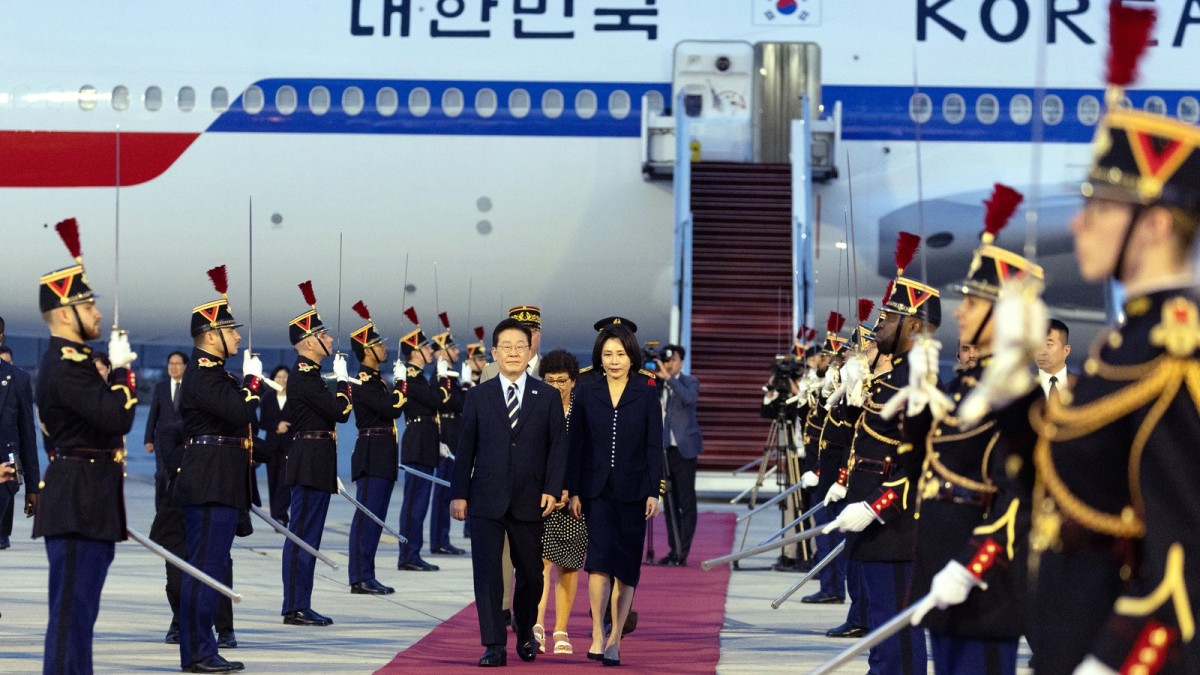
On maritime security, Lee said the two countries "agreed to continue close coordination so that freedom of navigation in the Strait of Hormuz and the stability of global supply chains can be restored as soon as possible." The Hormuz Strait remains a chokepoint of first-order importance to South Korea, which imports the overwhelming majority of its energy needs by sea. Coordinating with France, a permanent UN Security Council member with naval reach, offers Seoul a multilateral veneer for what is fundamentally an energy-security imperative.
The Deployment Caveat: No Decision, and a Legislative Hurdle
Seoul officials cautioned that the Hormuz discussion should not be read as a decision on troop deployment. South Korea has been weighing a range of contributions, including military options, but officials say no decision has been made. The distinction matters: summit language about "coordination" is not the same as an operational commitment, and the gap between the two is where domestic politics lives.
Any deployment, even of a small number of personnel, would require National Assembly approval under South Korean law. The approval requirement functions as a structural brake on rapid alignment with partners' expectations.
The caveat also reflects a broader pattern in Lee's foreign policy: commitments are framed as frameworks rather than deployments. By emphasizing coordination and future agreements, Seoul preserves optionality while signaling goodwill to Paris. Whether that posture satisfies French expectations over the medium term is an open question.
Economic Statecraft: A $20 Billion Trade Target
On the economic side, Lee said the countries agreed to pursue $20 billion, or about 27 trillion won, in two-way trade by 2030. Roughly 20 Korean and French companies took part in a business roundtable on new investment opportunities. The trade promotion agencies KOTRA and Business France signed a cooperation document meant to expand support for companies entering each other's markets.
The 2030 target is best understood as a directional commitment rather than a forecast. The KOTRA-Business France document is the practical instrument here, aimed at reducing the informational frictions that keep small and mid-sized firms out of each other's markets.
The roundtable format signals that both governments view corporate matchmaking as a legitimate instrument of diplomacy.
Technology and AI: Samsung's Bet on Mistral
The visit produced a private investment agreement between Samsung Electronics and Mistral, announced alongside government-level memorandums on artificial intelligence, semiconductors, and quantum technology. Samsung led a 3 billion euro funding round for Mistral, valuing the company at more than 21 billion euro. The investment gives Samsung a strategic stake as the two work on an in-house AI model for the Korean firm's chipmaking operations.
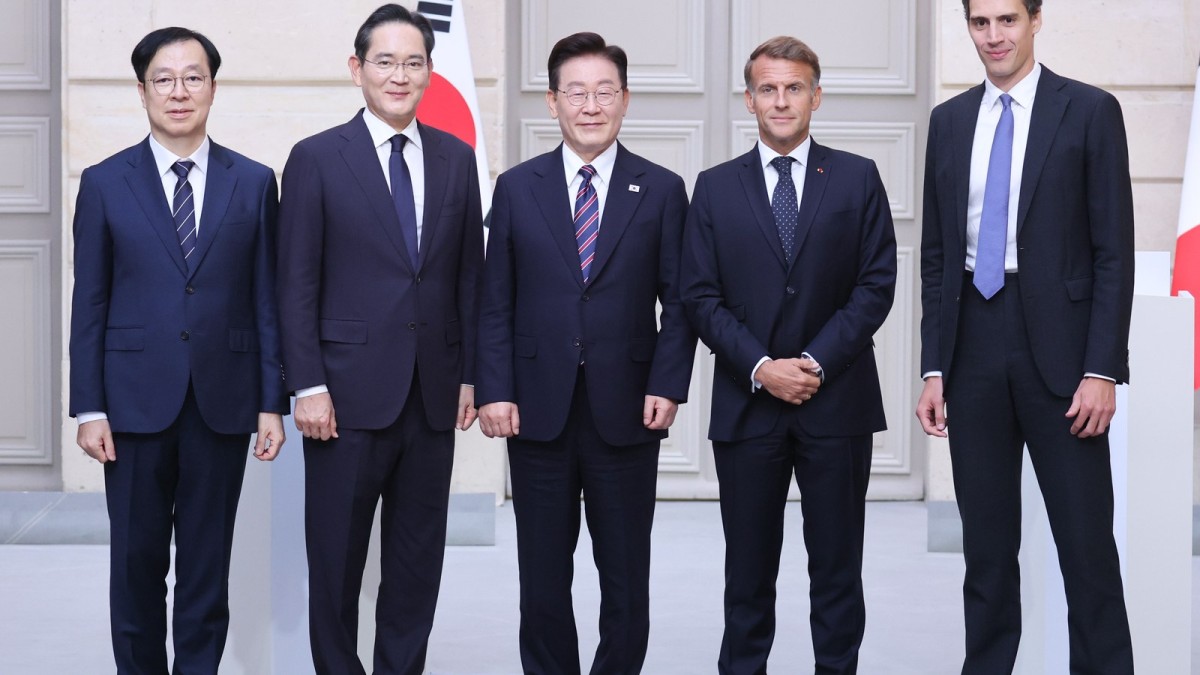
The government-level MOUs on AI, semiconductors, and quantum technology complement the private transaction. They create institutional channels for research collaboration and standard-setting that outlast any single corporate deal. For Seoul, the arrangement diversifies its technology partnerships beyond the United States at a time when export controls and supply-chain security dominate semiconductor policy.
Nuclear and Biotechnology: From Fuel Cycles to Drug Discovery
Nuclear cooperation advanced as well. Lee said the countries would sign further documents on nuclear research and fuel supply to push forward next-generation reactor development and diversify long-term supply chains, building on a nuclear fuel cycle cooperation agreement KHNP and French firm Orano signed during Macron's April visit to Seoul. The two governments also agreed to open a high-level dialogue channel for private-sector nuclear cooperation.
The high-level private-sector dialogue channel institutionalizes what has until now been episodic engagement.
Biotechnology cooperation also expanded. The Korea Research Institute of Bioscience and Biotechnology signed three memorandums of understanding with French research institutions and companies covering eco-friendly materials, climate-resilient crops, and quantum-computing-assisted drug discovery. Lee said the agreements would help Korean biotech firms gain a foothold in the European market.
The Korean Peninsula: A "Pacemaker" and the Wall of Distrust
Macron reaffirmed French support for Lee's approach to the Korean Peninsula. The two leaders agreed to keep cooperating on regional peace and stability, citing close links between security in Northeast Asia and in Europe. Macron also criticized North Korea's military support for Russia's war in Ukraine, saying Paris and Seoul share a commitment to upholding an international order based on law.
The peninsula was a recurring theme of Lee's visit. Le Monde published a written interview with Lee on September 6 in which he said he wants to serve as a "pacemaker" in reviving dialogue between the United States and North Korea. Lee's hope is that North Korea-U.S. diplomacy could lead to concrete and effective measures to halt Pyongyang's nuclear buildup. The president acknowledged that "the wall of distrust built up over many years" cannot be torn down overnight, but said he would keep working toward peaceful coexistence, a concept he laid out last month in his Liberation Day address.
The "pacemaker" metaphor suggests Seoul's role is facilitative rather than directive. Macron's endorsement gives that framing a European imprimatur, useful if Seoul ever needs to marshal multilateral support for a diplomatic opening.
Historical and Institutional Context: From April to the Elysee
The September 8 summit came five months after Macron's state visit to Seoul in April, when the two governments upgraded their relationship to a global strategic partnership. This year also marks the 140th anniversary of diplomatic ties between South Korea and France.
The two sides modernized a bilateral aviation agreement dating to 1974, concluding talks that began in 2016. The updated pact adds fair-competition protections for consumers, expands code-sharing routes, strengthens mutual assistance during emergencies, and sets environmental standards for flight operations. An agreement widening eligibility for their working holiday program, reached in April, takes effect October 1, and Korean teaching assistants will be dispatched to France starting in October under a language-exchange agreement also signed in April.
The two sides also signed a memorandum expanding research ties between Korean scholars and Paris-Saclay University, whose mathematics and physics researchers have produced 12 Fields Medalists, along with a police cooperation agreement targeting transnational crime. Before arriving in Paris, Lee spent two days in southern France, co-chairing the inaugural Lumiere Summit with Macron at the Maeght Foundation in Saint-Paul-de-Vence. The two governments launched the Lumiere Partnership, worth a total of 1 billion euro, aimed at promoting the growth and globalization of the film and video industry. Lee met with Korean film figures including directors Lee Chang-dong and Jung Ju-ri and actors Sul Kyung-gu and Jeon Do-yeon, and chaired a roundtable with executives from CJ ENM, Naver, Netflix and other companies.
What the Summit Signals for Korea's Middle-Power Diplomacy
Read as a whole, the Paris visit illustrates the operating logic of South Korea's middle-power diplomacy under Lee: accumulate bilateral frameworks across multiple domains, avoid exclusive alignment, and convert economic and technological assets into diplomatic standing. The defense agreements with France do not substitute for the U.S. alliance; they supplement it. The Samsung-Mistral deal does not decouple Korea from American technology ecosystems; it adds a European pillar. The nuclear and biotech MOUs open supply-chain and research options that reduce single-point dependencies.
This is hedging, but of a specific and disciplined kind. It is not neutrality between Washington and Beijing; Korea's security architecture remains anchored in the U.S. alliance. Rather, it is diversification within the Western camp, deepening ties with European partners who share Korea's interest in a rules-based order but whose geographic priorities differ. France's willingness to endorse Lee's North Korea approach, and its criticism of Pyongyang's support for Russia, fit neatly into this framework.
The constraints are equally clear. National Assembly approval requirements limit how far defense cooperation can be operationalized. Trade targets are aspirational. And the "pacemaker" role depends on a U.S.-North Korea process that Seoul cannot initiate on its own. What the summit demonstrates is that Korea's middle-power strategy is maturing institutionally, from summit communiques toward standing dialogue channels, amended protocols, and co-investment structures. Whether that institutional depth translates into strategic influence will be tested not in Paris, but in the capitals where the decisions that matter most to Korea are actually made.
This article was produced with AI-assisted research and editorial support. Sources: The Diplomat, September 9, 2026.
By Prof. David Park, Staff Writer
What's Your Reaction?
 Like
0
Like
0
 Dislike
0
Dislike
0
 Love
0
Love
0
 Funny
0
Funny
0
 Wow
0
Wow
0
 Sad
0
Sad
0
 Angry
0
Angry
0
East Asia/Technology Correspondent at Global1.News. Seoul-based voice covering Korean politics, technology, business, and culture. Analyzes how technology and geopolitics intersect across East Asia.












Comments (0)