
A New Zealand Court's Verdict on a Chinese Sect Leader and the Limits of Cross-Border Justice
A New Zealand court jailed Chinese-born sect leader Kaixiao Liu for more than 10 years over the manslaughter of 70-year-old follower Shulai Wang, who travelled from Hainan to live in his Auckland household. The case exposes cross-border religious recruitment, diaspora vulnerability, and the limits of extraterritorial enforcement.
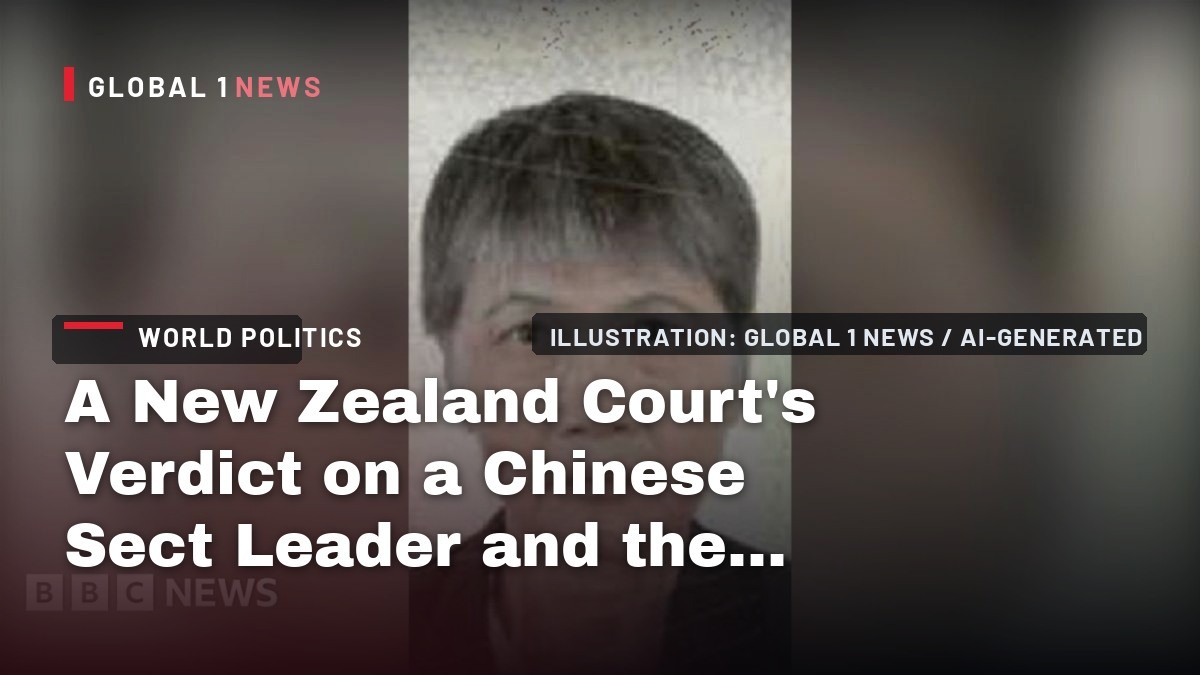
The sentencing of Kaixiao Liu in a New Zealand court this week marks the culmination of a case that began with a fisherman's grim discovery near Auckland's Gulf Harbour in March 2024. Liu, a Chinese-born musician and former China's Got Talent contestant, was found guilty of manslaughter and kidnapping in connection with the death of 70-year-old Shulai Wang, a follower who had travelled from Hainan island to live in his household. The High Court in Auckland handed down a sentence of more than ten years' imprisonment, while his wife, Lanyue Xiao, received nearly eight years for her role in the same offences.
Beyond the individual tragedy, the case offers a rare, unvarnished look at the mechanics of a fringe religious movement operating across borders. It also exposes the legal and diplomatic complexities that arise when Chinese citizens become victims of alleged exploitation abroad, and how Beijing's own robust anti-cult framework intersects with the judicial processes of a Western common-law jurisdiction. For analysts of Chinese domestic policy, the case is less about the exotic details of a self-styled "Ark" in suburban Auckland, and more about the enduring patterns of control, recruitment, and the state's long-standing war against unregistered belief systems.
The 'Ark' and the Structure of Control
Court testimony painted a detailed picture of life inside the house Liu called "the Ark." Wang, who arrived in New Zealand in August 2023, moved in with Liu, his wife, his parents, and several other female followers. Prosecutors argued that these women lived in a state of "servitude," their days consumed by childcare, scripture study, and vegetable planting, all under the watchful eye of a man they addressed as "Lord" or "Master." The court heard that Wang, due to her advanced age, struggled to comply with the strict rules and was frequently disciplined.
The hierarchical structure described in court mirrors patterns familiar to scholars of new religious movements: a charismatic leader, a closed residential community, the severing of external ties, and the use of discipline to enforce compliance. Justice Mathew Downs, in his sentencing remarks, noted Liu's "callous indifference" toward Wang, stating that she "died a lonely, frightening death." The judge's rebuke—that Liu displayed "no remorse whatsoever"—underscores the prosecution's successful portrayal of a man who viewed his followers as instruments rather than individuals.
From Talent Show to Transnational Recruitment
Liu's path to leadership was unconventional. A graduate of a military-based university in China, he appeared on China's Got Talent in 2011, performing blindfolded on stage. By 2017, he had relocated to New Zealand with Xiao, eventually becoming a permanent resident. It was on Chinese social media platforms that Liu built his following, posting religious discussions, video diaries, and cosmic-themed orchestral music under a project called "Universal Choir."
This digital recruitment strategy is a critical element of the case. Unlike traditional missionary work, Liu's outreach was conducted through song websites and social media, allowing him to cultivate a following from mainland China without setting foot in the country. A police officer testified that one female follower said she "met the people over the internet through a song website," referring to the household occupants as "friends." This online-to-offline pipeline—from virtual engagement to physical relocation—represents a significant challenge for both Chinese regulators and foreign immigration authorities.
China's Anti-Cult Legal Framework: A Point of Reference
For Beijing, the case resonates with a well-established domestic narrative. China's legal system has long treated unregistered religious groups with suspicion, viewing them as potential vectors for social instability. The 1999 decision to ban the Falun Gong movement set a precedent for aggressive state intervention against groups deemed "cults" (xie jiao). Subsequent regulations, including the 2017 State Council regulations on religious affairs, reinforced the requirement that all religious activities operate within state-sanctioned structures.
From this perspective, Liu's operation—a self-styled spiritual leader with a private following, a named residence, and a doctrine of obedience—falls squarely within the category of activity that Chinese authorities would classify as illegal. The fact that this group operated in New Zealand, outside Beijing's direct jurisdictional reach, highlights a gap in China's enforcement capabilities. While Chinese law can prosecute citizens for crimes committed abroad under certain conditions, the practical challenges of extraterritorial enforcement are immense, particularly when the host country has its own legal processes.
The Diaspora Dimension: Vulnerability and Isolation
Wang's journey from Hainan to Auckland is emblematic of a broader phenomenon: the movement of middle-aged and elderly Chinese citizens to join family or religious communities abroad. For many, the decision is driven by a desire for spiritual fulfillment or family reunification. However, as this case demonstrates, such individuals can become isolated in foreign environments where language barriers and unfamiliar legal systems leave them vulnerable to exploitation.
The court heard that Wang attempted to escape in March 2024 but was caught and restrained, dying later that day. Her inability to seek help—or her failure to be noticed by authorities—raises questions about the oversight of vulnerable migrants in New Zealand. The case also underscores the difficulty of monitoring closed religious communities, which often present a benign exterior to neighbours while maintaining strict internal control. For the Chinese diaspora, the case serves as a cautionary tale about the risks of following charismatic figures into insular settings.
Legal Proceedings and the Question of Remorse
The New Zealand trial was notable for the defence's insistence that Liu was not a cult leader. His lawyer argued for leniency, claiming his client feels remorse and "is not a cult leader, nor requires people to follow his cult." This assertion was contradicted by the evidence presented, including testimony about the use of the terms "Lord" and "Master," and the systematic control over followers' daily lives. Justice Downs' rebuke suggests the court found the defence's characterisation unconvincing.
The sentencing of Liu's wife, Lanyue Xiao, to nearly eight years, and the earlier convictions of his parents, Xiuyun Li and Jingui Liu, for kidnapping and misconduct regarding human remains, indicate that the court viewed the entire family unit as complicit in the operation. The family's collective involvement—from discipline to the disposal of Wang's body—paints a picture of a tightly knit group willing to protect its leader at any cost. Liu's decision to bring his children along to dump the body "as camouflage" adds a particularly disturbing dimension to the case.
Geopolitical Implications: A Test for Foreign Courts
For New Zealand, the case represents a successful exercise of judicial independence in handling a sensitive cross-border matter. The court's willingness to convict based on evidence of psychological control and physical restraint, despite the absence of a formal "cult" designation in New Zealand law, demonstrates the adaptability of common-law principles to novel factual scenarios. The verdict also sends a signal to other potential offenders that New Zealand will not tolerate the exploitation of vulnerable migrants within its borders.
From Beijing's perspective, the case offers a mixed message. On one hand, it validates China's long-standing warnings about the dangers of unregulated religious movements. On the other, it highlights the limits of Chinese influence over its citizens once they leave the mainland. The Chinese government has not publicly commented on the case, likely due to the sensitive nature of the subject and the desire to avoid drawing attention to the existence of such groups within the diaspora. However, the case may prompt quiet discussions within Chinese consular services about how to better protect elderly citizens travelling abroad for religious or family reasons.
Historical Context: The Evolution of China's Religious Regulation
China's approach to religious groups has evolved significantly since the reform era began in the late 1970s. The state recognises five official religions—Buddhism, Taoism, Islam, Protestantism, and Catholicism—but maintains strict oversight of their activities. The 1982 Document 19, which outlined the party's religious policy, emphasised the need to distinguish between legitimate religious belief and "feudal superstition" or "heterodox" practices. This distinction has been applied with varying degrees of intensity, culminating in the 1999 crackdown on Falun Gong and the subsequent legal framework that criminalised "cult" activities.
The Liu case, while occurring outside China's jurisdiction, illustrates the transnational nature of the challenge Beijing faces. The internet has enabled religious entrepreneurs to reach Chinese audiences without state oversight, creating a parallel ecosystem of spiritual content that exists beyond the reach of Chinese censors. For Beijing, the case is a reminder that its domestic regulatory framework, however robust, cannot fully contain the spread of unapproved religious movements in the digital age.
Conclusion: Justice Served, Questions Remain
The sentencing of Kaixiao Liu brings a measure of justice for Shulai Wang, whose lonely death in a foreign land was the result of a system of control that her own family had trusted. The New Zealand court's verdict is a testament to the rule of law and the importance of holding individuals accountable for their actions, regardless of their claims to spiritual authority. However, the case leaves unresolved questions about the broader phenomenon of cross-border religious recruitment, the vulnerability of elderly migrants, and the limits of both Chinese and international law in addressing such abuses.
For China, the case serves as a cautionary tale about the risks of unregulated religious movements, even as it highlights the challenges of extraterritorial enforcement. For the diaspora, it is a reminder of the importance of vigilance and community support. And for the international community, it underscores the need for cooperation in protecting vulnerable individuals from exploitation, wherever it occurs. The "Ark" may have sunk, but the currents that carried Shulai Wang to its shores remain a concern for all.
By Marcus Chen, Staff Writer
This article was produced with AI-assisted research and editorial support. Sources: BBC News.
What's Your Reaction?
 Like
0
Like
0
 Dislike
0
Dislike
0
 Love
0
Love
0
 Funny
0
Funny
0
 Wow
0
Wow
0
 Sad
0
Sad
0
 Angry
0
Angry
0

World Politics Analyst at Global1.News. Based in Beijing, covering US-China relations, global trade, and geopolitical strategy. Brings deep analytical perspective to the power dynamics shaping international affairs.















Comments (0)